
Second Brain for AI v2
AI memory that connects the dots across every tool
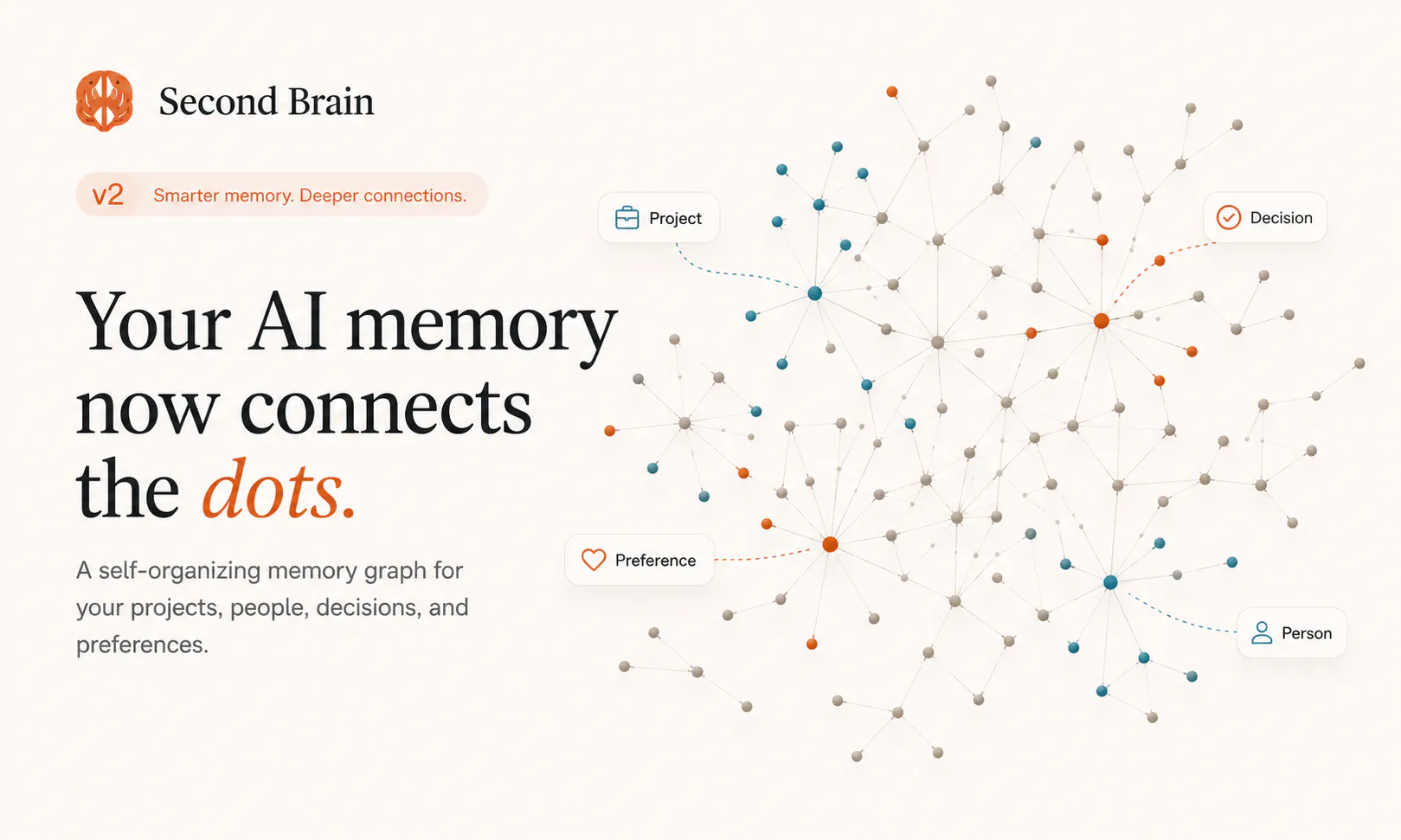
Second Brain remembers your projects, people, decisions, and preferences across Claude, ChatGPT, Cursor, Codex, and any MCP client. V2 automatically links related memories, follows those connections during recall, and distinguishes settled decisions from drafts and stale context. Open source and self-hosted in your Cloudflare account.
AI Analysis
Second Brain for AI v2 is an open-source, self-hosted AI memory layer that works across Claude, ChatGPT, Cursor, Codex, and any MCP client. Core features include remembering projects, people, decisions and preferences; automatic linking of related memories; connection-aware recall; and distinguishing settled decisions from drafts and stale context. It solves key pain points of fragmented context, repeated information, and lost continuity when switching between AI tools. USP is its intelligent graph-like memory that connects the dots while giving users full data ownership via Cloudflare self-hosting. Value proposition: dramatically improved productivity and consistency in AI-driven workflows without relying on proprietary clouds.
In 2025-2026, explosive growth of AI agents, multi-LLM workflows, and demand for persistent memory make this highly relevant. Technology for vector databases and graph memory has matured, user frustration with context loss is widespread, and self-hosting aligns with rising privacy concerns. Excellent Timing.
High. Leverages mature Cloudflare infrastructure for easy self-hosting, open-source model lowers development barriers, and core tech (memory linking, embeddings) uses established AI libraries. Minimal supply chain or compliance risks for self-hosted tool; highly scalable for individual and team use. Main challenge is building robust cross-client integrations.
Primary users: developers, AI power users, indie hackers and technical teams heavily using multiple LLM tools (Claude, ChatGPT, Cursor). Industries: software development, AI engineering, product building. Geographic: global with strong adoption in US, Europe, and Asia tech hubs. Core pain: context switching and memory fragmentation across AI sessions. Estimated market: AI productivity tools TAM >$50B, SAM for memory solutions ~$5B, SOM for open-source self-hosted niche ~$500M. High willingness to pay for time-saving reliability or enterprise support.
Medium. Direct competitors: 1. Mem (mem.ai), 2. MemGPT / Letta (memgpt.ai), 3. Reflect (reflect.app), 4. Rewind (rewind.ai), 5. Notion AI (notion.so). Advantages: fully open-source, self-hosted on Cloudflare for privacy, automatic memory linking with decision-state awareness, broad integration across AI clients. Disadvantages: requires self-setup (vs plug-and-play SaaS), potentially less polished consumer UI, smaller marketing reach than venture-backed competitors.
Upgrade Pro to unlock full AI analysis
Similar Products

Cohere Parse 5
Turn complex docs, tables & images into AI-ready data
▲ 158 votes

Adapt
The company brain that gets work done
▲ 124 votes
Kosshi
Simple, fast outliner for Mac and iPhone.
▲ 90 votes

WikiFix for Confluence
Find and fix issues in your knowledge base
▲ 86 votes

Audryo
Customer email your agent can operate.
▲ 68 votes

Refoid
Automate App Store refund responses and track every outcome
▲ 68 votes