
ServiceBeard
Sync your mailbox with your issue tracker
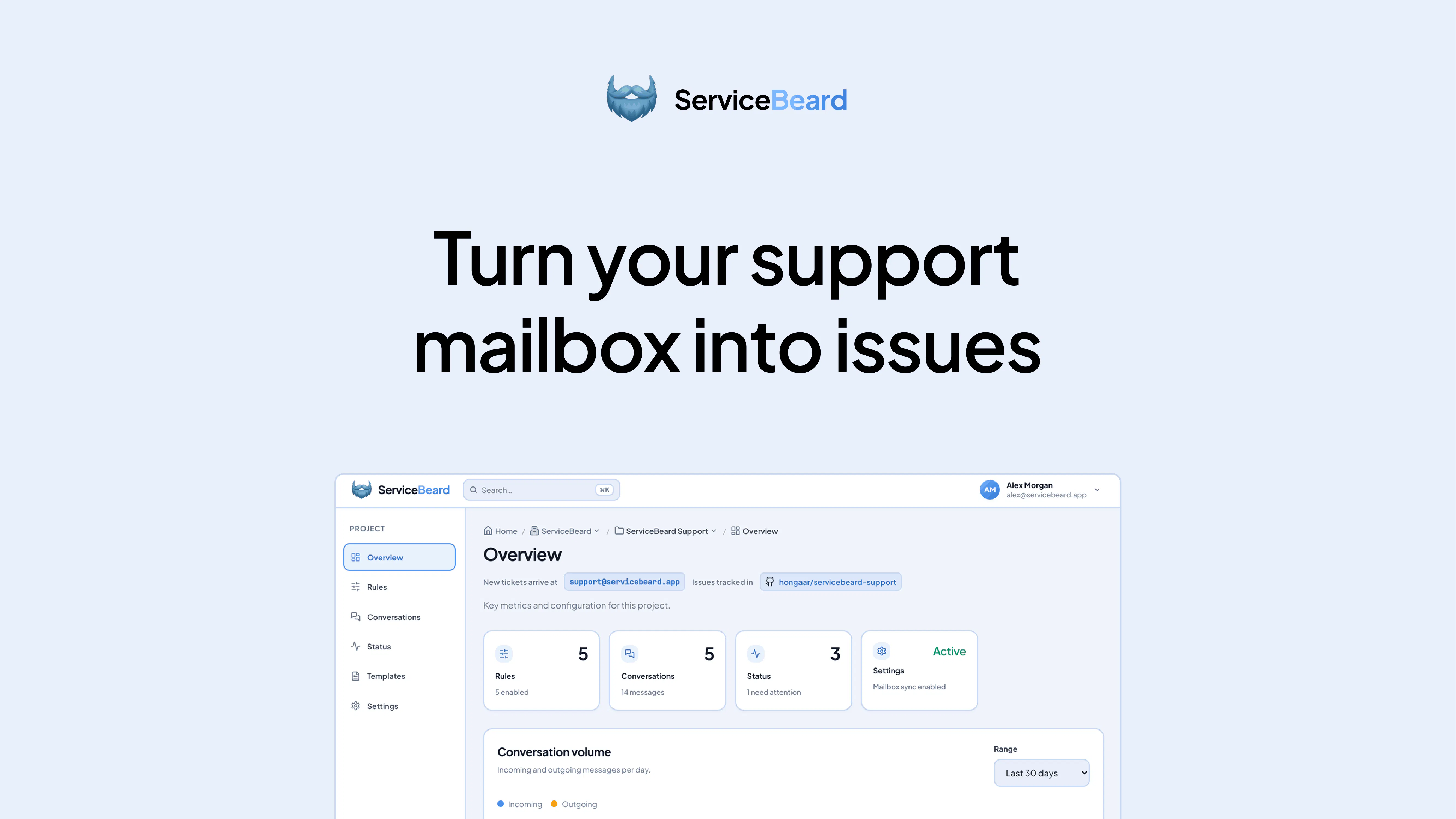
Turn your customer-facing mailbox into an issue board. ServiceBeard syncs your emails directly to your issue tracker, letting you run a full service desk from your existing workspace. You can leverage the automation pipelines you’ve already set up without investing in expensive, per-seat helpdesk software. It's open-source, connects via standard IMAP/SMTP, and currently supports GitHub, GitLab, and Linear.
AI Analysis
ServiceBeard syncs customer emails directly to issue trackers (GitHub, GitLab, Linear) via standard IMAP/SMTP, transforming your mailbox into a functional issue board. Core features include running a complete service desk within existing workspaces and leveraging pre-built automation pipelines. It solves key pain points such as context switching between email and dev tools, fragmented customer support records, and high costs of per-seat helpdesk platforms. As an open-source solution, its unique selling points are zero licensing fees for self-hosting, simplicity of standard protocol integration, and seamless fit into developer workflows. The value proposition is efficient, unified customer issue management without adopting expensive new software.
For 2025-2026, market timing is favorable due to rising adoption of Linear, GitHub, and GitLab as central workspaces amid remote/hybrid work trends. Economic pressures push cost-saving open-source alternatives over expensive SaaS helpdesks. Technology for email parsing and integrations is mature, while demand for unified dev-support tools grows with AI-assisted automation. Policy environments favor open-source in enterprise. This is a good time as teams seek to consolidate tools. Rating: Excellent Timing.
High feasibility. Technical difficulty is manageable using mature IMAP/SMTP libraries and existing APIs for supported trackers. Development and operation costs are low due to its open-source model enabling community contributions. Minimal supply chain or compliance risks as it avoids proprietary dependencies. Strong scalability for both self-hosted and potential SaaS versions. Fits well with developer teams experienced in these technologies.
Main target segments: Software engineering and support teams in small-to-medium tech/SaaS companies and startups; indie developers using GitHub/Linear. Demographics: Tech professionals aged 25-45. Industries: Software development, IT services. Geographic distribution: Global with heavy concentration in US, Europe. Estimated market size: TAM ~$12B (broader helpdesk/devops market), SAM ~$800M (email-to-tracker integrations), SOM ~$50M (open-source dev-focused segment). Core pain points: Tool fragmentation and high helpdesk costs. Potential willingness to pay: Medium-high for hosted/premium tiers despite open-source core.
Medium. Direct competitors: 1. Zendesk (zendesk.com), 2. Jira Service Management (atlassian.com/jira/service-management), 3. Front (front.com), 4. Help Scout (helpscout.com), 5. Groove (groovehq.com). Advantages: Fully open-source (free self-hosting), focused on existing issue trackers without new bloated UI, uses standard protocols for easy setup, preserves automation. Disadvantages: Potentially requires more initial configuration than polished SaaS, fewer enterprise features/support compared to incumbents, currently limited tracker integrations. Strong differentiation for dev-first teams avoiding per-seat pricing.
Upgrade Pro to unlock full AI analysis
Similar Products

Adapt
The company brain that gets work done
▲ 124 votes

Replay QA Security Scan
Automated Penetration Testing for AI-Built Apps
▲ 102 votes

Kosshi
Simple, fast outliner for Mac and iPhone.
▲ 90 votes

WikiFix for Confluence
Find and fix issues in your knowledge base
▲ 86 votes

Audryo
Customer email your agent can operate.
▲ 68 votes

Refoid
Automate App Store refund responses and track every outcome
▲ 68 votes