
ShareCube
Share what your agents make, get feedback on the exact line
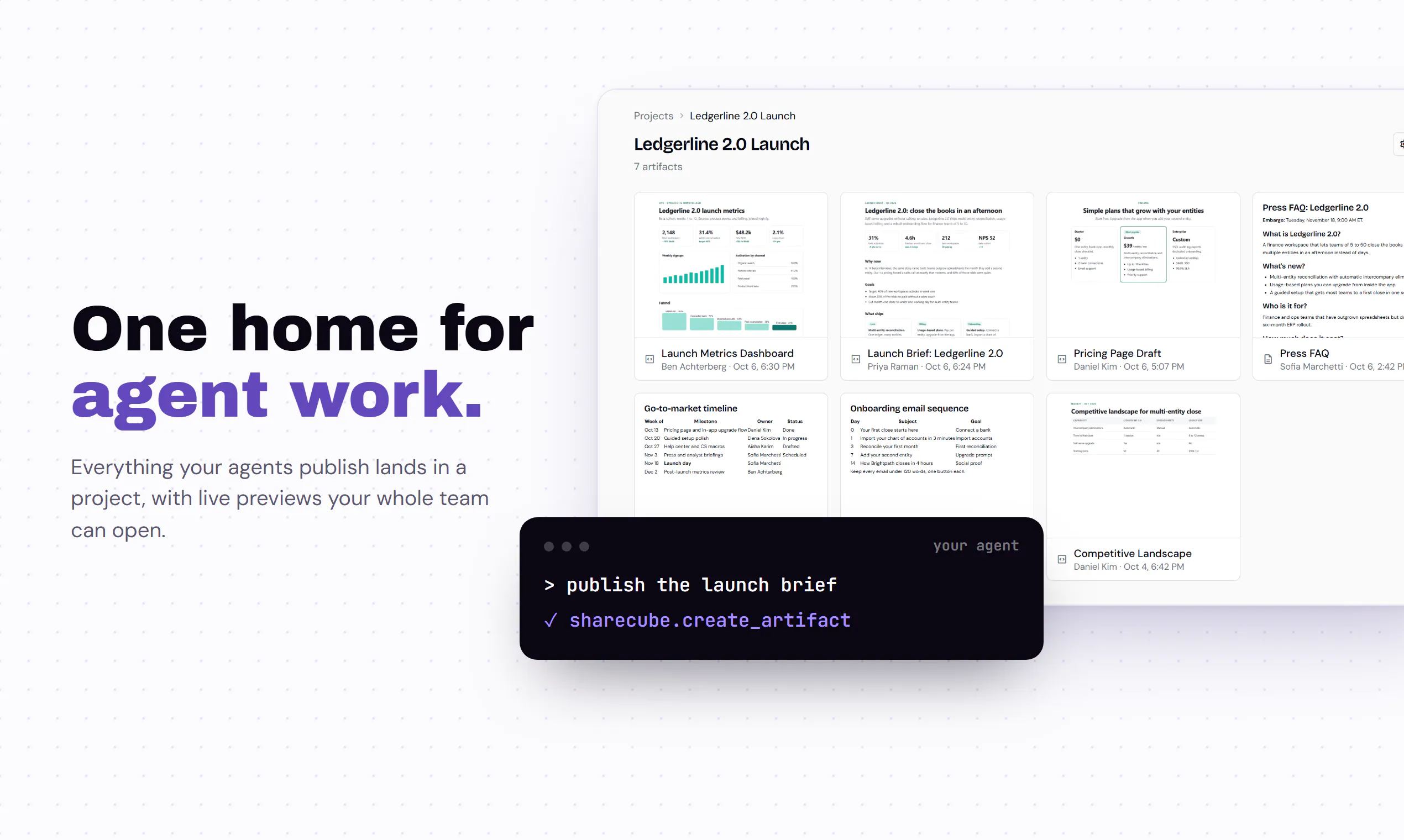
ShareCube gives your AI agents a place to publish. From Claude Code, Cursor, Codex or any MCP client, your agent posts an HTML or Markdown artifact to a project and hands you a link, not a wall of chat. Your team comments on the exact sentence, @mentions each other and resolves threads. The agent reads that feedback and ships the next version. Every save is versioned. Share privately, with your org, or publicly: anyone with the link can read it, no account needed.
AI Analysis
ShareCube is a publishing and collaboration platform for AI agents. It enables agents from tools like Claude Code, Cursor, or any MCP client to post HTML/Markdown artifacts to projects, providing clean shareable links instead of chat walls. Core features include precise commenting on exact sentences/lines, @mentions, thread resolution, versioning of every save, and flexible sharing (private, org, or public with no account needed for viewing). It solves key pain points of cluttered AI chat outputs, lack of structured feedback, and difficult iteration in team environments. USP is the closed feedback loop where agents can read comments and autonomously ship improved versions. Overall value: Enhances productivity in AI-driven development through seamless collaboration and version control.
In 2025-2026, the AI agent ecosystem is exploding with widespread adoption of tools like Claude and Cursor. User demands are shifting from basic generation to collaborative, iterative workflows with structured feedback. Technology for agentic AI and real-time collaboration is mature, supported by advancing LLMs. Economic environment prioritizes productivity gains amid AI investment boom. No major policy barriers. This is an Excellent Timing as it directly addresses the gap in AI output collaboration before the market saturates with generic tools.
Technical difficulty is medium: requires robust web platform for artifact hosting, rich annotation on text/HTML, real-time collaboration, versioning, and APIs for agent posting/reading feedback - all solvable with existing stacks like React, PostgreSQL, and cloud services. Development and operation costs are moderate for a SaaS (hosting, bandwidth for artifacts). Low supply chain risks, standard data privacy compliance needed (GDPR). High scalability potential via cloud. Strong team fit for dev tools/AI builders. Overall High feasibility with manageable risks.
Main target users: Software developers, AI/ML engineers, and product/tech teams (ages 25-40) heavily using AI coding assistants in startups and mid-large tech companies. Industries: Software development, IT services. Geographic: Primarily North America and Europe, with global remote developers. Estimated market: Developer tools TAM ~$15B by 2026; AI-enhanced dev tools SAM ~$2B; SOM for AI artifact collaboration ~$100-200M. Core pain points: Messy chat-based AI interactions, imprecise feedback, version tracking difficulties. High willingness to pay for team plans that boost productivity (freemium to premium subscriptions likely).
Competition Level: Medium. Direct competitors: 1. Claude Artifacts (anthropic.com/claude), 2. Cursor Composer/Sharing (cursor.com), 3. Vercel v0 (v0.dev), 4. Replit AI Artifacts (replit.com), 5. GitHub Gists with Copilot (gist.github.com). Advantages: Superior agent-readable feedback loop, precise line-level comments on any artifact, built-in versioning and project organization, seamless integration from multiple AI clients. Disadvantages: Newer player with less brand recognition, may require more setup than integrated vendor tools. Strong differentiation in closing the AI-human iteration loop compared to basic sharing features of competitors.
Upgrade Pro to unlock full AI analysis
Similar Products

Cohere Parse 5
Turn complex docs, tables & images into AI-ready data
▲ 158 votes

Opaline
PostHog for team Claude Code and Codex sessions.
▲ 141 votes

Adapt
The company brain that gets work done
▲ 124 votes

Replay QA Security Scan
Automated Penetration Testing for AI-Built Apps
▲ 102 votes

Kosshi
Simple, fast outliner for Mac and iPhone.
▲ 90 votes

Refoid
Automate App Store refund responses and track every outcome
▲ 68 votes