Ship OS by Notion
The agent-native way to ship software
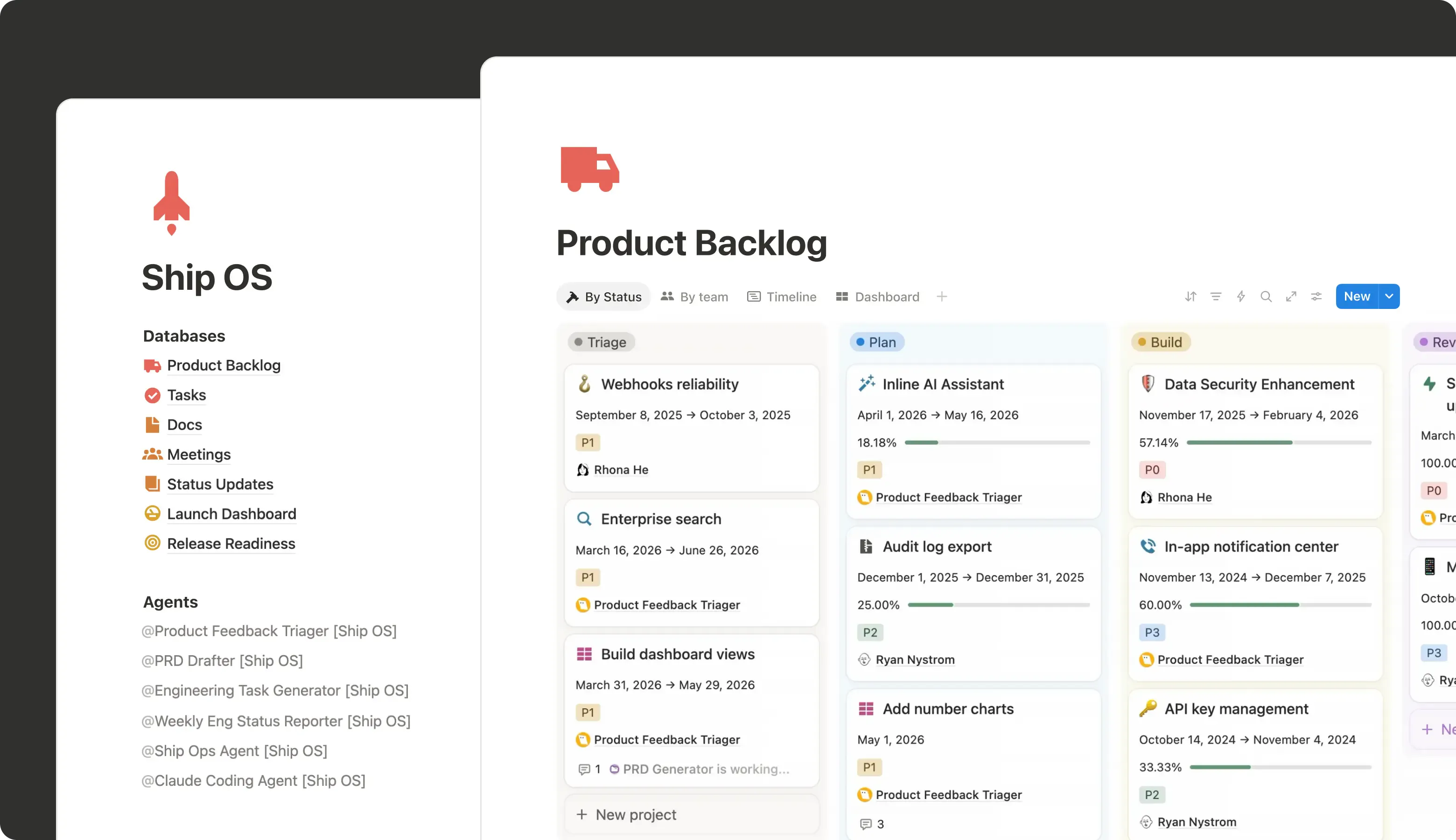
Run your entire product development cycle in Notion, from customer feedback to a merged PR. Agents handle the triaging, routing, and summarizing. Your team handles the judgment calls.
AI Analysis
Ship OS by Notion enables running the full product development cycle inside Notion, from ingesting customer feedback to achieving merged PRs. AI agents automatically handle triaging, routing tasks, and summarizing insights, while human teams focus on key judgment calls. Core features include seamless Notion-based workflows, agent-native automation, and integration across feedback, planning, and development stages. It solves major pain points like fragmented tools, manual data processing, context switching, and time wasted on routine tasks. The value proposition is faster software shipping through an agent-native approach that augments team intelligence without leaving the familiar Notion environment.
The timing is favorable as AI agents and autonomous workflows are maturing rapidly in 2025-2026, with widespread LLM adoption and demand for integrated AI in productivity tools like Notion. Industry trends show teams seeking to reduce tool fragmentation and automate dev ops routines amid economic pressure for efficiency. No major regulatory barriers for such tools. Excellent Timing.
High feasibility. Technical difficulty is manageable by building on Notion APIs, existing LLM frameworks for agents, and Git integration. Development and operation costs are moderate (API usage fees), with good scalability in cloud. Low supply chain or compliance risks for SaaS. Fits well with teams experienced in no-code and AI integrations. High
Main targets: Product managers, software engineering teams, and startups/scale-ups already embedded in Notion for docs and tasks. Industries: Technology and SaaS development. Geographic: Global, concentrated in US, Europe. TAM for AI devtools exceeds $15B; SAM for Notion-integrated tools approx $1B; SOM for early adopters in hundreds of millions. Core pains: Disconnected feedback-to-code loops and excessive manual coordination. High willingness to pay via subscription for proven time savings.
Medium. Direct competitors: 1. Linear (linear.app) with AI triage, 2. Notion AI (notion.so), 3. Coda AI (coda.io), 4. GitHub Copilot Workspace (github.com), 5. Productboard (productboard.com). Advantages: Deep agent-native integration for end-to-end cycle strictly inside Notion, unique feedback-to-merged-PR focus. Disadvantages: Relies heavily on Notion ecosystem (less standalone), potentially higher dependency risks vs dedicated dev platforms; may trail in advanced coding automation compared to GitHub tools. Strong differentiation in the Notion power-user niche.
Upgrade Pro to unlock full AI analysis
Similar Products

Cohere Parse 5
Turn complex docs, tables & images into AI-ready data
▲ 158 votes

Opaline
PostHog for team Claude Code and Codex sessions.
▲ 141 votes

Adapt
The company brain that gets work done
▲ 124 votes

Tapfree for Chrome
Voice dictation that adapts to what’s on your screen
▲ 122 votes

CodeBurn
See where your AI coding spend actually goes
▲ 101 votes

WikiFix for Confluence
Find and fix issues in your knowledge base
▲ 86 votes