
Simo
The judgment layer for software that acts
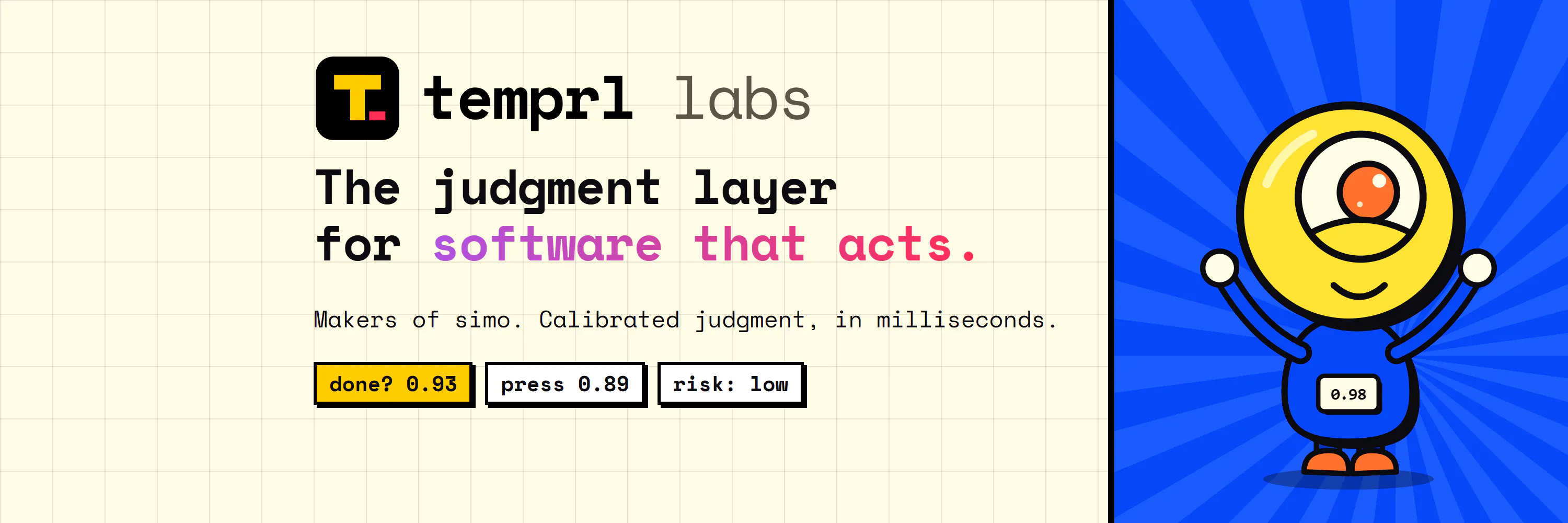
Simo is the System 1.5 judgment model from Temprl Labs. Ask typed questions about text, screenshots, or video and get calibrated probabilities and the values needed to act, in milliseconds.
AI Analysis
Simo is the System 1.5 judgment model from Temprl Labs, serving as a specialized judgment layer for acting software. Core features include accepting typed questions on text, screenshots, or video inputs and returning calibrated probabilities plus actionable values in milliseconds. Unique selling points are its rapid multimodal processing, uncertainty calibration, and bridging of fast intuitive judgment with deliberate reasoning. It solves key user pain points such as slow, uncalibrated AI outputs that hinder real-time autonomous software decisions. The overall value proposition is enabling confident, efficient actions in agentic systems through fast, reliable judgment.
In 2025-2026, the timing is highly favorable due to surging industry trends toward AI agents, autonomous software, and multimodal models. Technology for low-latency inference and calibrated AI is reaching maturity, user demands for reliable decision tools in dynamic environments are rapidly increasing, and supportive economic policies for AI innovation create tailwinds. This aligns perfectly with the rise of 'acting' software needing fast judgment layers. Rating: Excellent Timing.
Technical difficulty is significant, requiring advanced multimodal AI, precise probability calibration, and millisecond-level inference. Development and operation costs are high for model training and hosting. Supply chain and compliance risks involve AI ethics/regulations. However, leveraging existing foundation models improves scalability potential, and the focused scope aids team execution. Overall rating: Medium, with strong scalability once built but notable upfront barriers.
Main target segments: AI developers, software engineers building autonomous agents, and tech companies in AI/ML (demographics: 25-40 years old professionals). Industries: Software development, AI infrastructure. Geographic distribution: Primarily US and Europe, with global reach. Estimated market size: AI developer tools TAM ~$15B by 2026, SAM for decision-layer AI ~$3B, SOM ~$150M for specialized judgment models. Core pain points: Lack of fast, calibrated insights from multimodal data for real-time actions. Potential willingness to pay: High via API credits or enterprise subscriptions.
Competition level: Medium. Direct competitors: 1. OpenAI o1/GPT-4o (openai.com), 2. Anthropic Claude (anthropic.com), 3. LangChain/LangGraph (langchain.com), 4. Grok/xAI models (x.ai), 5. Hugging Face Inference (huggingface.co). Advantages: Highly specialized as 'judgment layer' with explicit calibrated probabilities and millisecond speed for acting software; strong differentiation in uncertainty-aware decisions. Disadvantages: Newer entrant with potentially smaller ecosystem/integration options and less brand recognition compared to incumbents; pricing details unclear but likely premium.
Upgrade Pro to unlock full AI analysis
Similar Products

Cohere Parse 5
Turn complex docs, tables & images into AI-ready data
▲ 158 votes

Adapt
The company brain that gets work done
▲ 124 votes

Coarena by Coasty
The arena where agents battle on real-world work
▲ 104 votes

WikiFix for Confluence
Find and fix issues in your knowledge base
▲ 86 votes

Audryo
Customer email your agent can operate.
▲ 68 votes

Refoid
Automate App Store refund responses and track every outcome
▲ 68 votes