
Skippr AI
The live AI employee inside your product, serving every user
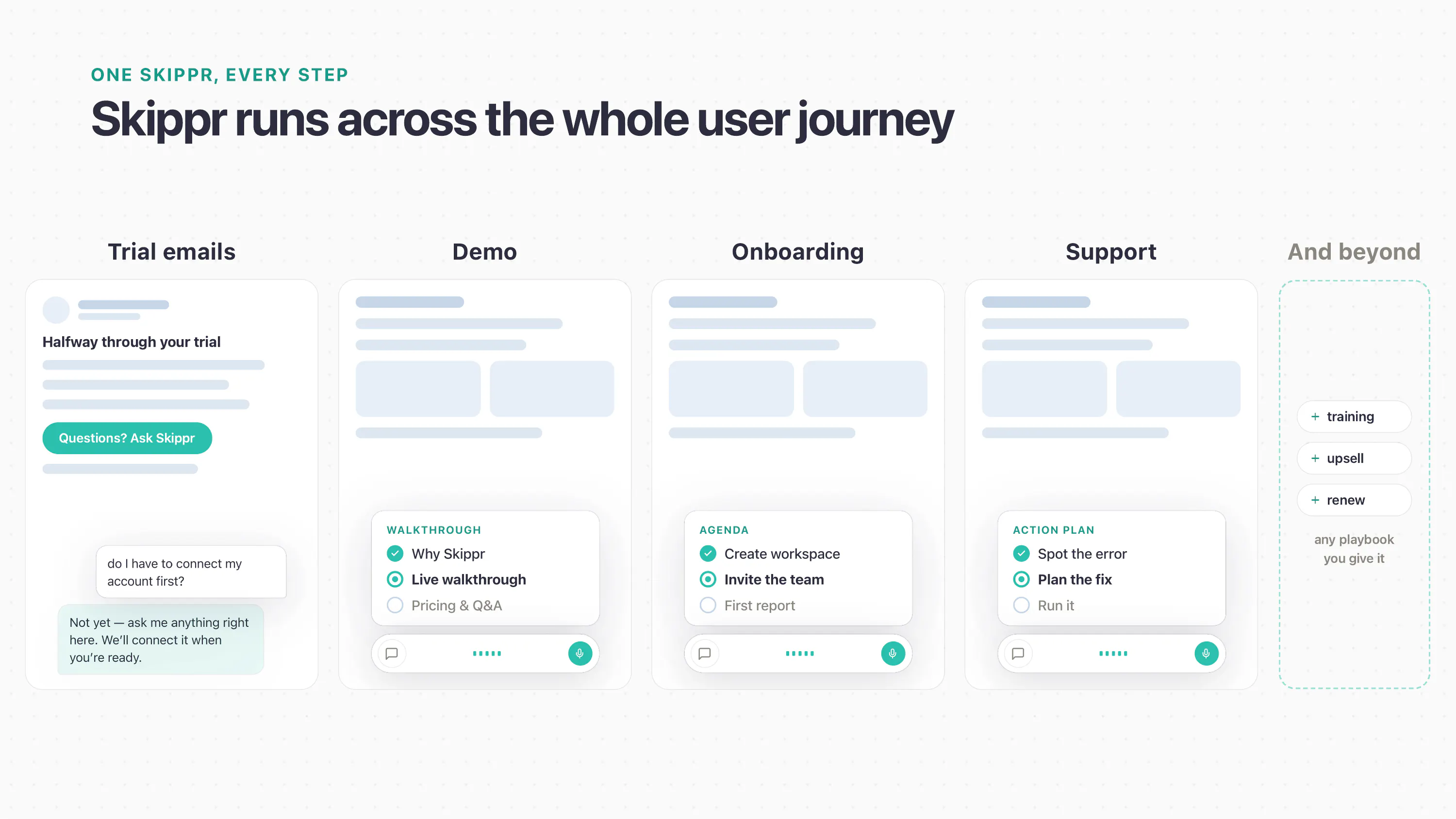
Real-time agents that see, talk, and operate software. They onboard, activate, and unblock your users. On their own. Skippr agents keep agenda and memory across full sessions, speak 10 languages, and act on screen with built-in browser automation. Fully self-serve: spin up an agent in minutes, embed with 2 lines of code, or share a meeting link. Trained on your knowledge, styled to your brand. 200 free credits to start, no card required. Talk to me for the deeper enterprise version.
AI Analysis
Skippr AI delivers real-time AI agents that act as live employees inside your product. They see, talk, and operate software autonomously to onboard, activate, and unblock users. Core features include persistent agenda and memory across sessions, support for 10 languages, and built-in browser automation for on-screen actions. USP: fully self-serve (setup in minutes, embed via 2 lines of code or meeting link), trained on your knowledge base, and styled to your brand. It solves key pain points like poor user onboarding, activation friction, support bottlenecks, and high operational costs by providing instant, independent assistance. Value proposition: enhanced customer success and UX with always-available AI agents that reduce reliance on human support.
Favorable for 2025-2026 due to maturing multimodal LLMs, computer-use AI capabilities, and surging demand for autonomous customer support amid labor shortages and cost pressures. User expectations for instant, in-app intelligent assistance are rising with AI adoption. Economic environment favors tools reducing support overhead. Browser automation tech is reaching practical reliability. Excellent Timing.
Medium. High technical difficulty in building reliable real-time visual perception, decision-making, and cross-software browser automation that avoids errors. Significant development and ongoing LLM inference/operation costs. Low supply chain risk but notable compliance/privacy risks for enterprise data access. Strong scalability potential in cloud but requires optimization for cost-efficiency. Already demonstrated via self-serve launch.
Primary segments: SaaS/product teams, customer success managers in B2B software companies (mid-market to enterprise). Industries: software/SaaS, fintech, e-commerce. Geographic: mainly US, Europe tech hubs. TAM for AI customer service ~$50B+ by 2027; SAM for in-product AI agents ~$5-10B; SOM for real-time acting agents ~$1B. Core pains: user drop-off from confusion, expensive human support, low activation rates. High willingness to pay for enterprise plans that demonstrably cut support costs.
Medium. Direct competitors: 1. Sierra (sierra.ai), 2. Forethought (forethought.ai), 3. Intercom AI (intercom.com), 4. Zendesk AI (zendesk.com), 5. MultiOn (multion.ai). Advantages: deeper screen operation via browser automation, cross-session memory/agenda, ultra-easy embed or link sharing, custom brand styling. Disadvantages: newer player with less brand recognition, potentially higher per-session costs than simple chatbots, unproven at massive scale compared to incumbents.
Upgrade Pro to unlock full AI analysis
Similar Products

Cohere Parse 5
Turn complex docs, tables & images into AI-ready data
▲ 158 votes

Opaline
PostHog for team Claude Code and Codex sessions.
▲ 141 votes

Adapt
The company brain that gets work done
▲ 124 votes

Tapfree for Chrome
Voice dictation that adapts to what’s on your screen
▲ 122 votes

React UI Kit V7
All the chat components you need. None of the complexity
▲ 115 votes

WikiFix for Confluence
Find and fix issues in your knowledge base
▲ 86 votes