
slash-editor
Notion-style block editor for React. MIT, UI you own
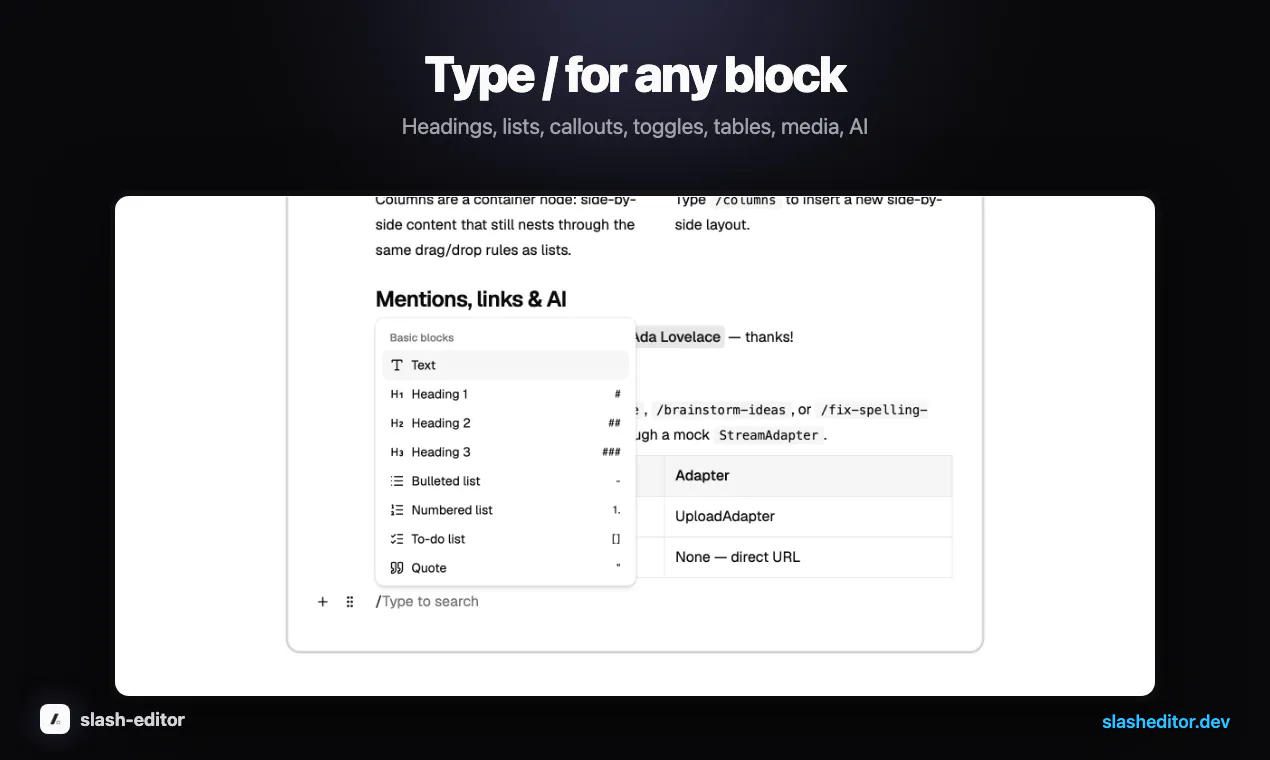
slash-editor gives your React app the Notion block experience: a slash menu, drag handles, nested reorder, turn-into, comments and real-time collab. It runs on a headless Tiptap v3 core. The UI arrives through a shadcn registry, so the components land in your repo and follow your Tailwind tokens. Tables, columns, Mermaid, AI via your own model, markdown import/export. MIT end to end, no paid tier, nothing hosted.
AI Analysis
slash-editor is an open-source, MIT-licensed Notion-style block editor for React built on headless Tiptap v3. Core features include slash menu, drag handles, nested reordering, turn-into, comments, real-time collab, tables, columns, Mermaid diagrams, AI via custom models, and Markdown import/export. UI components are delivered via shadcn registry, landing directly in your repo for full ownership and customization with Tailwind tokens. It solves the major pain of developers spending excessive time building complex, production-grade block editors from scratch. The value proposition is a flexible, no-lock-in, completely free solution that puts the UI under your control without any paid tiers or hosted dependencies.
In 2025-2026, market timing is favorable due to surging demand for AI-integrated productivity tools, maturity of real-time collaboration tech (e.g. Yjs), and continued dominance of React/Next.js in web development. Developers seek open-source, self-hosted alternatives amid growing concerns over vendor lock-in and data privacy. Economic trends favor cost-effective OSS solutions. Excellent Timing.
Overall feasibility is High. It builds on mature, well-maintained libraries (Tiptap v3, shadcn), resulting in moderate technical difficulty. As a client-side open-source library, dev/operation costs are low with no servers or supply chain involved. Compliance is straightforward under MIT. Strong scalability potential for integration into diverse React apps. Main risk is ongoing maintenance of advanced features like collab.
Main target: React/Next.js developers, indie hackers, SaaS startups, and engineering teams building note-taking, knowledge base, or AI content tools. Industries: Software/tech (global, concentrated in US, Europe, Asia). Estimated TAM for dev component libraries is multi-billion; SAM for rich text/block editors ~$300M; SOM for Notion-like OSS ~$30-50M. Core pains: high dev time/cost for advanced editors. Willingness to pay is moderate (for enterprise support, custom features) as core product is free.
Medium. Direct competitors: 1. Novel (novel.sh) - AI-first Notion editor for Next.js. 2. BlockNote (blocknotejs.org) - React block-based editor. 3. Tiptap (tiptap.dev) - core framework with extensions. 4. Lexical (lexical.dev by Meta). Advantages: true UI ownership via shadcn (customizable in-repo), comprehensive built-in features (collab, comments, AI, Mermaid), pure MIT with zero paid/hosted elements. Disadvantages: potentially steeper initial setup than turnkey alternatives, relies on community for growth compared to more established projects.
Upgrade Pro to unlock full AI analysis
Similar Products

Opaline
PostHog for team Claude Code and Codex sessions.
▲ 141 votes

React UI Kit V7
All the chat components you need. None of the complexity
▲ 115 votes

Replay QA Security Scan
Automated Penetration Testing for AI-Built Apps
▲ 102 votes

CodeBurn
See where your AI coding spend actually goes
▲ 101 votes

Refoid
Automate App Store refund responses and track every outcome
▲ 68 votes

Audryo
Customer email your agent can operate.
▲ 0 votes