
slop-grader
Jev-AI CLI tool that evaluates text against custom rulesets
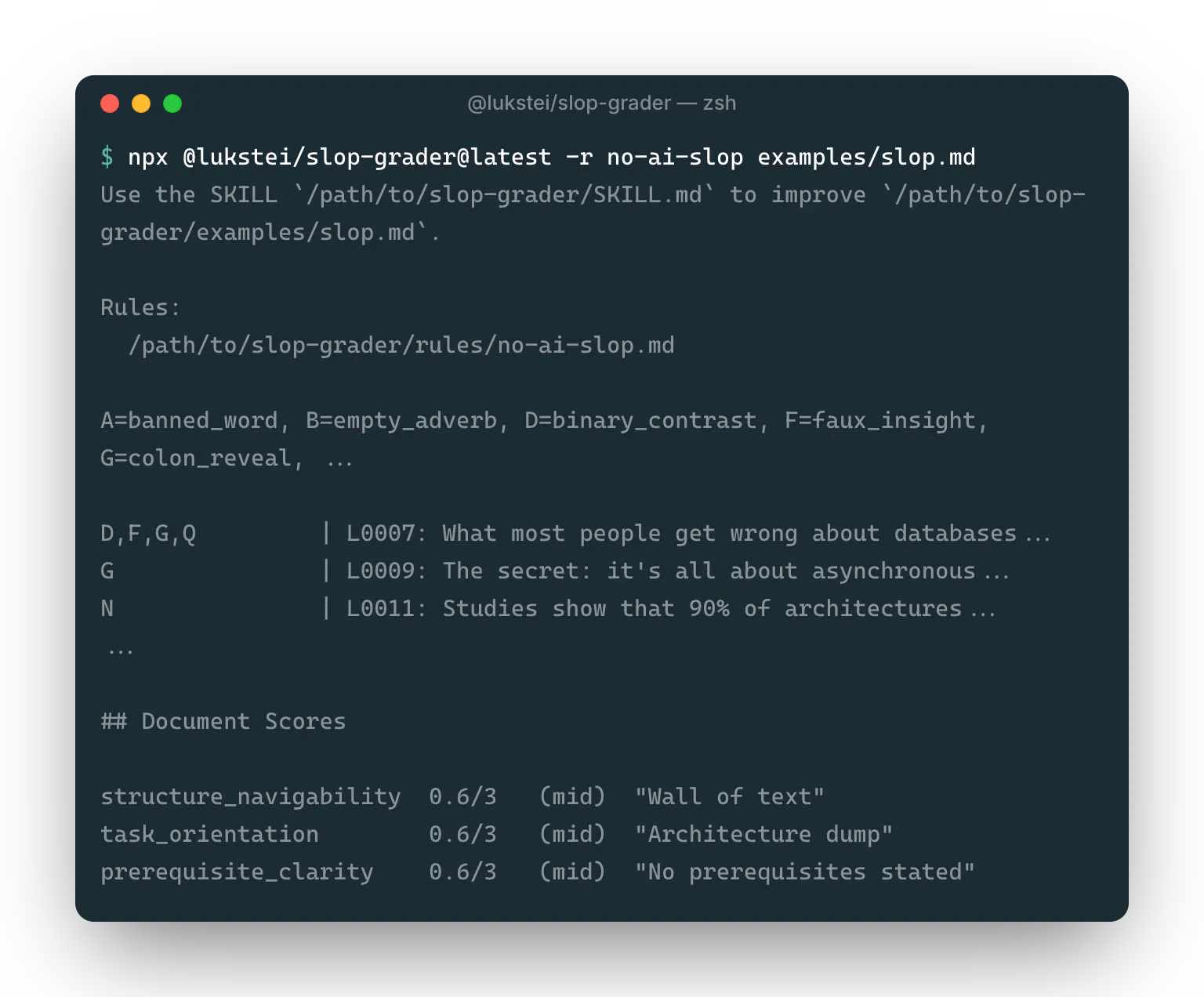
slop-grader is a rule-based CLI tool that evaluates documents against custom rulesets and produces document scores and line-by-line flags to guide auto-fixing with an AI agent. Use it to catch AI filler in launch copy, to strip buzzwords from landing pages, score narrative flow in launch emails. Flagged lines let agents draft sharper copy. The tool flags outputs prompts so agents can draft fixes.
AI Analysis
slop-grader is a rule-based CLI tool that evaluates documents against custom rulesets, outputting overall scores and line-by-line flags. It targets AI-generated 'slop' like filler words, buzzwords in launch copy, landing pages, and emails, while providing prompts for AI agents to auto-fix issues and improve narrative flow. Key USPs include customizable rules, actionable flags for automation, and integration with AI writing workflows. It solves pain points of poor-quality AI content, manual editing fatigue, and lack of structured quality control in marketing copy. Value proposition: Enables sharper, more effective copy with minimal effort by combining rules-based grading with AI remediation.
Favorable in 2025-2026 due to explosive growth in AI content generation tools and rising awareness of 'AI slop' degrading marketing quality. Technology maturity in LLMs and AI agents supports seamless integration for auto-fixing. User demand is shifting towards quality assurance and optimization rather than raw generation. Economic pressures favor efficient, low-cost tools like this CLI for startups. Excellent Timing.
High. Technical difficulty is low as it relies on rule-based parsing rather than complex ML training; can be built with Python and existing libraries. Development and operation costs are minimal for a CLI tool, likely open-source on GitHub. No supply chain or major compliance risks. Strong scalability for integration with AI agents and potential cloud versions. Main challenge is building comprehensive rulesets.
Main segments: Indie hackers, SaaS product marketers, copywriters, and growth teams in tech startups (demographics: 25-40 years old, tech-savvy). Industries: Advertising, Digital Marketing, Software. Primarily US/Europe with global GitHub users. TAM for AI writing assistants ~$2B+, SAM for content quality tools ~$300M, SOM for niche CLI ~$20M. Core pains: Ineffective AI copy with filler/buzzwords, time wasted on manual reviews. Willingness to pay: Medium; likely free/open-source with potential premium rules or agent integrations.
Low. Direct competitors: 1. Hemingway Editor (hemingwayapp.com), 2. Grammarly Business (grammarly.com), 3. GPTZero (gptzero.me), 4. Originality.ai (originality.ai), 5. Textlint (textlint.github.io). Advantages: Highly customizable rules for marketing-specific slop, explicit AI agent prompt outputs for auto-fixing, focused on launch copy/narrative scoring. Disadvantages: CLI interface limits accessibility vs polished web UIs, narrower scope than general writing assistants, potentially less brand recognition.
Upgrade Pro to unlock full AI analysis
Similar Products

Cohere Parse 5
Turn complex docs, tables & images into AI-ready data
▲ 158 votes

Adapt
The company brain that gets work done
▲ 124 votes

Tapfree for Chrome
Voice dictation that adapts to what’s on your screen
▲ 122 votes

CodeBurn
See where your AI coding spend actually goes
▲ 101 votes

Kosshi
Simple, fast outliner for Mac and iPhone.
▲ 90 votes

Thoughts for Mac
Capture notes from your menubar using text, images or voice
▲ 90 votes