
Snipplet
Create and share beautiful guides from places you love
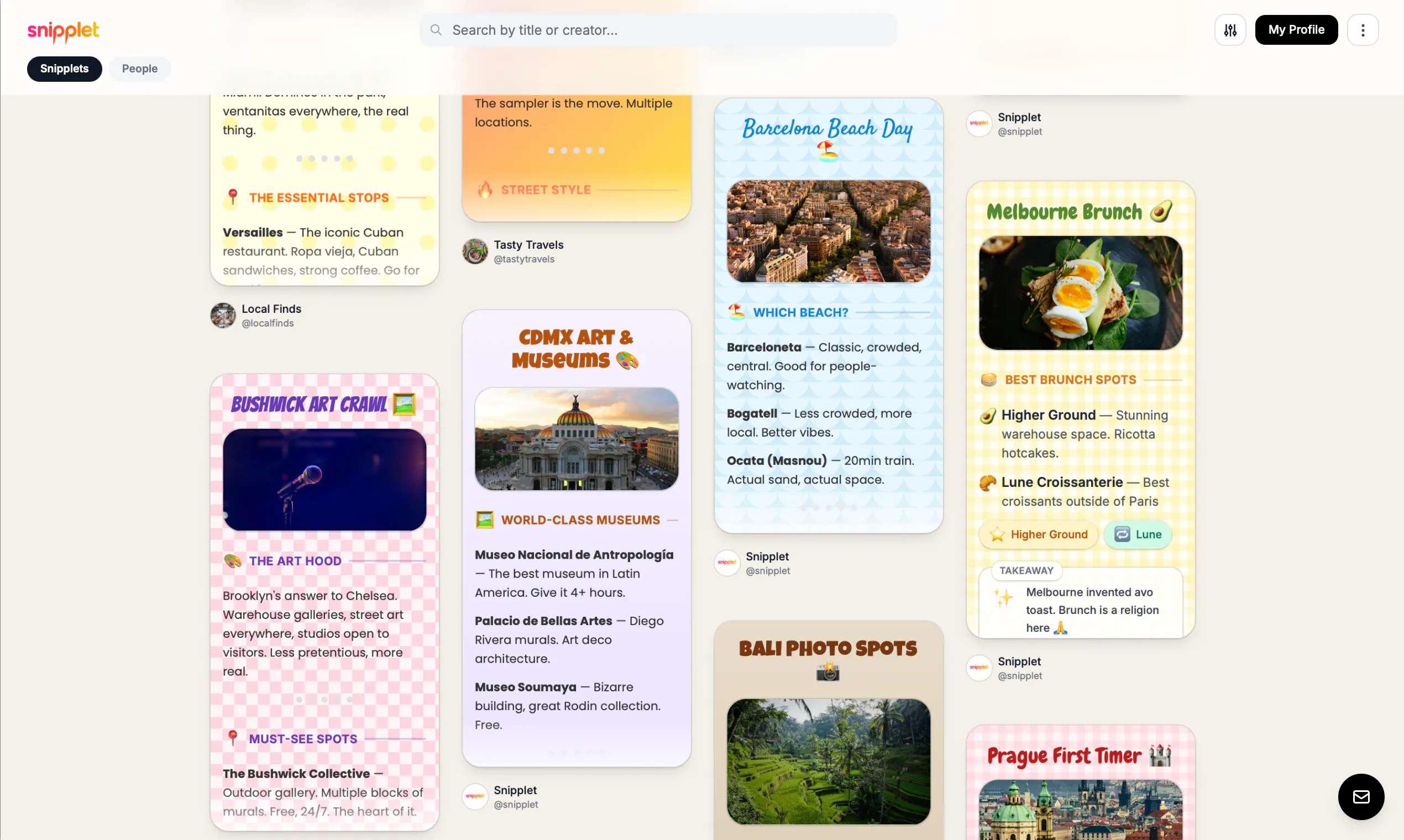
Most travel tools help you plan trips. Snipplet does the opposite. It's for places you've already been and actually loved. Save your favorite spots, add photos and tips, and it becomes a visual guide you can share with one link. No more scattered screenshots or 47 tab Google Docs. Make it yours with custom fonts, colors, stickers, backgrounds, and themes. Or drop a screenshot in and let AI build it for you. Real recs from real people. Works for Tokyo or your favorite spots around the corner.
AI Analysis
Snipplet enables users to create and share beautiful visual guides for places they've visited and loved. Key features include saving spots with photos and tips, one-link sharing, deep customization (fonts, colors, stickers, backgrounds, themes), and AI that auto-builds guides from screenshots. It solves pain points like scattered screenshots, messy multi-tab Google Docs, and lack of polished sharing tools for authentic recommendations. The value proposition centers on transforming personal experiences into professional, customizable, and easily shareable visual content for real people to give real recs.
Favorable for 2025-2026 with mature AI for content creation, rising demand for authentic post-travel sharing over pre-trip planning apps, growth in visual social media, and continued travel industry recovery. Users seek easy personalization tools amid economic emphasis on experiences. This aligns well with trends in user-generated content and AI-assisted design. Rating: Excellent Timing.
High feasibility. Technical difficulty is moderate by using existing AI APIs for screenshot analysis and modern no-code/low-code design tools for the editor. Development and operation costs are manageable for a SaaS product with cloud infrastructure. Low supply chain or compliance risks as it's digital content sharing. Strong scalability potential via user-generated content network effects. Main risk is initial user acquisition but team fit for design/AI product appears suitable.
Main segments: Avid travelers, digital nomads, influencers, and local enthusiasts (ages 25-40, tech-savvy, urban). Geographic focus: Global but strong in US, Europe, East Asia (e.g. Tokyo users). TAM for travel tech ~$800B+ (broader tourism digitization), SAM for personal guide/sharing tools ~$2-5B, SOM ~$100-300M for niche visual creators. Core pains: disorganized personal recs and poor sharing aesthetics. Moderate to high willingness to pay for premium customization and AI via freemium/subscription.
Medium. Direct competitors: 1. Wanderlog (wanderlog.com) - trip planning with sharing; 2. Polarsteps (polarsteps.com) - travel tracking and stories; 3. Notion (notion.so) - customizable travel guides via templates; 4. Canva (canva.com) - general visual design with templates; 5. Tripadvisor (tripadvisor.com) - user guides and reviews. Advantages: Post-trip focus, superior AI automation, higher aesthetic customization for beautiful one-link guides. Disadvantages: Newer entrant with smaller user base, less established network effects, may require more effort for initial content creation compared to review platforms.
Upgrade Pro to unlock full AI analysis
Similar Products

Load Nova
Dispatchers AI Co-Pilot and Dashboard that care about speed
▲ 131 votes

Adapt
The company brain that gets work done
▲ 124 votes

Tapfree for Chrome
Voice dictation that adapts to what’s on your screen
▲ 122 votes

Buddy AI Note
Your daily memo that turns notes into a plan
▲ 94 votes

Kosshi
Simple, fast outliner for Mac and iPhone.
▲ 90 votes

Thoughts for Mac
Capture notes from your menubar using text, images or voice
▲ 90 votes