
Socrati
Your personal knowledge podcast from any source
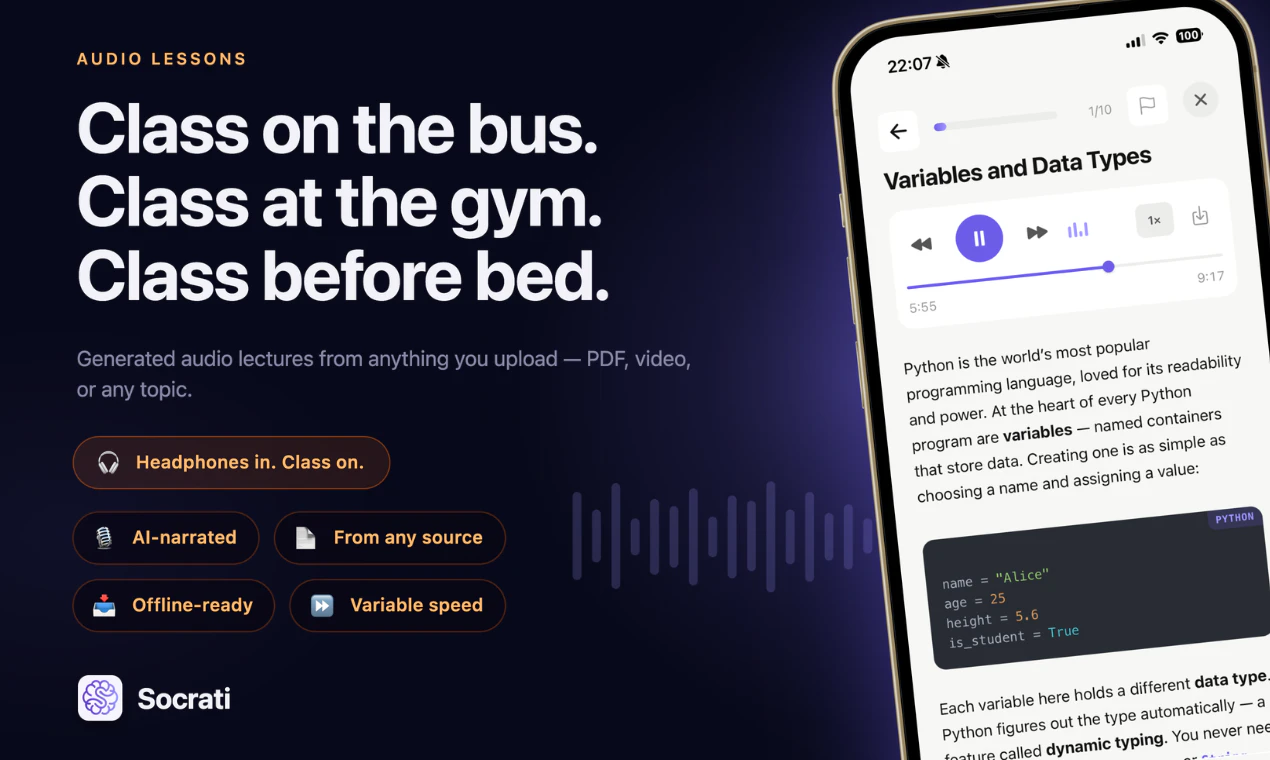
Your personal knowledge podcast — from any source. Drop in a PDF, a YouTube video, a photo of a page, or a topic you type in. Socrati builds you a full course: narrated audio lessons, multiple-choice drills, fill-in-the-blank exercises, and flashcards. Spaced repetition brings the material back on the day your brain is about to forget it. Built for the moments you can't be at your desk: headphones in on the bus, at the gym, or before bed. Live on iOS and Android in 6 languages.
AI Analysis
Socrati is a mobile app that converts any source—PDFs, YouTube videos, photos of pages, or typed topics—into personalized knowledge podcasts and structured courses. Core features include narrated audio lessons, multiple-choice drills, fill-in-the-blank exercises, flashcards, and spaced repetition algorithms that resurface content at optimal forgetting intervals. It is designed for on-the-go use with headphones during commutes, workouts, or before bed. USP: seamless multimodal input to full interactive courses in 6 languages on iOS/Android. It solves pain points of non-portable static materials, low knowledge retention, and inability to learn while multitasking. Value proposition: transforms passive content into active, effective, personalized mobile learning.
The 2025-2026 period features mature generative AI and multimodal models for content processing, high-quality TTS, and widespread adoption of personalized edtech. User demand is shifting toward flexible, on-the-go learning amid busy lifestyles and remote work trends. Economic environment supports affordable AI tools while policies encourage digital education. Overall favorable for AI-powered adaptive learning solutions. Excellent Timing.
Technical difficulty is manageable using existing AI APIs for transcription, summarization, quiz generation, and TTS; spaced repetition is a standard, low-complexity algorithm. Development and operation costs include mobile app maintenance and variable AI inference fees, which can scale with usage. Low supply chain or compliance risks for an education app. High scalability potential via cloud infrastructure. Strong fit for AI-focused teams. High.
Main segments: college/high school students, working professionals upskilling, lifelong learners, and multitasking users (commuters, gym-goers). Geographically global with initial focus on 6-language markets (primarily English-speaking regions plus others). TAM for AI edtech exceeds $20B with strong growth; SAM for mobile personalized learning ~$5B; SOM for podcast-style tools in hundreds of millions of users. Core pains: limited study time, poor retention from passive sources, lack of structured learning from arbitrary inputs. High willingness to pay for subscriptions offering unlimited conversions and advanced features.
Medium. Direct competitors: 1. NotebookLM (notebooklm.google.com) - AI audio discussions from documents but limited interactivity and no spaced repetition. 2. Anki (apps.ankiweb.net) - spaced repetition flashcards without audio course generation from video/PDF. 3. Duolingo Max (duolingo.com) - AI-powered lessons but focused on languages, not any topic. 4. Memrise (memrise.com) - video-based learning with quizzes but less emphasis on arbitrary source conversion. Advantages: unique all-in-one multimodal input to full adaptive podcast courses with spaced repetition. Disadvantages: newer product may face AI quality/performance variability; no mentioned pricing edge; depends on continuous AI API reliability compared to more established platforms.
Upgrade Pro to unlock full AI analysis
Similar Products

Auriko
Trading desk for LLM calls
▲ 332 votes

Cohere Parse 5
Turn complex docs, tables & images into AI-ready data
▲ 158 votes

Opaline
PostHog for team Claude Code and Codex sessions.
▲ 141 votes

Adapt
The company brain that gets work done
▲ 124 votes

Tapfree for Chrome
Voice dictation that adapts to what’s on your screen
▲ 122 votes

CodeBurn
See where your AI coding spend actually goes
▲ 101 votes