
space ocr
OCR that checks its own answers, as an app or an API
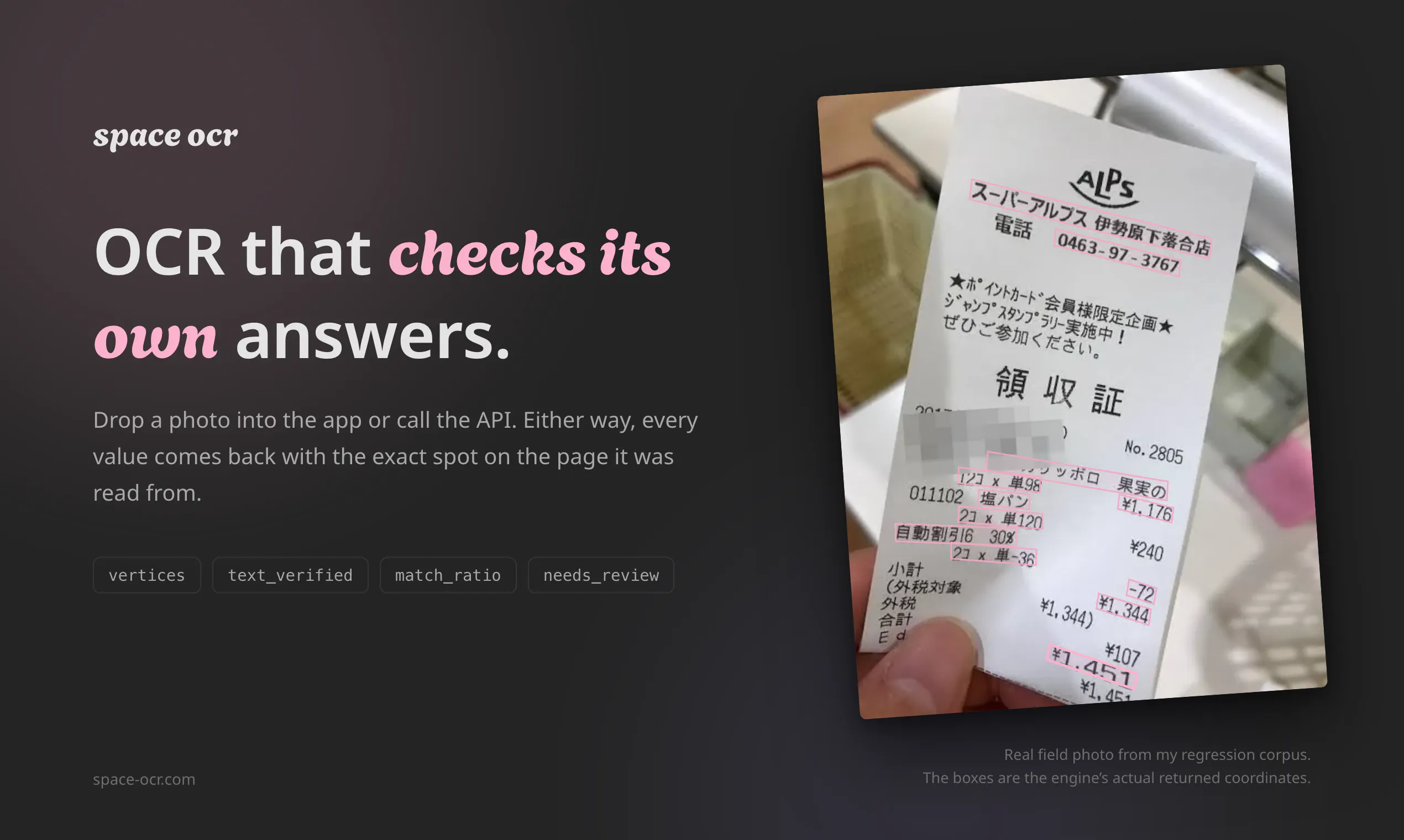
space ocr turns photos of receipts, invoices and forms into a table you can query. Drop them into a folder in the app or send them to the API, and each page becomes a row you can filter and sort. Every value shows where it came from. 100 free pages a month.
AI Analysis
Space OCR is an AI-powered OCR tool available as a desktop app and API that converts photos of receipts, invoices, and forms into structured, queryable tables. Users drop images into a monitored folder or send via API; each page becomes a filterable/sortable database row with full source traceability linking values back to the original image. Its standout USP is self-verifying OCR that checks its own accuracy. It addresses key pain points like time-consuming manual data entry, extraction errors, and lack of structured access to document data. Value proposition: boosts productivity for document-heavy workflows with high accuracy and ease of use, starting with 100 free pages monthly.
The timing is favorable for 2025-2026 as AI document understanding technologies (multimodal LLMs) reach maturity, enabling reliable self-verification. Rising demand for automation in finance and admin tasks driven by remote work, labor costs, and digital transformation aligns perfectly. Economic pressures for efficiency and supportive AI policies create strong tailwinds. Excellent Timing.
High feasibility. Technical difficulty is moderate leveraging mature OCR libraries plus LLMs for verification; app and API can be built with standard web/cloud tech. Development and operation costs are manageable (inference expenses offset by freemium model). Low supply chain risk, but data privacy compliance (GDPR for invoices/receipts) is essential. Strong scalability via cloud infrastructure. Overall viable for a small technical team.
Primary segments: small business owners, accountants, freelancers, and developers in accounting, finance, retail, and logistics industries. Geographically focused on US, Europe, and global English-speaking markets. TAM for AI document processing exceeds $10B with SAM for specialized OCR/APIs around $1-2B; SOM for this self-verifying niche estimated at $50-100M. Core pains: manual transcription errors and slow processing. High willingness to pay for accuracy, time savings, and API integration via tiered subscriptions.
Medium. Direct competitors: Nanonets (nanonets.com), Rossum (rossum.ai), Docparser (docparser.com), Parseur (parseur.com), ABBYY FlexiCapture (abbyy.com). Advantages: unique self-checking OCR for improved accuracy, simple folder-drop workflow, explicit source traceability, and dual app/API access. Disadvantages: smaller scale and brand recognition, limited free tier (100 pages), potentially fewer enterprise features/integrations and less proven on highly complex documents compared to established players.
Upgrade Pro to unlock full AI analysis
Similar Products

Cohere Parse 5
Turn complex docs, tables & images into AI-ready data
▲ 158 votes

Adapt
The company brain that gets work done
▲ 124 votes

Tapfree for Chrome
Voice dictation that adapts to what’s on your screen
▲ 122 votes

Replay QA Security Scan
Automated Penetration Testing for AI-Built Apps
▲ 102 votes

Kosshi
Simple, fast outliner for Mac and iPhone.
▲ 90 votes

Thoughts for Mac
Capture notes from your menubar using text, images or voice
▲ 90 votes