
Staats
Ask your coding agent how your site is doing
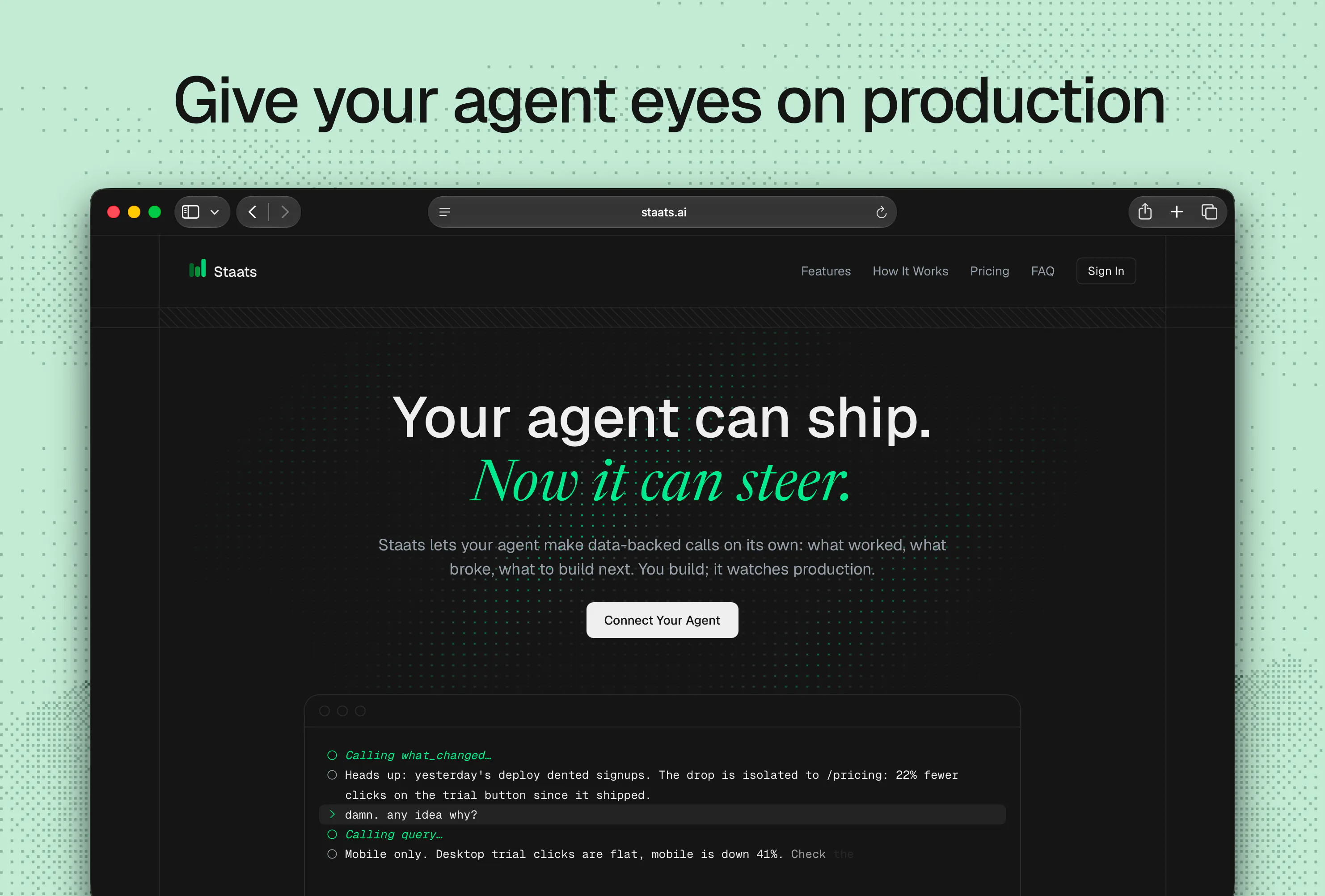
Agent-native, cookieless site analytics. Your coding agent measures deploys, flags changes, and suggests next moves with evidence. No dashboard, no charts to read.
AI Analysis
Staats is an agent-native, cookieless site analytics SaaS tool that integrates directly with coding agents. Core features include automatic measurement of deploys, flagging code changes impacting performance, and providing evidence-based suggestions for next steps. Its unique selling point is eliminating traditional dashboards and charts entirely—users query their AI coding agent conversationally for insights. It solves key pain points like time wasted interpreting complex analytics UI, privacy issues from cookies, and lack of actionable ties between code changes and site metrics. The value proposition is embedding analytics into AI-driven dev workflows for faster, smarter decisions without leaving the coding environment.
In 2025-2026, AI coding agents (e.g. Cursor, Devin-like tools) are reaching maturity with widespread adoption in dev workflows. Demand for privacy-first (cookieless) analytics is rising due to regulations like GDPR/CCPA, while users seek seamless, conversational tools over complex dashboards. Economic focus on AI efficiency makes this an Excellent Timing as it rides the AI agent boom and shifts toward integrated, actionable intelligence.
Technical difficulty is medium-high due to AI agent integration and accurate evidence linking to deploys, but leverages mature LLMs and server-side tracking for cookieless analytics. Development/operation costs are moderate for a SaaS startup. Low supply chain risk, but compliance with data privacy laws is manageable and advantageous. Strong scalability via cloud AI. Overall rating: High, due to accessible tech stack and clear path to MVP with existing AI APIs.
Main target users: Web developers, indie hackers, frontend engineers, and small product teams using AI coding tools (ages 25-40, tech-savvy). Industries: Software/SaaS development, digital agencies. Geographic: Primarily North America and Europe. Estimated TAM for web analytics ~$6B, SAM for AI-integrated dev tools ~$800M, SOM ~$50M in first 3 years. Core pain points: Dashboard fatigue, disconnected insights from code, cookie consent friction. High willingness to pay ($29-99/mo) for time-saving AI tools that boost productivity.
Competition level: Low. Direct competitors: 1. Google Analytics (analytics.google.com), 2. Plausible (plausible.io), 3. PostHog (posthog.com), 4. Fathom Analytics (usefathom.com), 5. Mixpanel (mixpanel.com). Advantages: Revolutionary no-dashboard, agent-native UX with deploy-aware suggestions and evidence; fully cookieless by design; deeply integrated into coding workflow. Disadvantages: Lacks visual reporting preferred by some enterprises; potential AI hallucination risks; less brand recognition than incumbents. Strong differentiation via AI agent focus sets it apart in a crowded but traditional analytics space.
Upgrade Pro to unlock full AI analysis
Similar Products

Cohere Parse 5
Turn complex docs, tables & images into AI-ready data
▲ 158 votes

Opaline
PostHog for team Claude Code and Codex sessions.
▲ 141 votes

Adapt
The company brain that gets work done
▲ 124 votes

Coarena by Coasty
The arena where agents battle on real-world work
▲ 104 votes

WikiFix for Confluence
Find and fix issues in your knowledge base
▲ 86 votes

Saldor
Speed up procurement and AP.
▲ 78 votes