
Stella
Local, open-source AI that automates your Mac
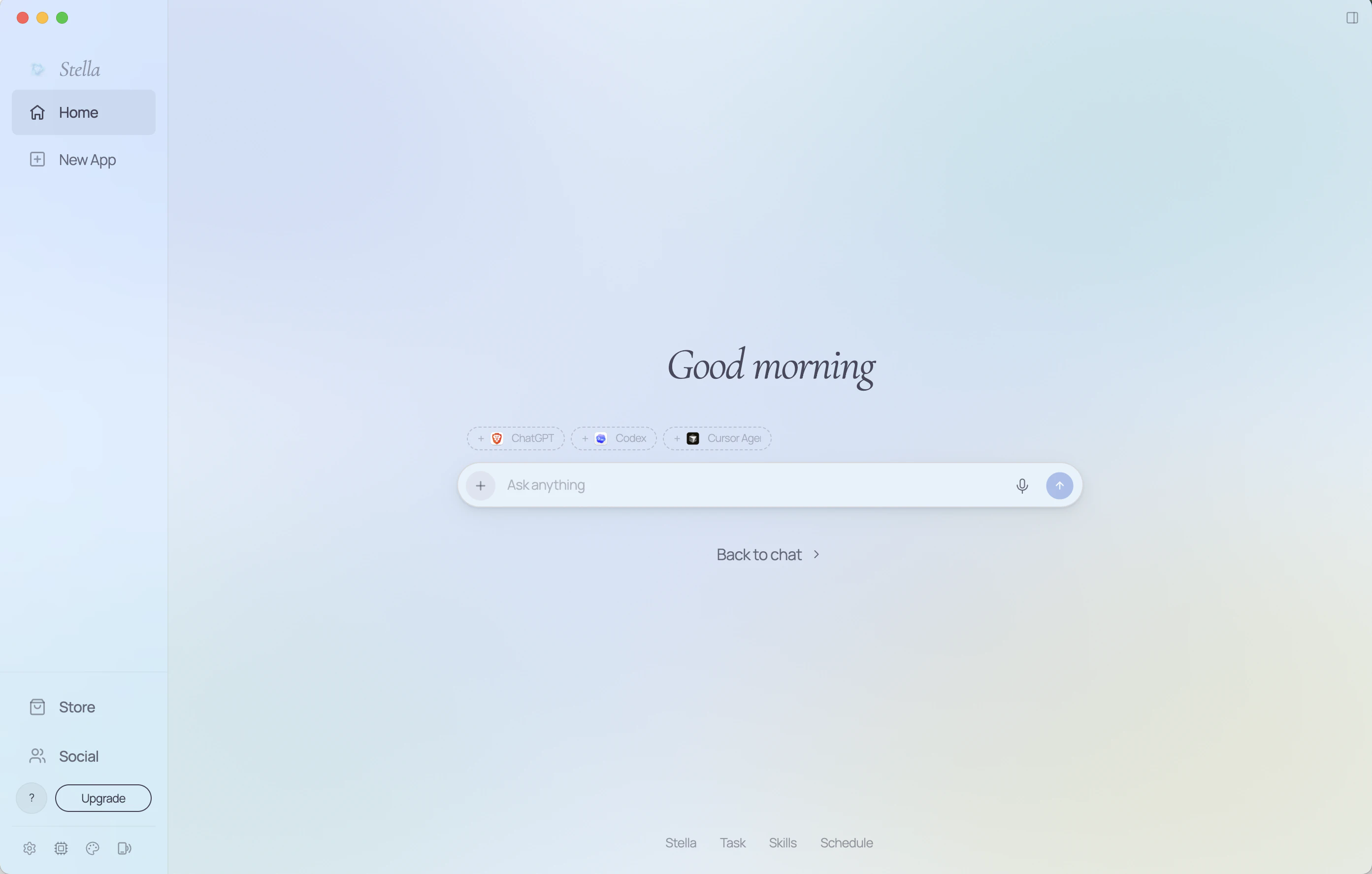
- Modify itself entirely, or work on external projects like normal agents - Background computer use - Browser use (via extension) - Office files — Word, Excel, PowerPoint, PDF, etc. Ai features: - Dictation: in-app or anywhere on your computer - realtime voice. Talk to stella - media generation (music, images, videos, etc) Other features: - Store: Share what you create. Get what others have created. - Social: talk with friends and work together on making an app
AI Analysis
Stella is a local, open-source AI that automates Mac tasks. Core features include self-modification, background computer control, browser extension use, office file handling (Word, Excel, PDF), system-wide dictation, real-time voice interaction, and media generation (music, images, videos). It features a Store for sharing creations and social tools for collaborative app building. USPs: runs entirely locally for privacy, open-source customizability, deep OS integration. Solves pain points like repetitive manual workflows, lack of seamless cross-app AI, and cloud AI privacy risks. Value proposition: a powerful, private, customizable AI companion that boosts productivity and creativity for Mac users.
Favorable in 2025-2026 as on-device AI matures with efficient local LLMs, privacy regulations tighten, and demand for autonomous AI agents surges (evidenced by industry moves toward 'computer use' capabilities). User needs for personalized, private automation align perfectly with post-2024 AI hype normalization. Economic focus on productivity tools supports adoption. Excellent Timing.
Medium feasibility. Technical difficulty is high for reliable self-modifying agents and background Mac control (requires advanced accessibility APIs and vision models). Local execution demands strong user hardware, increasing support costs. Open-source model aids development via community but raises maintenance and safety risks. Low compliance issues; good scalability for power users but variable performance. Team needs strong AI/Mac integration expertise.
Main segments: Tech-savvy Mac users, software developers, content creators, and productivity-focused professionals (ages 25-45), concentrated in North America, Europe. Industries: software, creative media, business ops. TAM: part of $100B+ AI productivity market; SAM for desktop AI agents ~$10B; SOM for open-source Mac tools ~$1B. Core pains: time lost to repetitive tasks, poor AI-OS integration, data privacy fears. High willingness to pay for seamless pro features or via store ecosystem.
Medium. Direct competitors: 1. Open Interpreter (openinterpreter.com), 2. Raycast (raycast.com), 3. Apple Intelligence (apple.com/intelligence), 4. Anthropic Claude Computer Use (anthropic.com), 5. MultiOn (multion.ai). Advantages: fully local/open-source (superior privacy/customization), broad Mac integration including voice/media/office, unique social/store features. Disadvantages: potentially higher hardware demands and less refined UX than cloud competitors; slower iteration without big-tech resources.
Upgrade Pro to unlock full AI analysis
Similar Products

Cohere Parse 5
Turn complex docs, tables & images into AI-ready data
▲ 158 votes

Opaline
PostHog for team Claude Code and Codex sessions.
▲ 141 votes

Adapt
The company brain that gets work done
▲ 124 votes

Tapfree for Chrome
Voice dictation that adapts to what’s on your screen
▲ 122 votes

Town
The assistant that learns how you work, then gets to work.
▲ 115 votes

Saldor
Speed up procurement and AP.
▲ 78 votes