
SUN-to-Spotify
Generate audio with SUN and send it to your Spotify library
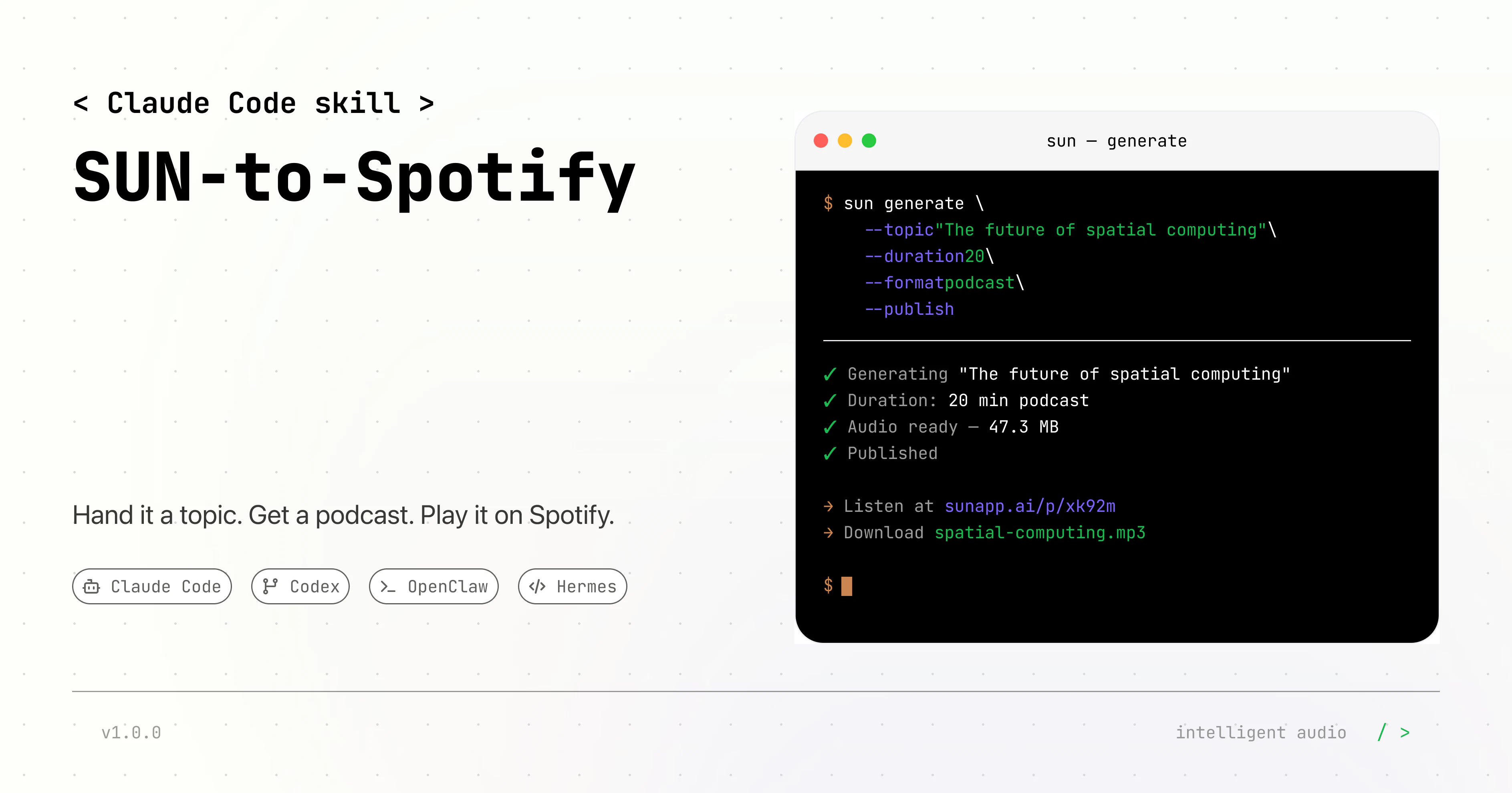
SUN-to-Spotify is a skill that lets you generate AI podcasts, audiobooks, and then publish them directly to your Spotify library for streaming or offline listening. Just describe what you want to hear: startup advice, history deep dives, philosophy, news, or custom learning content, and SUN creates a personalized audio experience in minutes. Built for creators, developers, and curious minds exploring the future of AI native audio.
AI Analysis
SUN-to-Spotify allows users to describe desired topics such as startup advice, history deep dives, philosophy, news or custom learning content, enabling SUN to generate personalized AI podcasts and audiobooks in minutes. The audio is then directly published to the user's Spotify library for streaming or offline listening. Core features include simple natural language input and seamless Spotify integration. It solves pain points of time-consuming content creation, lack of personalization in audio learning, and complicated distribution. USP is its AI-native workflow for creators, developers and curious minds, delivering convenient, on-demand personalized audio experiences.
In 2025-2026, generative AI technology is maturing rapidly with improved audio quality and accessibility. User demand for personalized, on-demand educational and informative audio content is surging amid busy lifestyles and remote learning trends. Spotify continues to dominate streaming with expanding podcast features, creating a supportive ecosystem. Economic and policy environments favor AI innovation in content creation. This convergence makes it an opportune moment for AI-to-platform audio tools. Rating: Excellent Timing.
Technical difficulty is medium as it depends on SUN's AI APIs and Spotify's integration for library publishing (via podcast hosting or API). Development and operation costs include API usage fees which could scale with volume. Compliance risks involve content moderation, copyright of AI outputs, and adherence to Spotify terms. No major supply chain issues; scalability is good via cloud infrastructure. Team fit is strong for AI/audio developers. Overall rating: Medium, due to third-party platform dependencies and potential API limitations.
Main target segments: tech-savvy creators, developers, educators, and curious lifelong learners (ages 18-45), interested in AI, self-improvement, and niche educational content. Geographic distribution: primarily US and Europe with global reach via Spotify. Industries: education, content creation, technology. Estimated market size: large and growing TAM in the global podcast/audiobook sector (tens of billions), with AI personalization as a fast-growing SAM; SOM for this integration niche is meaningful for early adopters. Core pain points: difficulty finding or creating tailored audio quickly. Potential willingness to pay: moderate to high for reliable, time-saving premium features.
Competition level: Medium. Direct competitors: 1. NotebookLM (notebooklm.google.com), 2. ElevenLabs (elevenlabs.io), 3. Play.ht (play.ht), 4. Murf.ai (murf.ai), 5. Spotify for Podcasters (podcasters.spotify.com). Advantages: extremely simple description-to-Spotify workflow, focus on personalized learning audio with direct library integration. Disadvantages: less control over voice/audio editing compared to specialized tools, reliant on underlying SUN quality which may not match dedicated competitors' customization depth or output consistency in features and differentiation.
Upgrade Pro to unlock full AI analysis
Similar Products

Cohere Parse 5
Turn complex docs, tables & images into AI-ready data
▲ 158 votes

Opaline
PostHog for team Claude Code and Codex sessions.
▲ 141 votes

Adapt
The company brain that gets work done
▲ 124 votes

Tapfree for Chrome
Voice dictation that adapts to what’s on your screen
▲ 122 votes

WikiFix for Confluence
Find and fix issues in your knowledge base
▲ 86 votes
Patchcord
Studio sound for your mic in every Mac meeting with EQ
▲ 64 votes