
Sunrise
A real planner for Google Tasks
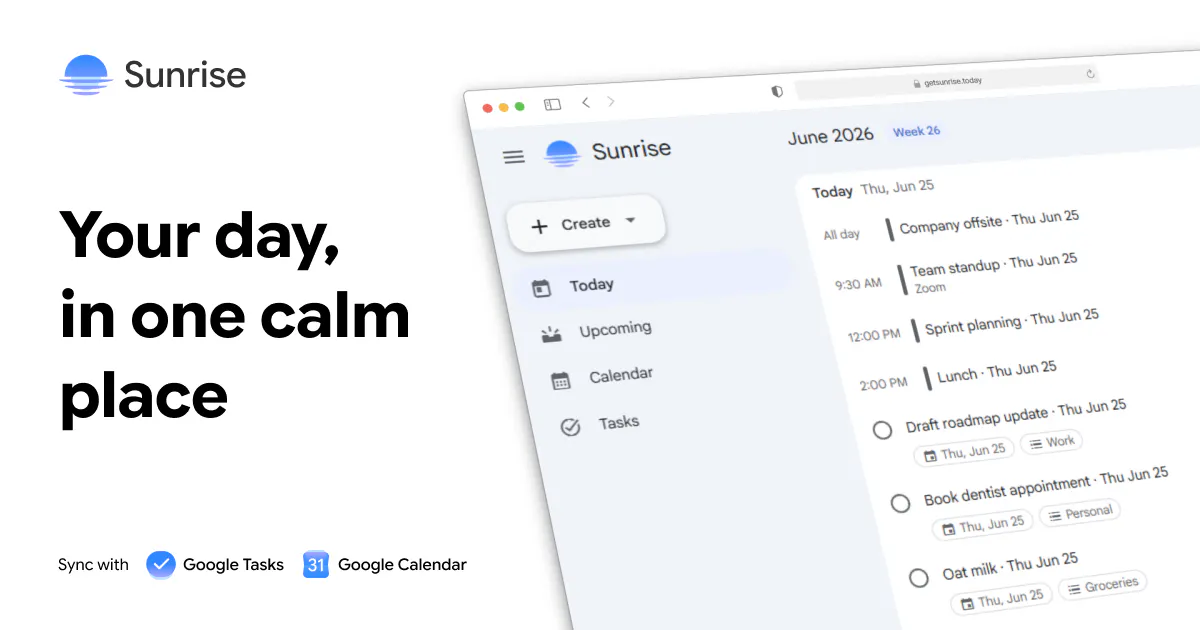
Google Tasks is fine for jotting things down. It’s terrible for planning your day. No Today view. No overdue section. No way to see what’s due this week at a glance. Just flat lists. Sunrise is a planner built on top of Google Tasks. See today’s tasks, catch what’s overdue, scroll through what’s coming up, and organize work on a kanban board — all synced with your existing Google Tasks lists. Your data stays in Google.
AI Analysis
Sunrise transforms Google Tasks from basic flat lists into a functional daily planner. It solves key pain points like missing Today view, overdue task visibility, and at-a-glance weekly planning by offering dedicated sections for today's tasks, overdue items, upcoming schedule, and a Kanban board for workflow organization. All changes sync bidirectionally with native Google Tasks, ensuring users' data remains securely in their Google account without migration. The core USP is delivering powerful planning capabilities while staying fully within the Google ecosystem, providing immediate productivity gains for existing Google Tasks users without learning a new app.
The timing is moderately favorable for 2025-2026. Productivity tools remain in demand due to hybrid work trends and focus on personal efficiency. Google Workspace continues to grow, favoring integrated add-ons. However, the rapid rise of AI-powered task assistants (like Google Gemini integrations) may reduce appeal for non-AI planners. Overall, it aligns with ecosystem enhancement trends but faces pressure from more advanced AI solutions. Rating: Moderate Timing.
High feasibility. The product leverages the mature and well-documented Google Tasks API, minimizing technical complexity and eliminating the need for proprietary data storage (reducing compliance risks). Development and operation costs are relatively low for a web-based interface app. Scalability is strong as it offloads data handling to Google. No supply chain issues. Main risk is potential API changes by Google. Overall highly feasible for a small experienced team.
Primary users are existing Google Tasks/Google Workspace users: knowledge workers, freelancers, managers, and students aged 25-45, tech-savvy, concentrated in North America and Europe. Industries include technology, consulting, education, and small business. Core pain points are inefficient daily/weekly task visualization and lack of planning tools in native Google Tasks. TAM for task management software is large (tens of billions globally); SAM for Google ecosystem productivity addons is substantial but niche; SOM depends on marketing within Google user base. Willingness to pay is moderate for premium planning features via subscription.
Medium. Direct competitors: 1. Official Google Tasks (tasks.google.com), 2. Todoist (todoist.com), 3. TickTick (ticktick.com), 4. Microsoft To Do (to-do.live.com), 5. Any.do (any.do). Advantages: Zero data migration, perfect bidirectional sync with Google Tasks, unique Kanban view specifically for Google users. Disadvantages: Feature set is limited by Google Tasks backend (fewer advanced capabilities than full competitors), potential API dependency risks, and less brand recognition than established players. Differentiation is strong for Google loyalists but narrower overall market appeal.
Upgrade Pro to unlock full AI analysis
Similar Products

Adapt
The company brain that gets work done
▲ 124 votes

Tapfree for Chrome
Voice dictation that adapts to what’s on your screen
▲ 122 votes
Kosshi
Simple, fast outliner for Mac and iPhone.
▲ 90 votes

Thoughts for Mac
Capture notes from your menubar using text, images or voice
▲ 90 votes

WikiFix for Confluence
Find and fix issues in your knowledge base
▲ 86 votes
Refoid
Automate App Store refund responses and track every outcome
▲ 68 votes