
Taste Lab
Extract any website's design DNA
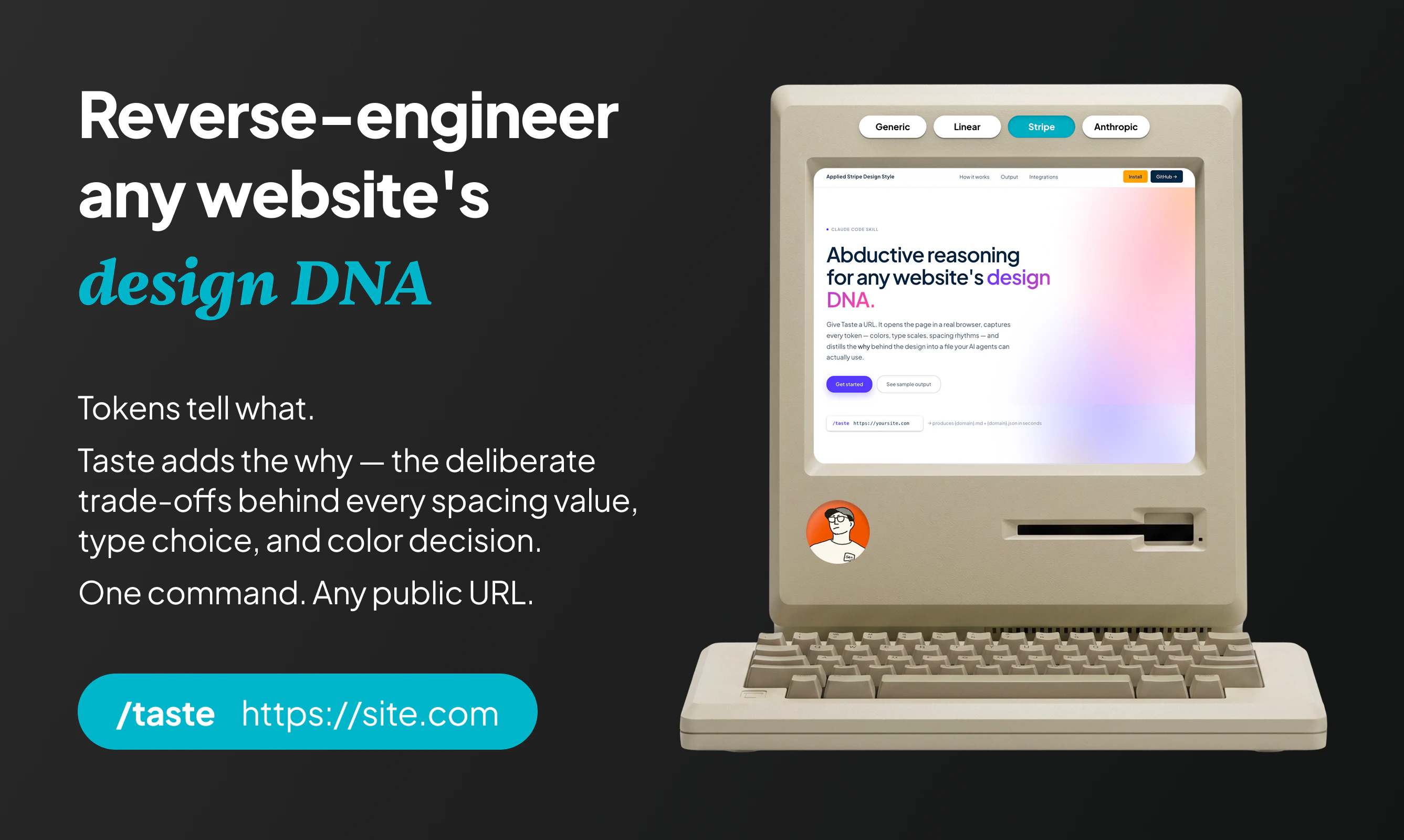
Point your AI agent at any website. Get back a complete design breakdown — colors, type, spacing, and the reasoning behind every decision — ready to use in your next build.
AI Analysis
Taste Lab is an AI agent tool that analyzes any website to extract its complete design DNA, including colors, typography, spacing, and the underlying reasoning for each choice. Core features include instant design breakdowns ready for implementation. It solves key user pain points like time-consuming manual inspection of websites and difficulty understanding professional design decisions. Unique selling points are the explanatory AI analysis and 'vibe coding' focus, enabling faster builds and learning. Overall value proposition: transform any site into an actionable, educational design system to boost productivity for creators.
Favorable for 2025-2026 due to surging AI adoption in design and development, maturity of multimodal LLMs for web analysis, and rising demand for vibe-based and no-code tools. Trends favor AI agents that accelerate prototyping amid economic push for efficient digital creation. Excellent Timing.
High. Technical difficulty is manageable using current vision LLMs and web parsing tech. Development/operation costs center on AI API usage but are controllable. Minimal supply chain or compliance risks for public web data. Strong scalability as a cloud SaaS. Team fit good for AI/product builders. Key reasons: leverages mature tech stack with high potential for iteration.
Primary segments: frontend developers, UI/UX designers, indie hackers, and product teams (ages 25-40, tech-savvy). Industries: software, digital agencies, startups. Geographic: global with focus on US/Europe. Market size: rapidly expanding AI design tools sector (part of broader multi-billion design software TAM). Core pain points: inefficient design research and replication. High willingness to pay for time-saving, actionable insights via subscriptions.
Medium. Direct competitors: 1. Uizard (uizard.io), 2. Galileo AI (usegalileo.ai), 3. Visily (visily.ai), 4. v0 by Vercel (v0.dev). Advantages: unique focus on explanatory 'design DNA' reasoning and educational breakdowns vs. generation-focused rivals. Disadvantages: newer entrant with potentially higher AI hallucination risks and fewer established integrations/pricing details.
Upgrade Pro to unlock full AI analysis
Similar Products

Lev8
Find, research, and reach the right people
▲ 451 votes

Auriko
Trading desk for LLM calls
▲ 332 votes

Cohere Parse 5
Turn complex docs, tables & images into AI-ready data
▲ 158 votes

Adapt
The company brain that gets work done
▲ 124 votes

Tapfree for Chrome
Voice dictation that adapts to what’s on your screen
▲ 122 votes

CodeBurn
See where your AI coding spend actually goes
▲ 101 votes