Termexo
A local Windows workbench for Claude Code and Codex
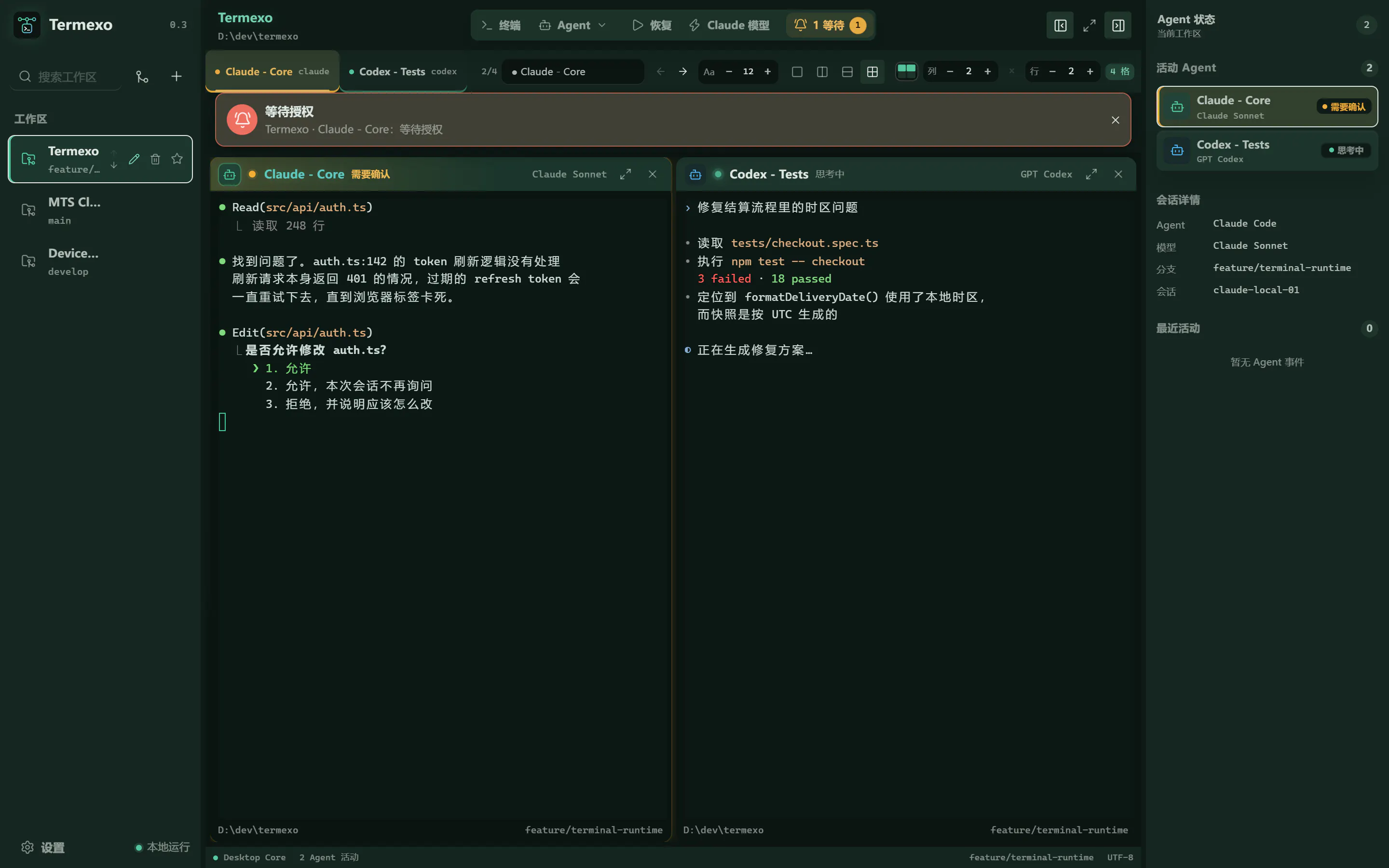
Termexo brings Claude Code and Codex into one recoverable Windows workspace. Arrange real PTY terminals in custom grids, search and resume native sessions, get notified when an agent needs approval, and switch Claude-compatible model profiles without rebuilding environment variables. Local-first, no Termexo account required.
AI Analysis
Termexo is a local-first Windows workbench integrating Claude Code and Codex into a single recoverable workspace. Core features include arranging PTY terminals in custom grids, searching/resuming native sessions, notifications for agent approvals, and seamless switching of Claude-compatible models without rebuilding environment variables. It solves key pain points for developers such as fragmented AI coding sessions, difficult session recovery on Windows, complex model configurations, and dependency on cloud accounts. The value proposition is enhanced productivity through a native, privacy-focused, and flexible terminal environment for AI-assisted development.
The timing is favorable in 2025-2026 as AI coding agents like Claude see explosive adoption, local-first tools gain traction due to privacy concerns and API costs, and Windows developers seek better native integrations amid maturing PTY and AI SDKs. Changing demands for efficient multi-agent workflows align well, despite potential economic uncertainty. Rating: Excellent Timing.
Overall feasibility is High. Technical difficulty is moderate (leveraging existing PTY libs and Claude APIs on Windows), development/operation costs are low for a desktop app with no servers needed. Minimal supply chain or compliance risks beyond Anthropic terms. Strong scalability as a local tool and good team fit for desktop/AI devs. Key challenge is polished cross-session UX.
Primary users: Independent developers, AI engineers, and software teams using Claude for coding, focused on Windows environments. Demographics: Tech professionals aged 25-45. Industries: Software development, startups. Geographic: Global with concentration in North America and Europe. TAM for AI developer tools exceeds $15B, SAM for AI terminals ~$1B, SOM for Claude/Windows niche ~$80M. Core pains: Inefficient terminal management and setup friction. High willingness to pay for productivity gains via one-time or subscription models.
Competition level: Medium. Direct competitors: 1. Warp (warp.dev), 2. Aider (aider.chat), 3. Continue.dev (continue.dev), 4. Tabby (tabby.sh). Advantages: Deep Claude integration, custom grid PTY layouts, local-first with zero-account requirement, native Windows session recovery. Disadvantages: Narrower scope (Windows/Claude only), fewer general AI features than broader platforms like Warp or Continue, potentially higher learning curve for grid system.
Upgrade Pro to unlock full AI analysis
Similar Products

Cohere Parse 5
Turn complex docs, tables & images into AI-ready data
▲ 158 votes

Adapt
The company brain that gets work done
▲ 124 votes

Tapfree for Chrome
Voice dictation that adapts to what’s on your screen
▲ 122 votes

Replay QA Security Scan
Automated Penetration Testing for AI-Built Apps
▲ 102 votes
Kosshi
Simple, fast outliner for Mac and iPhone.
▲ 90 votes

Thoughts for Mac
Capture notes from your menubar using text, images or voice
▲ 90 votes