TestSprite 3.0
Let a fleet of parallel agents test your app in minutes.
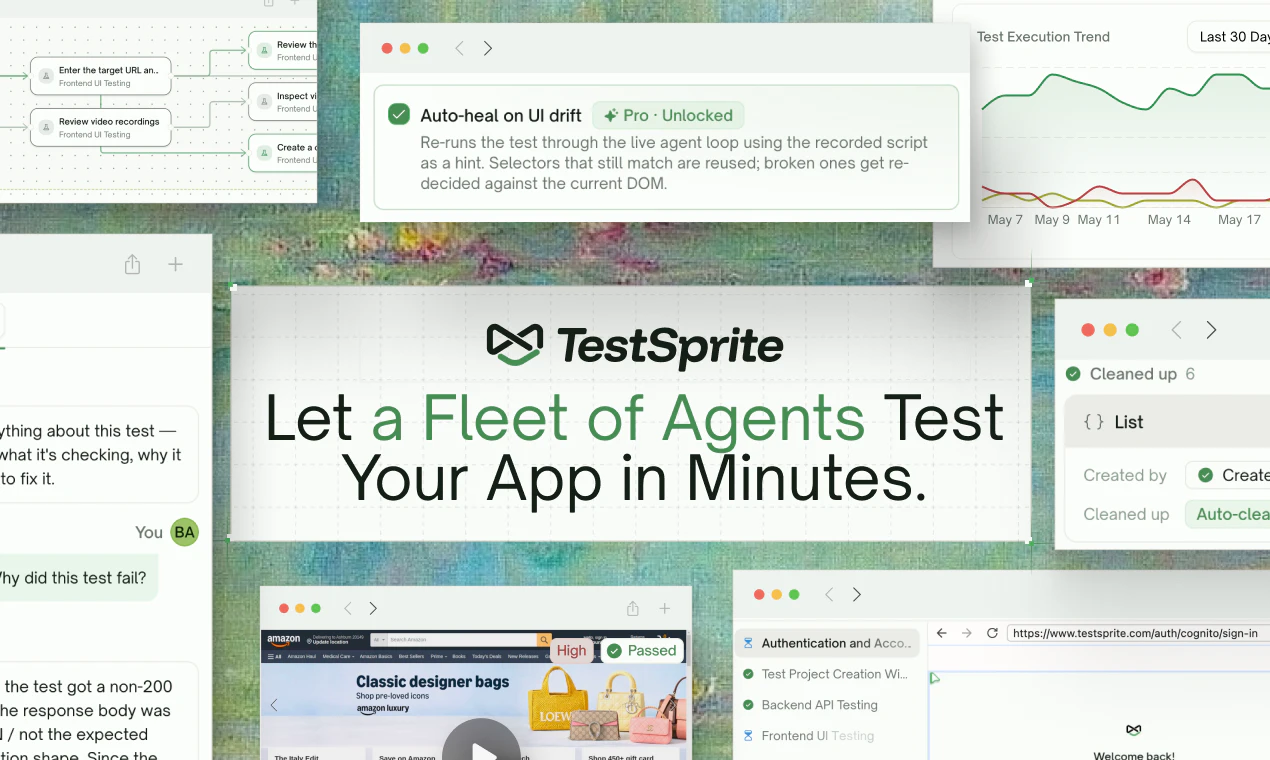
TestSprite generates and runs end-to-end tests for your app, autonomously. For backend, we can now generate complex integration tests with dynamic variables, auto-cleanup, and Data Flow debugging. For frontend, we now send a fleet of parallel AI agents to explore your app first — clicking through every feature like real users, then feeding results into testing. We're the first to do this. 3.0 also adds auto-heal for UI drift, auto-auth for regression, and a CLI for Claude Code, Codex users.
AI Analysis
TestSprite 3.0 is an autonomous SaaS platform that generates and runs end-to-end tests for frontend and backend applications. Core features include a fleet of parallel AI agents that explore apps like real users before testing, complex integration tests with dynamic variables, auto-cleanup, data flow debugging, auto-heal for UI drift, auto-auth for regressions, and CLI integration for Claude/CodeX users. It solves key pain points like time-consuming manual test creation, brittle tests prone to breakage, incomplete coverage, and maintenance overhead. The value proposition is delivering reliable, full-coverage testing in minutes, accelerating development while reducing QA effort. It is the first to deploy parallel agent exploration at this scale.
In 2025-2026, agentic AI and multimodal LLMs are reaching maturity, with strong industry trends toward AI-native dev tools (e.g. GitHub Copilot, Cursor). User demand for automated QA is rising as release cycles shorten and AI adoption grows. Economic pressures favor tools that cut engineering costs. Policy support for AI innovation is positive. This is an ideal window before the space becomes saturated. Excellent Timing.
Technical difficulty is medium-high due to ensuring AI agent reliability and accurate test generation, but version 3.0 demonstrates proven capabilities. Development and operation costs are manageable as a cloud SaaS leveraging existing LLMs, though inference expenses could be significant. Low supply chain or compliance risks for a dev tool. Strong scalability potential via parallel agents. Overall High feasibility for an experienced AI team. Rating: High.
Main segments: Software developers, QA engineers, and engineering leads at SaaS/web app companies; startups to mid-market enterprises. Industries: Software development, fintech, e-commerce. Geographic: Global with concentration in US, Europe. TAM for test automation software exceeds $12B (2025), AI-powered segment growing at 30%+ CAGR; SAM ~$2B, SOM ~$150M. Core pains: Manual testing consumes 40%+ of dev time, tests break with UI changes. High willingness to pay ($99–$499/mo) for time savings and reliability.
Medium. Direct competitors: 1. Mabl (mabl.com), 2. Testim (testim.io, now Tricentis), 3. Applitools (applitools.com), 4. Functionize (functionize.com), 5. Reflect (reflect.run). Advantages: First-mover with parallel AI agent fleet for true autonomous exploration, strong backend integration tests, auto-heal and CLI features. Disadvantages: Newer entrant may face trust issues vs established players; potentially higher per-test compute costs. Better differentiation in agent-based approach and full-stack coverage compared to visual/UI-focused rivals.
Upgrade Pro to unlock full AI analysis
Similar Products

Cohere Parse 5
Turn complex docs, tables & images into AI-ready data
▲ 158 votes

Adapt
The company brain that gets work done
▲ 124 votes

WikiFix for Confluence
Find and fix issues in your knowledge base
▲ 86 votes

Saldor
Speed up procurement and AP.
▲ 78 votes

Audryo
Customer email your agent can operate.
▲ 68 votes

Refoid
Automate App Store refund responses and track every outcome
▲ 68 votes