
Toone
Build complex, reliable AI agent workflows & routines
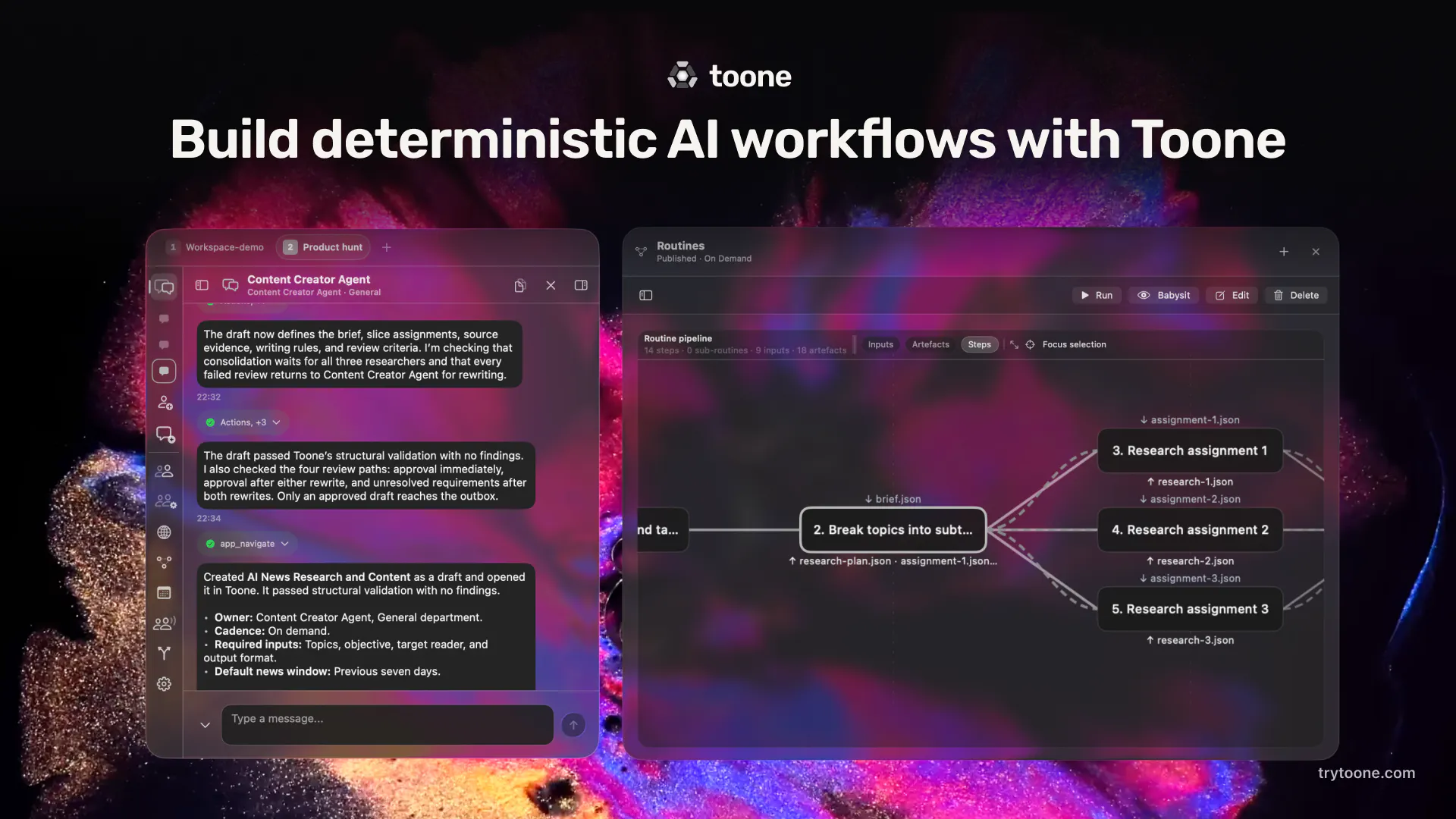
Build, run and debug long-running or complex workflows in natural language. Inspect and debug each step with the visibility and control production workflows need. Edit and resume where you stopped. OpenAI or Anthropic accounts needed Predictable and deterministic AI: Craft workflows and routines with the consistency and observability needed for production, with multimodality supported between steps. Tip: Use ChatGPT desktop for ++ awesomeness Start building your routines today at trytoone.com
AI Analysis
Toone is a tool for building, running, and debugging complex AI agent workflows and routines using natural language. Core features include step-by-step inspection, edit-and-resume capabilities, production-grade visibility/control, multimodality between steps, and support for OpenAI/Anthropic accounts. It solves key pain points of unpredictability, lack of observability, and brittleness in long-running AI processes by emphasizing deterministic, reliable outputs suitable for production. Unique selling points are its natural language interface combined with debugging tools akin to traditional software workflows. Overall value proposition: enables users to create consistent, inspectable AI automations efficiently, with tips for enhanced experience via ChatGPT desktop app.
The current market timing is favorable for 2025-2026. AI agent and workflow orchestration technologies are maturing rapidly, with rising industry trends toward production-grade, multi-modal, and reliable AI systems. User demands are shifting from experimental prompts to robust, debuggable routines as businesses scale AI adoption. Supportive policy environments for AI innovation and economic investment in productivity tools further boost this. Overall, it aligns well with the boom in agentic AI. Excellent Timing.
Overall feasibility is High. Technical difficulty is moderate since it builds on mature LLM APIs (OpenAI/Anthropic) rather than training new models; the main challenges lie in creating a reliable natural language-to-workflow engine and debugging UI. Development and operation costs are typical for SaaS AI tools with cloud scaling potential. Low supply chain risks, standard compliance for AI data handling. Strong scalability for user workflows. Best fit for teams with AI tooling and frontend experience. Key risks are ensuring determinism across multimodal steps.
Main target segments: AI developers, software engineers, automation specialists, and product teams in tech startups and enterprises (demographics: tech-savvy professionals aged 25-45). Industries: software development, AI services, digital automation. Geographic focus: primarily North America and Europe. Estimated TAM for AI dev and agent tools ~$10-15B, SAM for workflow platforms ~$2B, SOM for new entrants ~$100-200M. Core pain points: unreliable long-chain AI agents, poor visibility into failures, difficulty resuming interrupted tasks. High willingness to pay via subscriptions for tools improving reliability and dev productivity.
Medium. Direct competitors: 1. LangChain (langchain.com), 2. CrewAI (crewai.com), 3. AutoGen (microsoft.github.io/autogen), 4. Dify (dify.ai), 5. SmythOS (smythos.com). Toone's advantages include natural language workflow building, strong debugging/visibility/resume features, and focus on production determinism/multimodality. Disadvantages: dependency on external LLM accounts (no built-in models), potentially smaller ecosystem/community than LangChain, and being a newer entrant with less proven scale. Differentiation is solid in observability but faces pressure from more comprehensive frameworks.
Upgrade Pro to unlock full AI analysis
Similar Products

Auriko
Trading desk for LLM calls
▲ 332 votes

Cohere Parse 5
Turn complex docs, tables & images into AI-ready data
▲ 158 votes

Adapt
The company brain that gets work done
▲ 124 votes

Tapfree for Chrome
Voice dictation that adapts to what’s on your screen
▲ 122 votes

CodeBurn
See where your AI coding spend actually goes
▲ 101 votes

Kosshi
Simple, fast outliner for Mac and iPhone.
▲ 90 votes