
TraceLLM
OpenTelemetry for production AI applications
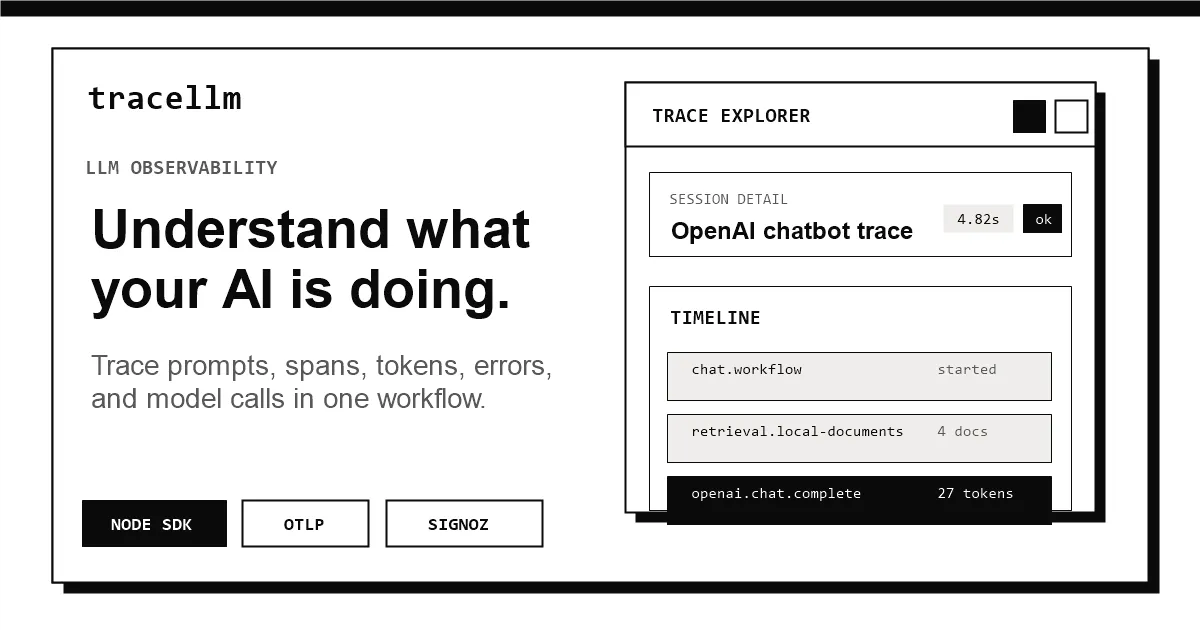
Tracellm is an observability platform for production AI applications. Monitor prompt execution, token consumption, latency, spans, errors, and model calls across your LLM workflows. Export traces using OpenTelemetry (OTLP) and quickly identify bottlenecks before they impact users
AI Analysis
TraceLLM is an observability platform for production AI applications, functioning as OpenTelemetry for LLMs. Core features include monitoring prompt execution, token consumption, latency, spans, errors, and model calls within LLM workflows, with OTLP trace exports for seamless integration. It addresses key pain points such as lack of visibility into AI operations, difficulty identifying performance bottlenecks, unexpected costs from token usage, and debugging complex LLM chains. The unique value proposition is delivering enterprise-grade observability to help developers optimize reliability, efficiency, and user experience in generative AI applications before issues impact production.
The market timing is highly favorable for 2025-2026. With explosive growth in production LLM deployments, industry trends emphasize cost control, reliability, and observability as AI moves beyond experimentation. Technology maturity of OpenTelemetry standards and LLM APIs enables easy adoption, while user demands shift toward production-grade tools amid rising AI spend. Supportive economic and policy environments for AI innovation further accelerate demand. Excellent Timing.
High. Technical difficulty is moderate by building on mature OpenTelemetry protocols and existing LLM SDKs, though maintaining compatibility across providers requires effort. Development and operation costs are manageable especially as an open-source project with potential SaaS upsell. Low supply chain and compliance risks (standard data privacy measures suffice). Excellent scalability in cloud environments and strong fit for developer-oriented teams. Key risks are ongoing updates for new LLM models.
Main target segments: AI/ML engineers, backend developers, and DevOps teams at AI startups, scale-ups, and enterprises building LLM applications. Demographics: Tech professionals aged 25-45. Industries: Software/SaaS, AI services, fintech, healthcare tech. Geographic: Primarily US and Europe, with growing Asia adoption. Estimated market: TAM ~$5B+ (AI observability/ops), SAM ~$800M (LLM-specific monitoring), SOM ~$80M (OTEL-focused tools). Core pain points: opaque costs, latency issues, and production debugging. High willingness to pay for tools reducing AI spend and downtime.
Medium. Direct competitors: 1. Langfuse (langfuse.com), 2. Helicone (helicone.ai), 3. LangSmith (smith.langchain.com), 4. Arize Phoenix (arize.com/phoenix), 5. OpenLLMetry by Traceloop (traceloop.com). Advantages: Native OpenTelemetry (OTLP) integration for existing monitoring stacks, focused on production spans/traces and bottleneck detection. Disadvantages: Smaller ecosystem/community than LangSmith; may offer fewer built-in AI evaluation or analytics features. Differentiation via standards compliance gives edge in enterprise environments already using OTEL, though pricing and advanced LLM insights could be competitive weaknesses.
Upgrade Pro to unlock full AI analysis
Similar Products

Auriko
Trading desk for LLM calls
▲ 332 votes
Xirp
The agentic development environment built by Spotify
▲ 224 votes

React UI Kit V7
All the chat components you need. None of the complexity
▲ 115 votes

Coarena by Coasty
The arena where agents battle on real-world work
▲ 104 votes

Replay QA Security Scan
Automated Penetration Testing for AI-Built Apps
▲ 102 votes

CodeBurn
See where your AI coding spend actually goes
▲ 101 votes