
transfa.sh
WeTransfer for AI agents
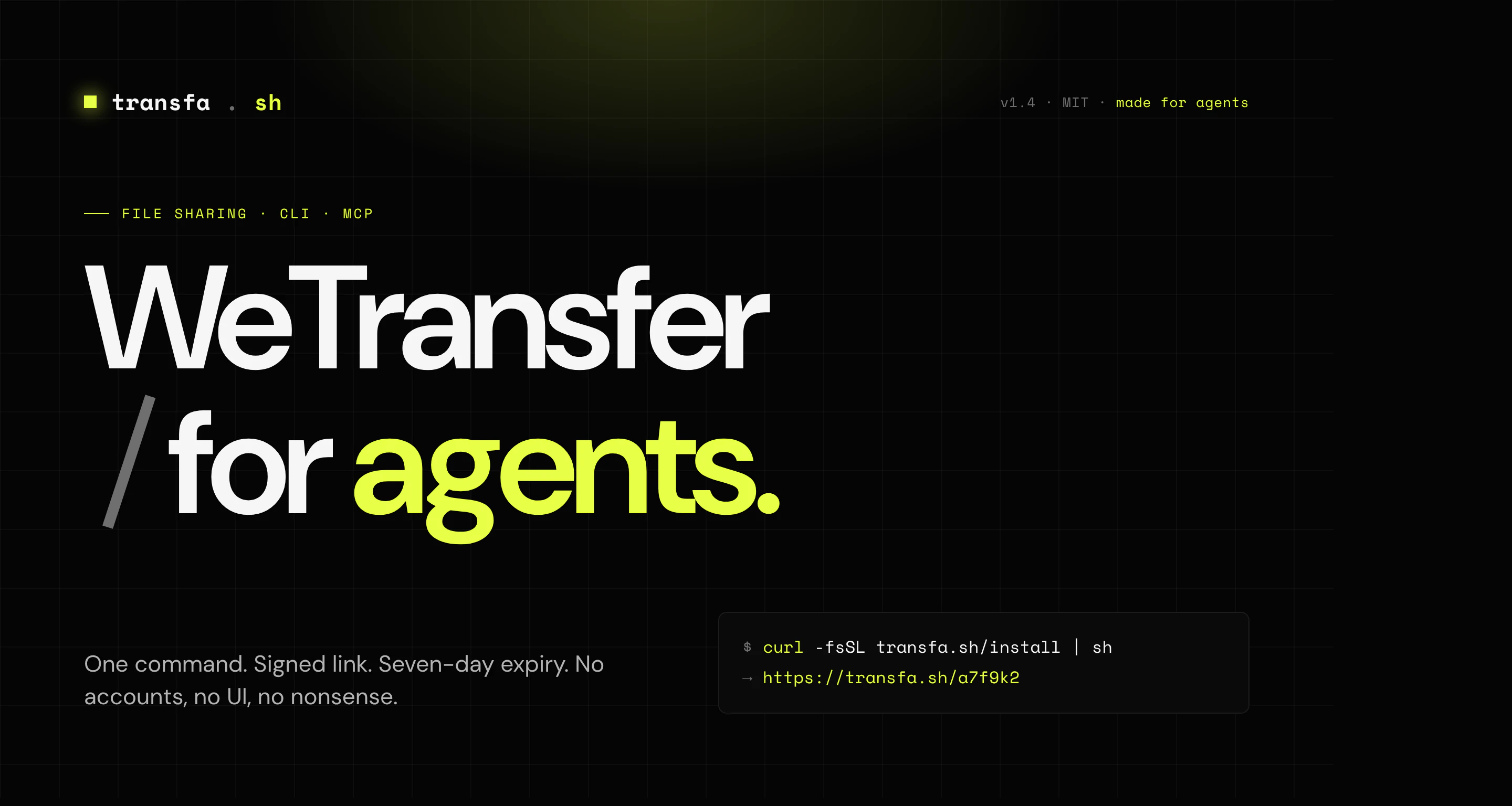
Most file sharing tools assume a human with a browser. Transfa assumes a process with an API budget and a deadline. tf upload model.pt returns a signed URL in seconds. No browser, no account required. Works out of the box with Claude, Cursor, and any MCP host. -MCP-native: drop-in server for any MCP host -JSON output for agent pipelines -Guest mode: upload without an account -Idempotent uploads: same file = same URL -Password-gated & one-time links -Free tier forever
AI Analysis
Transfa.sh is a file-sharing service designed for AI agents and automated processes, positioned as 'WeTransfer for AI agents'. Core features include API-driven uploads returning signed URLs in seconds (e.g. tf upload model.pt), MCP-native drop-in server for any MCP host, JSON output for pipelines, guest mode without accounts, idempotent uploads ensuring same file yields same URL, password-gated and one-time links, plus a forever free tier. It solves key pain points where traditional tools assume human browser users, unfit for AI workflows with API budgets and strict deadlines. Unique selling points are its agent-first design and seamless integration with tools like Claude and Cursor. Overall value proposition: frictionless, efficient file transfers enabling smoother AI agent pipelines and automation.
The current market timing is highly favorable. In 2025-2026, AI agent ecosystems are exploding with maturing technologies like advanced LLMs, MCP protocols, and autonomous workflows. Developer demand is shifting from human-centric tools to API-first, machine-native solutions amid rising automation needs. Economic investment in AI infrastructure remains strong despite broader market fluctuations, and open-source AI tools are thriving. This product directly capitalizes on these trends by filling a clear gap in agent tooling. Rating: Excellent Timing.
Overall feasibility is High. Technical difficulty is low-to-medium since it leverages standard signed URL mechanisms from cloud object storage (e.g. S3), with straightforward API and MCP integration. Development and operation costs are manageable via serverless architecture and open-source components that can attract community support. Scalability potential is strong with cloud backends. Supply chain and compliance risks are low (primarily data privacy for transient files). It fits well for small dev teams experienced in AI tooling. Main challenge is ensuring reliable uptime for agent deadlines.
Main target segments: AI/ML developers, automation engineers, and teams building agentic AI pipelines; heavy users of Claude, Cursor, and MCP-compatible hosts. Industries: Artificial Intelligence, software development, tech startups and research labs. Geographic distribution: Global with concentration in US, Europe, and China tech hubs. Estimated market size: AI developer tools TAM ~$15B+, SAM for AI infrastructure/file services ~$1B, SOM for this AI-specific file transfer niche ~$50-100M. Core pain points: Lack of file-sharing solutions optimized for non-interactive, API-driven AI processes. Potential willingness to pay: High for paid tiers offering higher limits, priority support, and advanced security as these tools become production-critical.
Competition level: Medium. Direct competitors: 1. transfer.sh (https://transfer.sh) - command-line temporary file sharing; 2. WeTransfer (https://wetransfer.com) - browser-focused easy transfers; 3. Wormhole (https://wormhole.app) - encrypted P2P file sharing; 4. File.io (https://www.file.io) - simple one-time file links; 5. Magic Wormhole (magic-wormhole.readthedocs.io) - secure CLI transfers. Advantages vs competitors: purpose-built for AI agents with native MCP integration, JSON pipeline support, idempotent uploads, and guest/API-first design; strong differentiation in the emerging agent ecosystem. Disadvantages: newer with less brand recognition, potentially more limited free-tier storage/bandwidth compared to established services, and relies on users adopting the AI-specific workflow.
Upgrade Pro to unlock full AI analysis
Similar Products

Cohere Parse 5
Turn complex docs, tables & images into AI-ready data
▲ 158 votes

Opaline
PostHog for team Claude Code and Codex sessions.
▲ 141 votes

Adapt
The company brain that gets work done
▲ 124 votes

Tapfree for Chrome
Voice dictation that adapts to what’s on your screen
▲ 122 votes

Replay QA Security Scan
Automated Penetration Testing for AI-Built Apps
▲ 102 votes

Refoid
Automate App Store refund responses and track every outcome
▲ 68 votes