Unsloth Desktop
Run and train AI models locally on your desktop
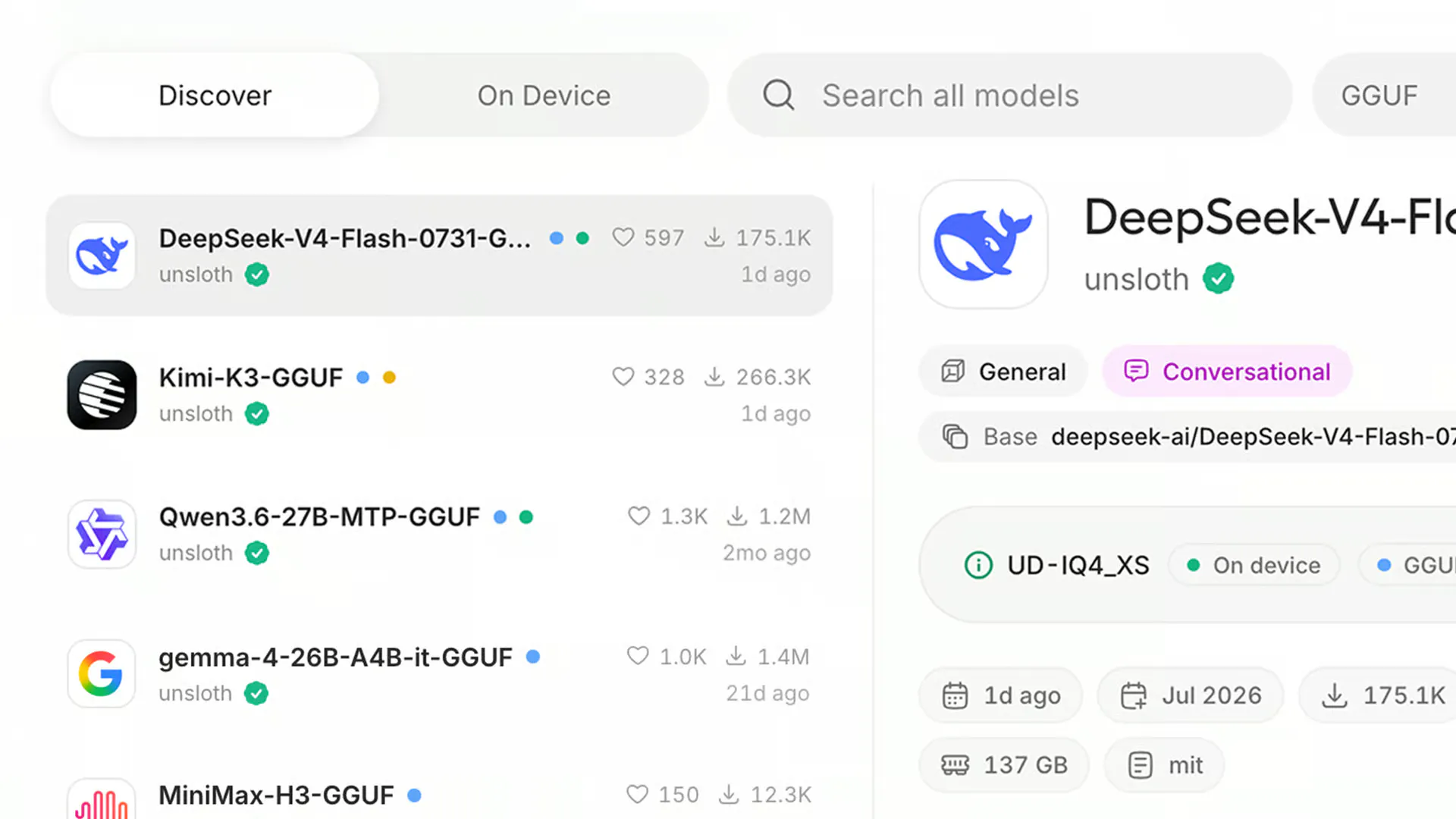
Unsloth Desktop is an open-source app to run and train AI models locally. Run LLMs, image/video diffusion, and audio. Connect agents like Claude Code or Codex to your local GPU with one command, and fine-tune models with no-code workflows.
AI Analysis
Unsloth Desktop is an open-source desktop app enabling users to run and train AI models locally on personal hardware. Core features include LLM inference, image/video diffusion, audio models, one-command agent connections (e.g. Claude to local GPU), and no-code fine-tuning workflows. USPs are full privacy, zero cloud costs, simplified multi-modal AI access, and efficient training optimizations. It solves pain points like expensive cloud APIs, data security risks, internet dependency, and coding barriers for customization. Value proposition: Empowers developers, researchers, and creators with accessible, private, and customizable local AI capabilities without infrastructure overhead.
For 2025-2026, market timing is highly favorable. Explosive growth in open-source models (Llama, Mistral), maturing consumer GPU tech, rising privacy regulations, and user shift away from costly cloud dependencies align perfectly. Economic pressures on AI compute and demand for on-device customization further support local solutions. Excellent Timing.
Overall feasibility is High. Technical challenges in cross-platform GPU optimization and multi-modal support exist but are mitigated by Unsloth's proven efficient training tech and mature frameworks like PyTorch. Dev/ops costs are moderate for open-source with community help. Minimal supply chain or compliance risks (software-only). Strong scalability via ecosystem growth. Key reasons: established AI tooling and hardware trends.
Primary segments: AI/ML developers, researchers, indie hackers, and tech enthusiasts (ages 25-45, tech professionals). Industries: Software dev, AI startups, academia. Geographic: North America, Europe, East Asia (high GPU penetration). TAM for local AI tools ~$5B+, SAM for desktop training apps ~$500M, SOM ~$30-50M. Core pains: cloud costs, privacy, setup complexity. High willingness to pay for pro features/support despite open-source base.
Competition level: Medium. Direct competitors: 1. Ollama (ollama.com), 2. LM Studio (lmstudio.ai), 3. GPT4All (gpt4all.io), 4. Pinokio (pinokio.computer), 5. oobabooga/text-generation-webui (github.com/oobabooga). Advantages: Unique no-code fine-tuning, multi-modal (image/video/audio) beyond text LLMs, seamless agent integration, and training efficiency. Disadvantages: Smaller user base than Ollama, higher hardware demands for training vs. inference-only tools, potentially less polished UI. Strong differentiation in training capabilities reduces pressure.
Upgrade Pro to unlock full AI analysis
Similar Products

Auriko
Trading desk for LLM calls
▲ 332 votes

Cohere Parse 5
Turn complex docs, tables & images into AI-ready data
▲ 158 votes

Opaline
PostHog for team Claude Code and Codex sessions.
▲ 141 votes

Adapt
The company brain that gets work done
▲ 124 votes

Tapfree for Chrome
Voice dictation that adapts to what’s on your screen
▲ 122 votes
CodeBurn
See where your AI coding spend actually goes
▲ 101 votes