VELA
Securely execute AI-generated & untrusted code
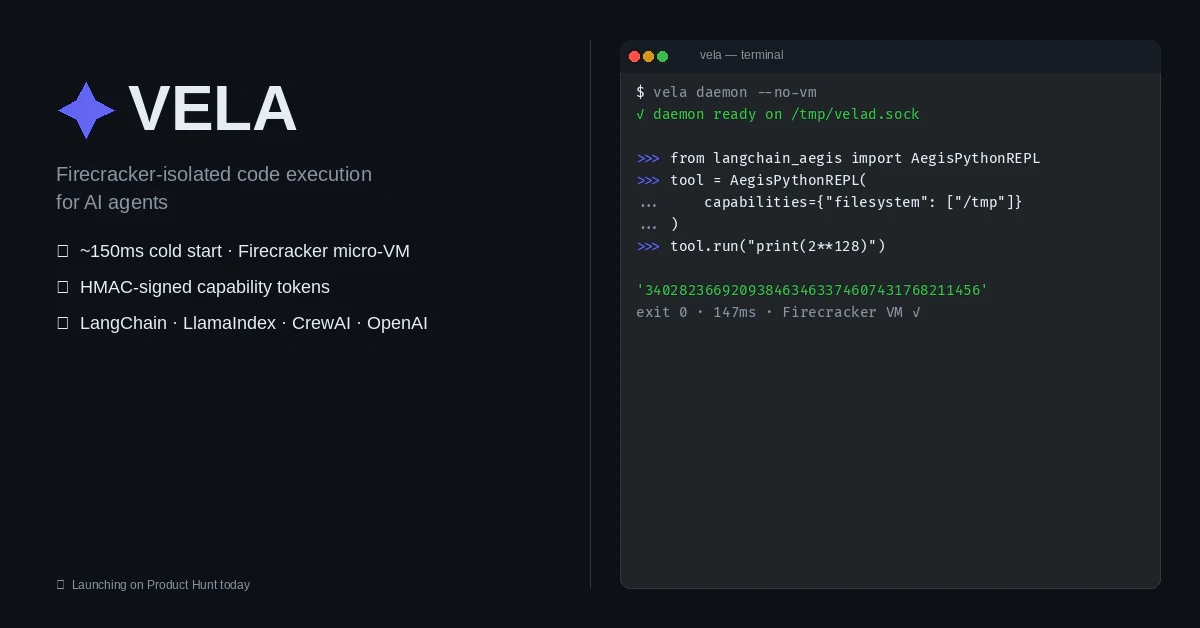
Autonomous AI agents are writing and executing code, but running it on your host server is a massive security risk. Vela (powered by the Aegis runtime) solves this. It’s a policy-driven execution guard that uses Firecracker micro-VMs and HMAC capability tokens to safely run untrusted code. Get structured results, fine-grained filesystem/network restrictions, and a full JSONL audit trail. Open-source, MIT licensed, and built for LangChain/LlamaIndex.
AI Analysis
VELA is a policy-driven execution guard powered by the Aegis runtime that securely executes AI-generated and untrusted code. It solves the major security risk of running autonomous AI agent code directly on host servers by leveraging Firecracker micro-VMs and HMAC capability tokens for strong isolation. Core features include structured outputs, fine-grained filesystem and network restrictions, and a complete JSONL audit trail for transparency. Open-source under MIT license and built specifically for LangChain and LlamaIndex integrations, its value proposition is enabling safe, auditable AI code execution without compromising the underlying system.
In 2025-2026, the explosion of autonomous AI agents and tools like LangChain drives urgent demand for secure code execution solutions amid rising AI security concerns. Firecracker micro-VM technology is mature, user needs for agent safety are intensifying, and regulatory focus on AI governance is increasing. This creates strong alignment for adoption. Excellent Timing.
Technical difficulty is moderate as it builds on mature Firecracker micro-VMs, though custom policy engines and HMAC tokens require security expertise. Development and operation costs are low for an open-source MIT project with no significant supply chain issues. Compliance risks depend on user environments, but scalability potential is high due to efficient micro-VM isolation. Overall High feasibility with strong technical foundations. High
Primary users are AI/ML developers and engineers building autonomous agents with LangChain/LlamaIndex, mainly in the software/tech industry and AI startups. Geographically focused on North America and Europe with global OSS adoption. The AI developer tools and security market is rapidly expanding with substantial demand. Core pain point is preventing breaches from untrusted AI code execution. High willingness to pay for enterprise support or premium features on top of the free OSS core.
Medium. Direct competitors: 1. E2B (e2b.dev) - secure sandboxes for AI agents; 2. Modal (modal.com) - isolated cloud execution; 3. Kata Containers (katacontainers.io) - lightweight VM security; 4. Google gVisor (github.com/google/gvisor). VELA advantages: deep LangChain/LlamaIndex integration, policy-driven HMAC tokens for fine-grained control, full JSONL audits, and fully open-source MIT license. Disadvantages: newer project may lack polished enterprise features, managed hosting, or extensive ecosystem compared to commercial platforms.
Upgrade Pro to unlock full AI analysis
Similar Products

Cohere Parse 5
Turn complex docs, tables & images into AI-ready data
▲ 158 votes

Adapt
The company brain that gets work done
▲ 124 votes

Tapfree for Chrome
Voice dictation that adapts to what’s on your screen
▲ 122 votes

React UI Kit V7
All the chat components you need. None of the complexity
▲ 115 votes

Replay QA Security Scan
Automated Penetration Testing for AI-Built Apps
▲ 102 votes
CodeBurn
See where your AI coding spend actually goes
▲ 101 votes