
Ventorah
run virtual wind tunnel aerodynamic analysis in your browser
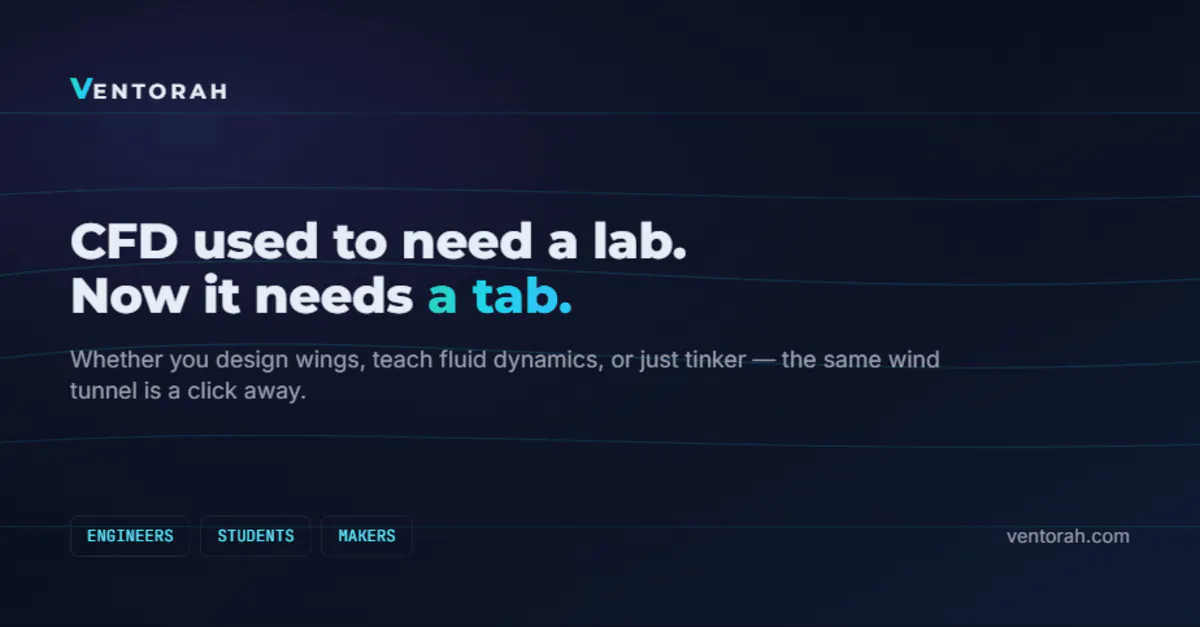
Upload a 3D model and run virtual wind tunnel aerodynamic analysis in your browser. Streamlines, pressure fields, lift & drag — Ventorah brings CFD to the cloud.
AI Analysis
Ventorah enables users to upload 3D models and run virtual wind tunnel CFD analysis directly in the browser. It delivers visualizations of streamlines, pressure fields, plus lift and drag calculations, bringing complex aerodynamics to the cloud. Key USPs include no-install accessibility, rapid prototyping support for drones and engineering, and intuitive cloud-based simulation. It solves major pain points like expensive licensed CFD software (e.g. ANSYS), steep learning curves, and need for high-end hardware, allowing faster design iteration. Value proposition: democratizes professional-grade aerodynamic analysis for engineers, designers, and makers.
Favorable in 2025-2026 due to mature cloud GPU infrastructure, WebGPU/browser compute advances, AI-accelerated simulation trends, and surging demand in drone, EV, and sustainable design sectors. Remote collaboration and digital prototyping needs are rising amid economic push for efficient R&D. Not saturated yet. Rating: Excellent Timing.
Medium. Technical challenges in accurate real-time CFD are mitigated by cloud backends and AI approximations (per AI tag), but compute costs for simulations remain high. Scalability is strong via cloud; low supply chain risk; compliance straightforward for SaaS. Requires solid devops for cost control and accuracy validation. Rating: Medium.
Primary segments: mechanical/aerospace engineers, drone developers & hobbyists, automotive/product designers, prototyping teams. Demographics: tech professionals aged 25-45. Geographic: mainly US, Europe, China (drone/tech hubs). TAM for global CFD market ~$3B (2025), SAM for cloud/browser aero tools ~$200-400M, SOM smaller for early stage. Core pains: simulation cost, setup time, hardware barriers. High willingness to pay via subscriptions for pros; freemium for individuals.
Medium. Direct competitors: 1. SimScale (simscale.com), 2. Autodesk CFD (autodesk.com/products/cfd), 3. ANSYS Discovery (ansys.com), 4. Cloud-based OpenFOAM platforms (e.g. cloud.openfoam.com). Advantages: pure browser UX for instant access, streamlined for aerodynamics visuals, potentially faster with AI. Disadvantages: likely less mature feature set, validation data, and accuracy vs established enterprise tools; newer so smaller ecosystem.
Upgrade Pro to unlock full AI analysis
Similar Products

Cohere Parse 5
Turn complex docs, tables & images into AI-ready data
▲ 158 votes

Opaline
PostHog for team Claude Code and Codex sessions.
▲ 141 votes

Adapt
The company brain that gets work done
▲ 124 votes

Tapfree for Chrome
Voice dictation that adapts to what’s on your screen
▲ 122 votes

CodeBurn
See where your AI coding spend actually goes
▲ 101 votes

WikiFix for Confluence
Find and fix issues in your knowledge base
▲ 86 votes