Viberia
Command AI agents like you're playing Civilization
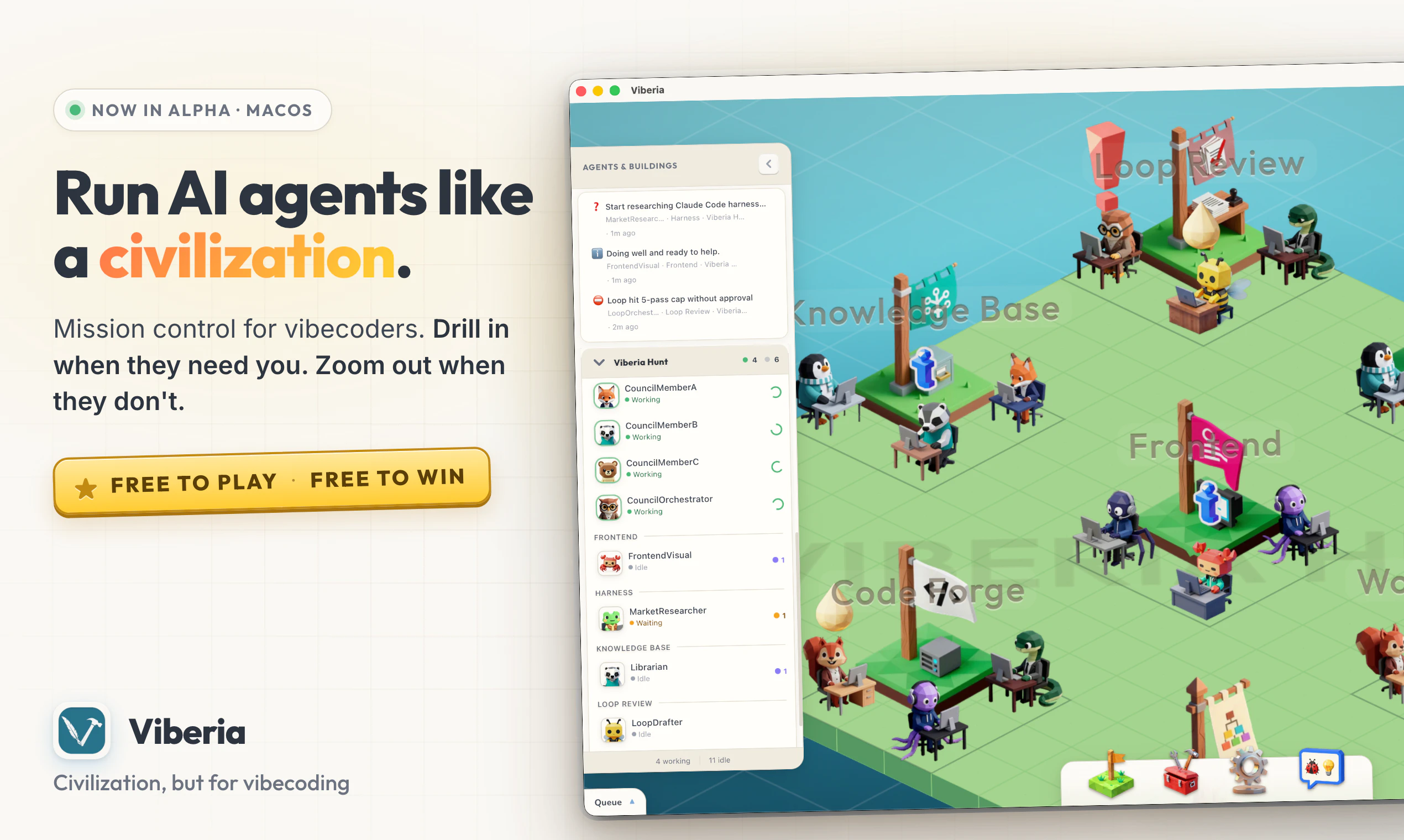
Do you like your Claude/Codex pet but wish you had a zoo? Viberia is a spatial command center for your AI agents. Your whole AI org lives on an isometric map, status icons show who’s blocked, who’s asking, who’s done. Zoom in to chat with anyone, pick any model, bring your own keys. Agents collaborate, build their own little teams, and pick up new skills as they go. Docs, terminals, browsers built in.
AI Analysis
Viberia is a spatial command center for managing AI agents on an isometric map inspired by Civilization. Key features include visual status icons for agents (blocked, asking, done), zoom-to-chat interaction, flexible model selection with bring-your-own keys, agent collaboration and team building, skill development over time, plus integrated docs, terminals, and browsers. It addresses the pain of chaotic, fragmented management of multiple AI tools like Claude by offering an intuitive, game-like overview and control hub. USP is transforming AI orchestration into a strategic, visual experience. Overall value: enables users to efficiently command a full 'zoo' of agents for complex tasks and higher productivity.
In 2025-2026, market timing is highly favorable. Multi-agent AI systems are rapidly maturing with advances from providers like Anthropic and OpenAI, user demand is shifting from single chatbots to orchestrated agent teams for productivity, and economic conditions favor AI tools that boost efficiency. No major regulatory hurdles specific to this concept. Excellent Timing.
Technical difficulty is significant for building a performant real-time isometric map, multi-model integration, and agent collaboration logic. Development and operation costs are medium-high due to complex UI, LLM API usage, and potential inference expenses. Low supply chain or compliance risks. Scalability is promising via cloud but depends on optimization. Overall Medium feasibility with strong potential if executed by an experienced AI/frontend team.
Main segments: Software developers, AI enthusiasts, indie hackers, and small AI/productivity teams (ages 25-45, tech-savvy). Industries: Software development and tech. Geographic: Global with concentration in US, Europe, and East Asia. TAM for AI productivity tools exceeds $20B, SAM for agent orchestration platforms ~$2-5B, SOM for visual/spatial interfaces ~$300-500M. Core pains: lack of visibility and coordination across multiple disparate AI instances. High willingness to pay ($20-99/mo) for time-saving professional tools.
Medium. Direct competitors: 1. CrewAI (crewai.com), 2. AutoGen (microsoft.github.io/autogen), 3. LangGraph by LangChain (langchain.com), 4. SmythOS (smythos.com), 5. MultiOn (multion.ai). Advantages: Highly differentiated fun, visual isometric Civilization-style interface for oversight and interaction; all-in-one built-in tools reduce context switching. Disadvantages: Less code-centric and customizable than framework competitors; newer product may lack ecosystem maturity and proven reliability at scale; potentially higher learning curve and compute costs.
Upgrade Pro to unlock full AI analysis
Similar Products

Cohere Parse 5
Turn complex docs, tables & images into AI-ready data
▲ 158 votes

Adapt
The company brain that gets work done
▲ 124 votes

Kosshi
Simple, fast outliner for Mac and iPhone.
▲ 90 votes

WikiFix for Confluence
Find and fix issues in your knowledge base
▲ 86 votes

Audryo
Customer email your agent can operate.
▲ 68 votes

Refoid
Automate App Store refund responses and track every outcome
▲ 68 votes