
Visual Usability Checker
Validate your design decisions instantly with AI insights
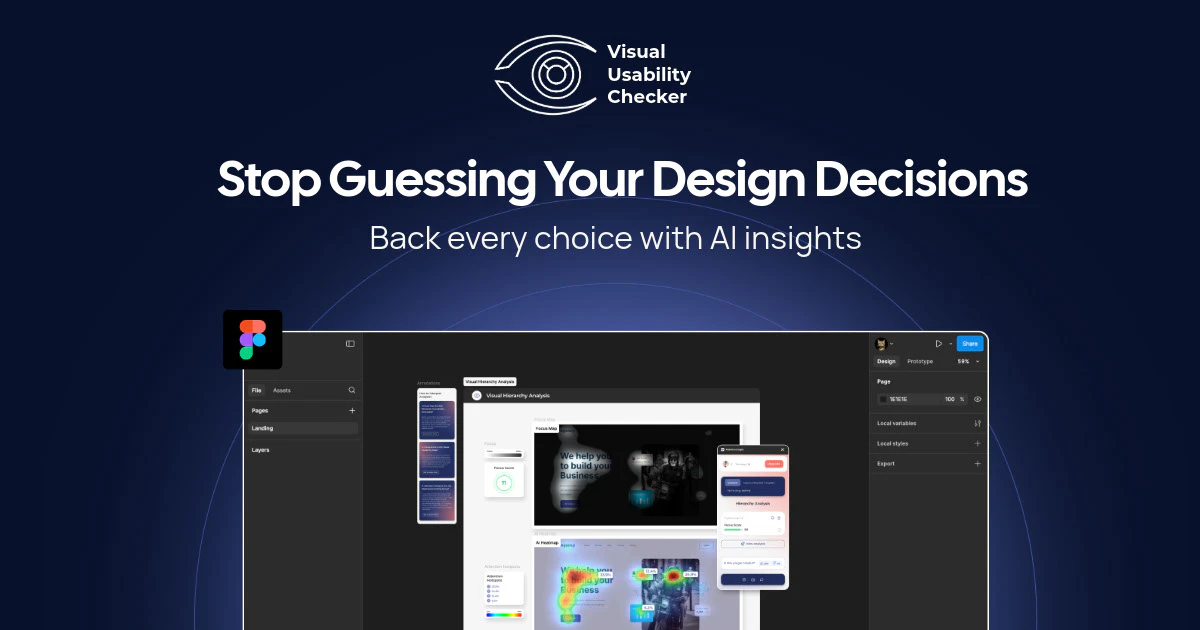
Get instant AI recommendations to improve your design. Detect cognitive load, see where users focus, catch issues early, and compare variations - so you can confidently make and defend design decisions with data-backed insights.
AI Analysis
Visual Usability Checker is an AI-powered design tool that delivers instant recommendations to improve UI/UX. Core features include cognitive load detection, user focus prediction, early issue identification, and design variation comparison. It solves key pain points such as time-consuming traditional user testing, lack of objective data for decisions, and challenges in defending designs to stakeholders. The value proposition is enabling designers to validate choices quickly with data-backed AI insights, reducing risk and accelerating confident iterations.
In 2025-2026, AI vision models have reached sufficient maturity for reliable design analysis, while UX teams face pressure for faster, data-driven decisions amid digital product proliferation. User demand for AI productivity tools in creative fields is surging, supported by favorable economic focus on efficiency. This aligns perfectly with industry trends. Excellent Timing.
High. Technical difficulty is manageable using current computer vision and multimodal AI models for image analysis. Development and cloud inference costs are moderate for a SaaS product with good scalability. Minimal supply chain or compliance risks. Key reasons: leverages existing AI tech; main challenge is curating quality training data for accurate cognitive predictions, but overall feasible for an experienced AI team.
Primary segments: UX/UI and product designers, design agencies, and PMs in tech firms (ages 25-45). Industries: software, digital agencies, e-commerce. Geographic focus: North America, Europe. TAM for design/UX tools is multi-billion with AI subset growing rapidly; SAM/SOM targeted at AI validation tools in mid-market. Core pains: costly slow user research and subjective decisions. High willingness to pay for time-saving, integrable tools (~$20-100/mo).
Medium. Direct competitors: 1. Attention Insight (attentioninsight.com), 2. EyeQuant (eyequant.com), 3. Maze (maze.co), 4. UsabilityHub (usabilityhub.com), 5. Optimal Workshop (optimalworkshop.com). Advantages: unique cognitive load focus plus instant recommendations and variation testing. Disadvantages: newer entrant may lack established trust, ecosystem integrations (e.g. Figma), and proven large-scale accuracy compared to veterans. Differentiation is solid but faces pressure from broader design platforms adding AI.
Upgrade Pro to unlock full AI analysis
Similar Products

Cohere Parse 5
Turn complex docs, tables & images into AI-ready data
▲ 158 votes

Opaline
PostHog for team Claude Code and Codex sessions.
▲ 141 votes

Adapt
The company brain that gets work done
▲ 124 votes

Tapfree for Chrome
Voice dictation that adapts to what’s on your screen
▲ 122 votes

React UI Kit V7
All the chat components you need. None of the complexity
▲ 115 votes

WikiFix for Confluence
Find and fix issues in your knowledge base
▲ 86 votes