
Voice Memo
Open-source voice notes that file your tasks and reminders
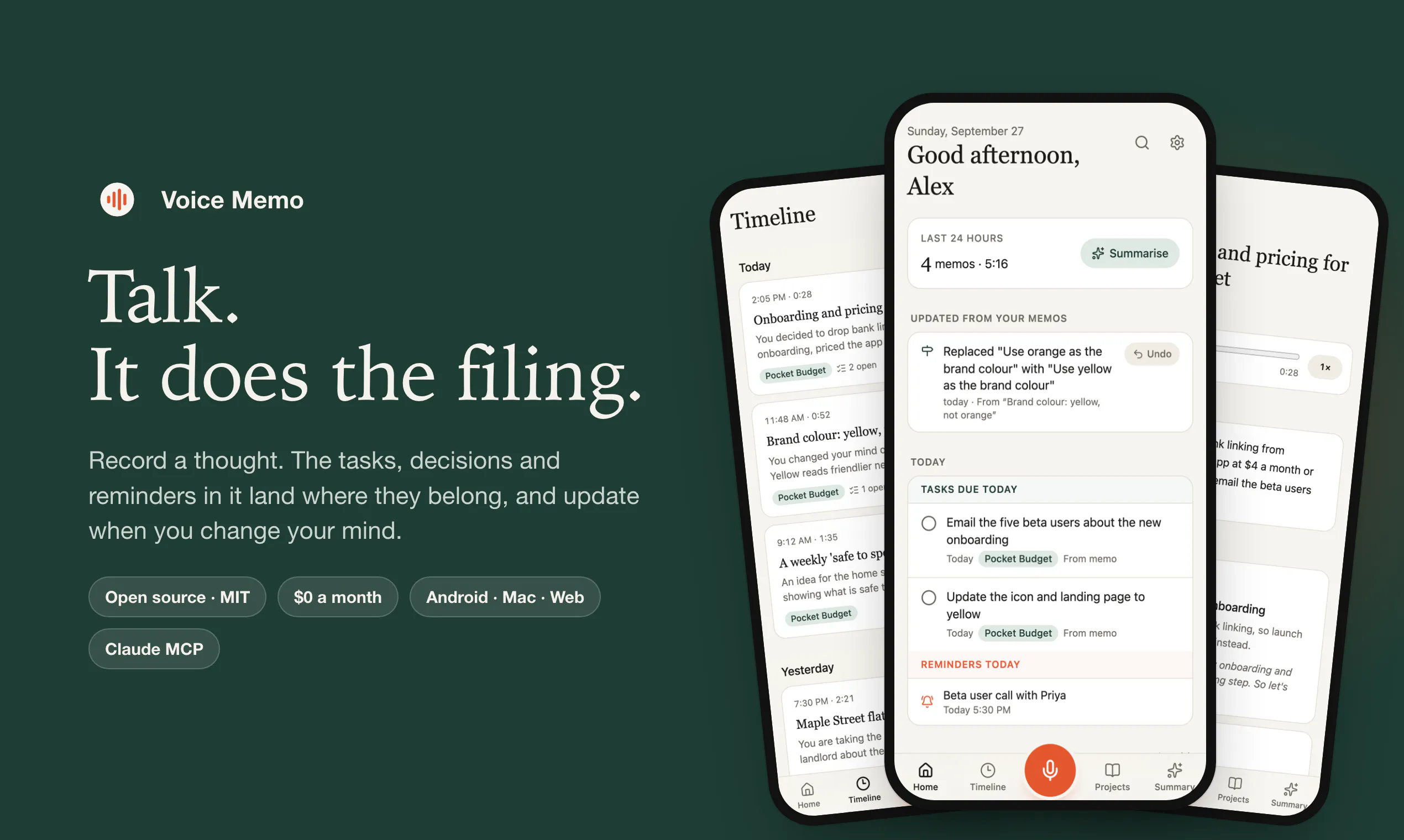
You think of things while walking or driving, record a voice note, and never play it again. Voice Memo does the listening. It pulls out the tasks, decisions, questions and reminders, files them into the right project, and updates the old ones when you change your mind. Reminders ring like an alarm, and Claude can answer questions about your notes. Open source and MIT. You run your own copy on Cloudflare's free tier, so it costs $0 a month and your notes are stored in your own account.
AI Analysis
Voice Memo is an open-source AI tool that converts casual voice notes into structured tasks, decisions, questions, and reminders. Users record thoughts during walks or drives; AI (powered by Claude) transcribes, extracts actionable items, organizes them into projects, updates prior entries when thoughts change, sets alarm-like reminders, and allows natural Q&A about the notes. It solves the core pain of voice memos being recorded but never revisited or actioned, by automating organization and follow-through. Key USPs include full self-hosting on Cloudflare's free tier (zero monthly cost), personal data ownership in user's own account, and MIT license. Value proposition: privacy-focused, cost-free AI that turns fleeting thoughts into managed productivity.
Favorable in 2025-2026 as LLMs like Claude reach high maturity for nuanced understanding of casual speech, while voice AI interfaces explode in popularity. User demands shift toward frictionless, always-on personal productivity aids amid information overload. Economic environment favors zero-cost open-source tools; privacy regulations boost self-hosted solutions. AI integration in daily workflows is mainstream. Excellent Timing.
High. The product is fully built and MIT open-sourced, with low technical barriers using mature speech-to-text and Claude APIs. Development/operation costs are minimal via Cloudflare free tier. No significant supply chain or compliance risks for self-hosted use; users manage their own data. Scalability is strong for personal and small-team use, though API costs could rise with heavy usage. Team fit is ideal for indie developers. High.
Primary segments: Tech-savvy knowledge workers, developers, entrepreneurs, and professionals (ages 25-45) who generate ideas while commuting or multitasking. Industries: Software, consulting, creative. Geographic: Global, concentrated in US/Europe (English-first). TAM for AI productivity ~$50B+, SAM for voice-to-task tools ~$2B, SOM for open-source self-hosted ~$100M+. Core pains: Forgotten voice notes and lack of actionable follow-up. Willingness to pay: Low-to-medium; core users value free/self-hosted but may pay for premium hosted ease or advanced features.
Medium. Direct competitors: 1. Mem (mem.ai) - AI memory/notes with capture. 2. Otter.ai (otter.ai) - Voice transcription and task extraction. 3. Notion AI (notion.so) - Voice notes integrated with tasks. 4. Reflect (reflect.app) - AI journaling with reminders. 5. Limitless (limitless.ai) - AI wearable for voice capture. Advantages: True open-source/self-hosted zero-cost model, dynamic project filing and 'change your mind' updates, strong privacy. Disadvantages: Requires technical setup, potentially less seamless UX than polished SaaS, dependency on external AI APIs.
Upgrade Pro to unlock full AI analysis
Similar Products

Cohere Parse 5
Turn complex docs, tables & images into AI-ready data
▲ 158 votes

Opaline
PostHog for team Claude Code and Codex sessions.
▲ 141 votes

Adapt
The company brain that gets work done
▲ 124 votes

Kosshi
Simple, fast outliner for Mac and iPhone.
▲ 90 votes

Thoughts for Mac
Capture notes from your menubar using text, images or voice
▲ 90 votes

Refoid
Automate App Store refund responses and track every outcome
▲ 68 votes