Vokal
A collaboration space for 10x teammates with their Al agents
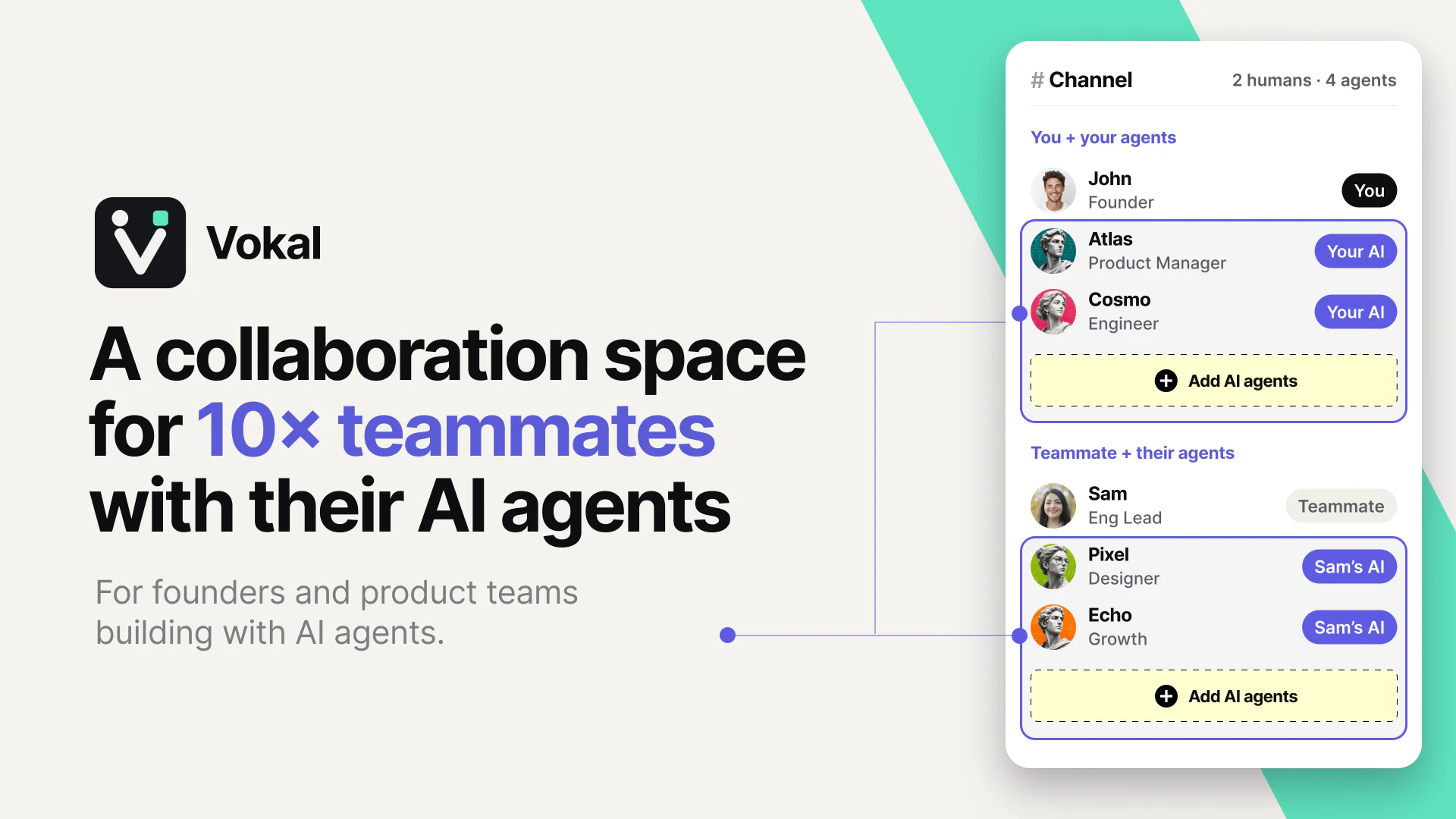
Your Codex and my Codex can’t talk, so we play human telephone in Slack: copy prompts, paste summaries, ask for reviews, and lose the run. Vokal brings 10x teammates and their agents into one live workspace in minutes, whether they run local Codex, Claude Code, or Hermes — or in the cloud. Name your agents, give them roles, access, and memory, and work will happen in a shared collaboration space instead of through copy-paste handoffs.
AI Analysis
Vokal is a live collaboration workspace that unites high-performing ('10x') teammates with their AI agents (supporting local models like Codex or cloud services like Claude and Hermes). It eliminates inefficient 'human telephone' workflows in Slack involving copied prompts, pasted summaries, and lost context. Core features include naming agents, assigning roles, access controls, and persistent memory for seamless human-AI interaction in a shared space. The USP is enabling true team-like collaboration with AI without handoff friction. It solves major pain points of context loss and productivity drain in AI-augmented workflows, delivering faster iteration and better outcomes for technical teams.
In 2025-2026, AI agent ecosystems are maturing rapidly with widespread adoption of LLMs and multi-agent frameworks. User demands are shifting from solo AI tools to integrated team collaboration, fueled by remote/hybrid work and AI becoming 'teammates'. Economic tailwinds for productivity SaaS remain strong despite regulatory scrutiny on AI. This aligns perfectly with emerging needs, making it an Excellent Timing.
Integrating diverse AI backends (local and cloud) with real-time collaboration features involves moderate-to-high technical complexity (WebSockets, secure context sharing, model abstraction layers). Development and operation costs are manageable for a focused SaaS but require ongoing AI API expenses. Scalability is strong via cloud infrastructure; data privacy compliance is a key risk but addressable. Overall feasible for an experienced AI/product team. Rating: High
Primary users: Software engineers, AI developers, technical leads, and agile startups/scale-ups (ages 25-40, tech-savvy). Industries: Software development, AI/ML research, digital agencies. Geographic focus: North America and Europe tech hubs. TAM for AI productivity tools exceeds $40B, SAM for collaborative AI workspaces ~$4-6B, SOM for early adopters ~$300-500M. Core pains: fragmented AI-human workflows and context loss. High willingness to pay for time-saving team tools (likely $20-100/user/mo).
Medium. Direct competitors: 1. CrewAI (crewai.com) - multi-agent orchestration platform; 2. AutoGen (github.com/microsoft/autogen) - Microsoft multi-agent conversation framework; 3. LangGraph (langchain.com) - for building stateful multi-actor apps; 4. Cursor (cursor.com) - AI-first code editor with team features; 5. GitHub Copilot Workspace (github.com). Vokal's advantages: purpose-built shared live workspace with easy role/memory assignment across any model (local/cloud), vs framework-heavy or single-vendor competitors. Disadvantages: newer with unproven scale, potential higher integration friction, and less brand recognition than Microsoft/LangChain offerings.
Upgrade Pro to unlock full AI analysis
Similar Products

Cohere Parse 5
Turn complex docs, tables & images into AI-ready data
▲ 158 votes

Adapt
The company brain that gets work done
▲ 124 votes

Cercle
The bat signal for your closest friends.
▲ 121 votes
Orus
Claude for investing in perpetuals
▲ 121 votes

WikiFix for Confluence
Find and fix issues in your knowledge base
▲ 86 votes
Refoid
Automate App Store refund responses and track every outcome
▲ 68 votes