
Wandesk
Build Your Own AI Desktop
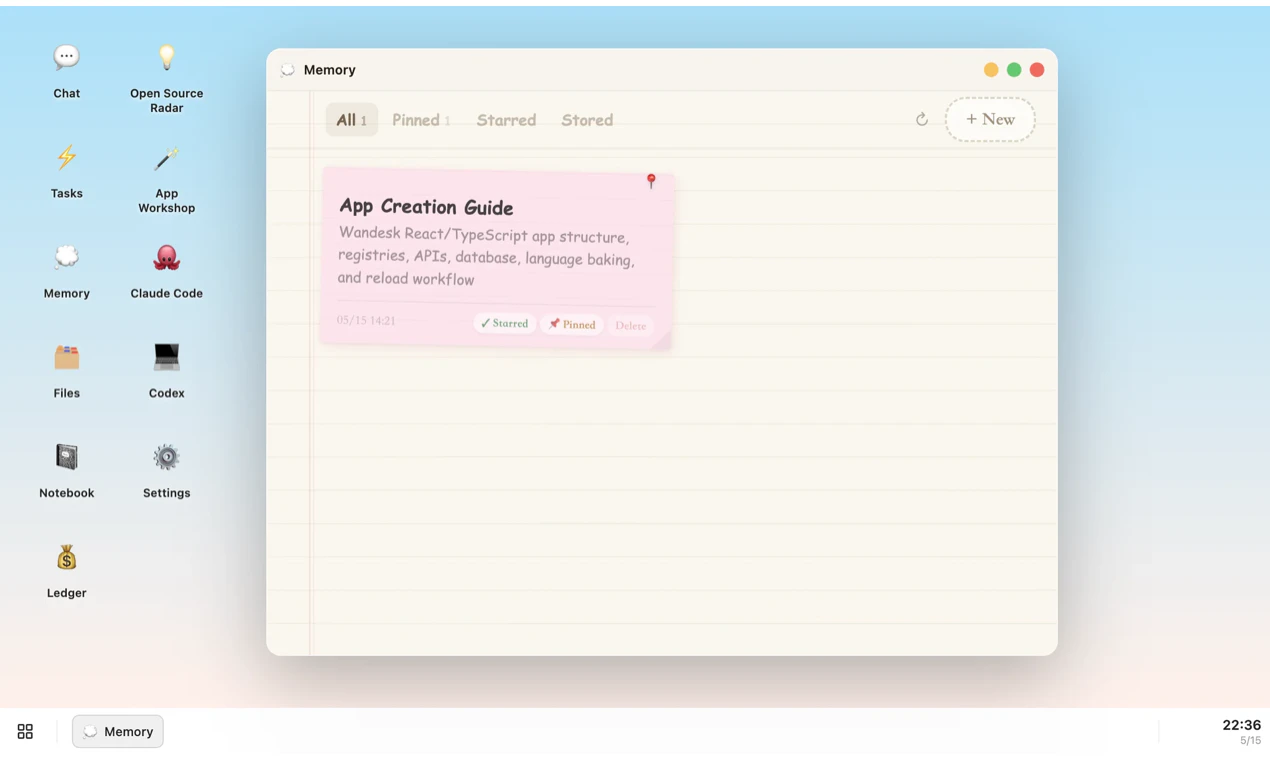
Wandesk is an AI desktop. Build the apps you need just by describing them. Plug in Claude Code, Codex, DeepSeek, OpenAI, Kimi, Qwen — anything OpenAI-compatible. Apps share context. AI remembers you. All local. No signup.
AI Analysis
Wandesk is an open-source AI desktop environment that lets users build custom apps simply by describing them in natural language. It integrates with any OpenAI-compatible models including Claude, DeepSeek, OpenAI, Kimi, and Qwen. Core features include seamless context sharing across apps, personalized AI memory, fully local processing for privacy, and zero signup. It solves key pain points like the high barrier of traditional app development, lack of personalization and continuity in AI tools, and cloud-based privacy risks. The value proposition is empowering anyone to create tailored productivity solutions quickly, enhancing efficiency while ensuring complete data control and sovereignty.
In 2025-2026, timing is highly favorable with maturing local LLM technology (e.g. efficient inference engines), surging demand for privacy-first and personalized AI tools, and industry shift toward AI agents and no-code creation. Growing concerns over cloud data usage and economic incentives for local computing align perfectly. Excellent Timing.
High feasibility overall. Technical difficulty is mitigated by using established OpenAI-compatible APIs and local runtimes; development/operation costs are low as an open-source project. Limited supply chain or compliance risks beyond model licensing. Excellent scalability via community contributions and app ecosystem. Main challenge is reliable interpretation of natural language into functional desktop apps. High.
Main segments: tech-savvy developers, AI enthusiasts, productivity power users (ages 25-45, predominantly in software/IT and creative industries). Geographically global with strong adoption expected in US, China, and Europe. TAM for AI productivity tools exceeds $100B, SAM for local/no-code desktop AI approx. $5-10B, SOM for open-source niche ~$500M-$1B. Core pain points: slow custom tool creation, fragmented AI experiences, and privacy concerns. High willingness to pay for premium models, support, or enterprise features despite core offering being free.
Medium. Direct competitors: 1. Open Interpreter (openinterpreter.com) - natural language code execution, 2. Cursor (cursor.com) - AI-powered code editor, 3. Aider (aider.chat) - terminal-based AI coding, 4. Replit Agent (replit.com) - AI app builder, 5. v0 by Vercel (v0.dev) - AI UI generation. Advantages: fully local/desktop-centric, multi-model flexibility, shared context and memory across apps, no signup/privacy focus. Disadvantages: potentially less mature UI/polish than commercial tools, accuracy depends heavily on underlying model quality, smaller ecosystem as a newer open-source entrant.
Upgrade Pro to unlock full AI analysis
Similar Products

Cohere Parse 5
Turn complex docs, tables & images into AI-ready data
▲ 158 votes

Opaline
PostHog for team Claude Code and Codex sessions.
▲ 141 votes

Adapt
The company brain that gets work done
▲ 124 votes

Kosshi
Simple, fast outliner for Mac and iPhone.
▲ 90 votes

WikiFix for Confluence
Find and fix issues in your knowledge base
▲ 86 votes

Refoid
Automate App Store refund responses and track every outcome
▲ 68 votes