
WebBrain
The sidebar agent for the rest of us
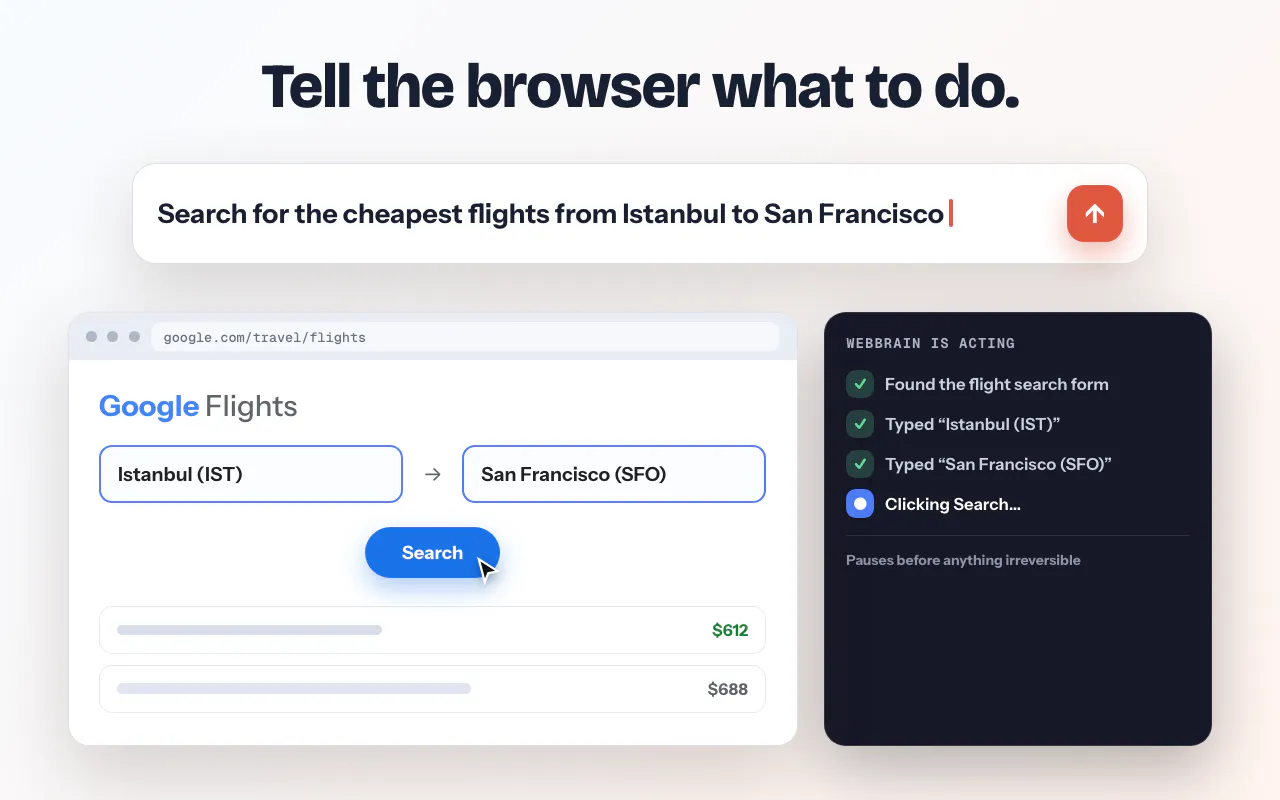
Your browser, your models, your data. WebBrain is a free, open-source AI browser agent for Chromium browsers and Firefox. Run it locally with llama.cpp and most queries cost nothing — your data never leaves your device. It reads pages, extracts data, and automates tasks right from the sidebar. Prefer the cloud? Bring your own API key for OpenAI, Claude, OpenRouter, or 100+ OpenAI-compatible providers. Multilingual UI, token-conscious screenshots. MIT licensed.
AI Analysis
WebBrain is a free, open-source AI browser agent functioning as a sidebar in Chromium browsers and Firefox. It enables local execution via llama.cpp for zero-cost queries with full data privacy (nothing leaves the device), alongside options to use personal API keys for OpenAI, Claude, OpenRouter and 100+ providers. Core features include reading web pages, extracting data, automating tasks, multilingual UI, and token-efficient screenshots. It solves key user pain points like data privacy risks, high cloud AI costs, and lack of customizable browser AI. USP: user-controlled models and data with MIT licensing. Value proposition: accessible personal AI agent for everyday productivity without vendor lock-in.
In 2025-2026, on-device AI and local LLM inference are maturing rapidly with tools like llama.cpp, aligning with rising user demands for privacy and cost control amid stricter data regulations (e.g., GDPR expansions) and economic pressures on API usage. Browser-based AI adoption is accelerating, making local-first agents highly relevant. This is an Excellent Timing as cloud fatigue grows and hardware supports efficient local runs.
High feasibility. Technical difficulty is manageable using mature llama.cpp and standard browser extension APIs; development and operation costs are low as it's open-source and primarily local (minimal server needs). Low supply chain/compliance risks due to privacy-by-design and MIT license. Strong scalability via community contributions and cross-browser support, though hardware variability for local models is a minor consideration. Overall well-suited for broad adoption.
Main target segments: tech-savvy individuals, developers, AI enthusiasts, and privacy-focused professionals (ages 25-45) in software, research, and content creation industries. Geographically distributed globally with high adoption in North America, Europe, and Asia among open-source users. Core pain points: compromised data privacy in cloud AI, unpredictable costs, and inefficient manual web tasks. The AI browser extension and local AI tool market has strong demand; users show high willingness to pay for enhanced cloud options via their own keys while core product remains free.
Medium. Direct competitors: 1. Monica (monica.im) - AI web assistant extension; 2. Merlin AI (merlin.foyer.work) - productivity browser AI; 3. Sider (sider.ai) - sidebar AI copilot; 4. WebPilot (webpilot.ai) - web agent extension; 5. AIPRM for ChatGPT (aiprm.com) - prompt-focused Chrome extension. Advantages: true local-first with llama.cpp (superior privacy, zero cost for basic use), fully open-source. Disadvantages: potentially slower local inference vs cloud competitors, requires user hardware for optimal performance. Strong differentiation in data control and no-vendor lock-in reduces competitive pressure.
Upgrade Pro to unlock full AI analysis
Similar Products

Auriko
Trading desk for LLM calls
▲ 332 votes

Cohere Parse 5
Turn complex docs, tables & images into AI-ready data
▲ 158 votes

Opaline
PostHog for team Claude Code and Codex sessions.
▲ 141 votes

Adapt
The company brain that gets work done
▲ 124 votes

Tapfree for Chrome
Voice dictation that adapts to what’s on your screen
▲ 122 votes

CodeBurn
See where your AI coding spend actually goes
▲ 101 votes