
Wilson
AI coworker in Slack that builds reports, work tools, + more
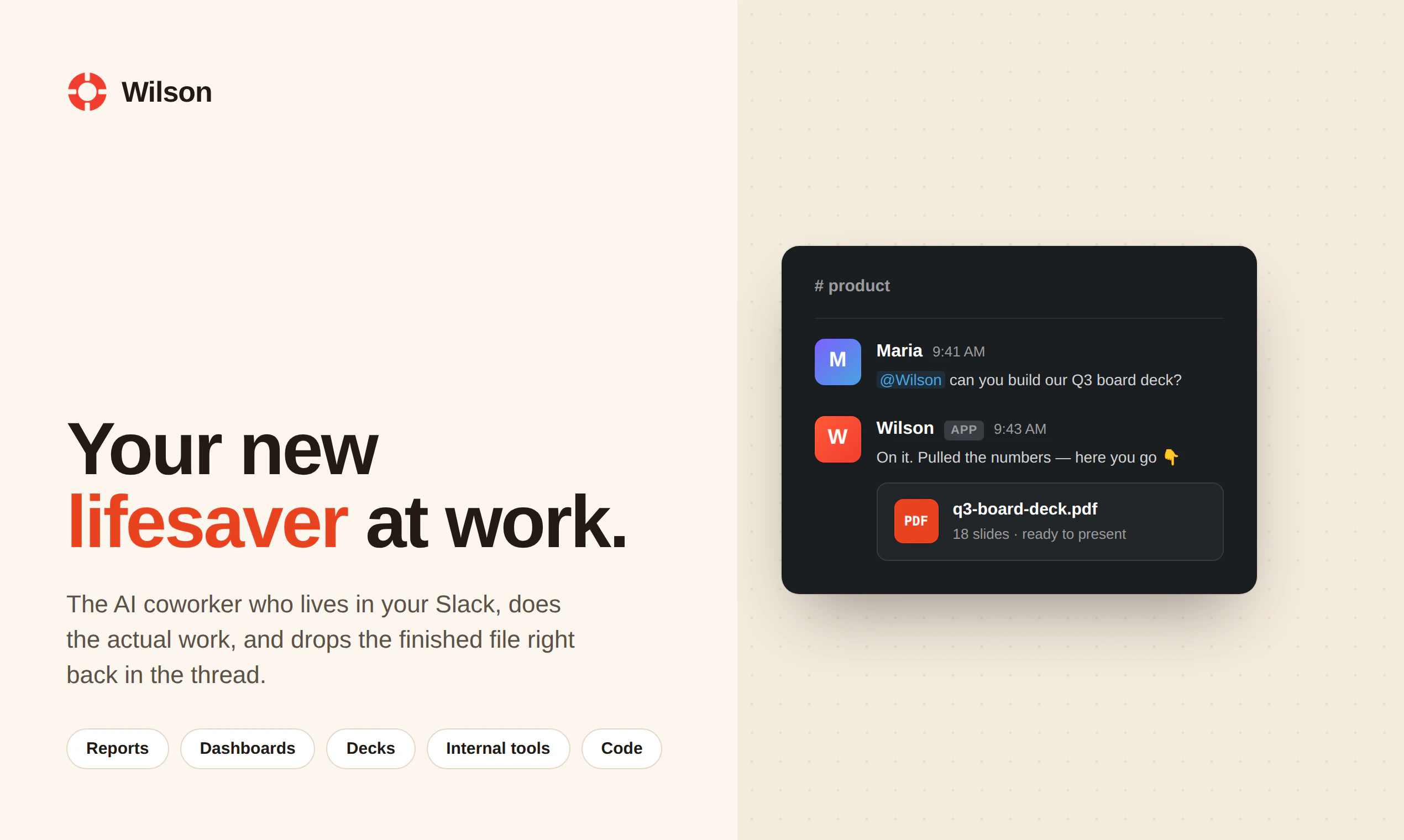
Wilson is the AI coworker who lives in your Slack and does the actual work, not advice, finished files. Ask in a thread and he builds the report, dashboard, deck, internal tool, or code, then drops it right back in the chat. He connects to your real everyday tools (Stripe, HubSpot, GitHub, Meta & Google Ads…), pulls the real numbers himself, asks before anything risky, and never trains on your data. Named after a certain volleyball. Far more useful. 🛟
AI Analysis
Wilson is an AI coworker integrated into Slack that executes real tasks by building reports, dashboards, decks, internal tools, or code from thread requests. It connects directly to tools like Stripe, HubSpot, GitHub, and Meta/Google Ads to pull live data, delivers finished files in-chat, confirms risky actions, and never trains on user data. Unlike advisory AI, it focuses on actionable outputs. It solves key pain points of time-consuming manual data aggregation, reporting, and tool creation for busy teams, delivering immediate productivity gains and reducing context-switching in communication platforms.
In 2025-2026, agentic AI and LLM capabilities have matured sufficiently to support complex, multi-tool task execution while workplace adoption of Slack-based workflows continues to grow. User demand is shifting from chat-based advice to autonomous AI coworkers that deliver finished work amid pressure for efficiency gains. Economic environments favor productivity tools that reduce headcount needs for routine tasks. Excellent Timing.
Medium. Technical challenges include reliable multi-step AI reasoning for varied outputs (code, decks, dashboards), secure API integrations across many tools, and minimizing hallucinations in business contexts. LLM inference and integration maintenance costs are high. Privacy-by-design helps with compliance, but scalability depends on usage-based pricing control. No supply chain issues; suitable for experienced AI dev teams with good potential to scale as SaaS.
Primary segments: Product managers, marketers, analysts, and founders in tech startups and SMBs (10-200 employees) heavily using Slack. Industries: SaaS, e-commerce, digital marketing agencies. Geographic focus: US and English-speaking markets. TAM for AI-driven productivity and automation tools is large and expanding rapidly; SAM for Slack-integrated AI estimated in hundreds of millions annually. Core pains: hours lost to manual reporting and data wrangling. Strong willingness to pay for proven time-saving tools via subscription.
Medium. Direct competitors: 1. Slack AI (slack.com), 2. Zapier AI (zapier.com), 3. Bardeen (bardeen.ai), 4. Lindy (lindy.ai), 5. Microsoft Copilot (in Teams/Slack integrations). Advantages vs competitors: Delivers complete finished artifacts rather than advice or simple automations, broad native integrations with business data sources, explicit privacy (no training on data), and Slack-native 'coworker' experience. Disadvantages: Newer entrant with potentially fewer proven case studies, high dependency on LLM accuracy which rivals are also improving, and unspecified pricing may overlap with established players.
Upgrade Pro to unlock full AI analysis
Similar Products

Load Nova
Dispatchers AI Co-Pilot and Dashboard that care about speed
▲ 131 votes

Adapt
The company brain that gets work done
▲ 124 votes

Tapfree for Chrome
Voice dictation that adapts to what’s on your screen
▲ 122 votes

Buddy AI Note
Your daily memo that turns notes into a plan
▲ 94 votes

Kosshi
Simple, fast outliner for Mac and iPhone.
▲ 90 votes

Thoughts for Mac
Capture notes from your menubar using text, images or voice
▲ 90 votes