
Wolfram Language 15
Computational language built for humans and AI agents
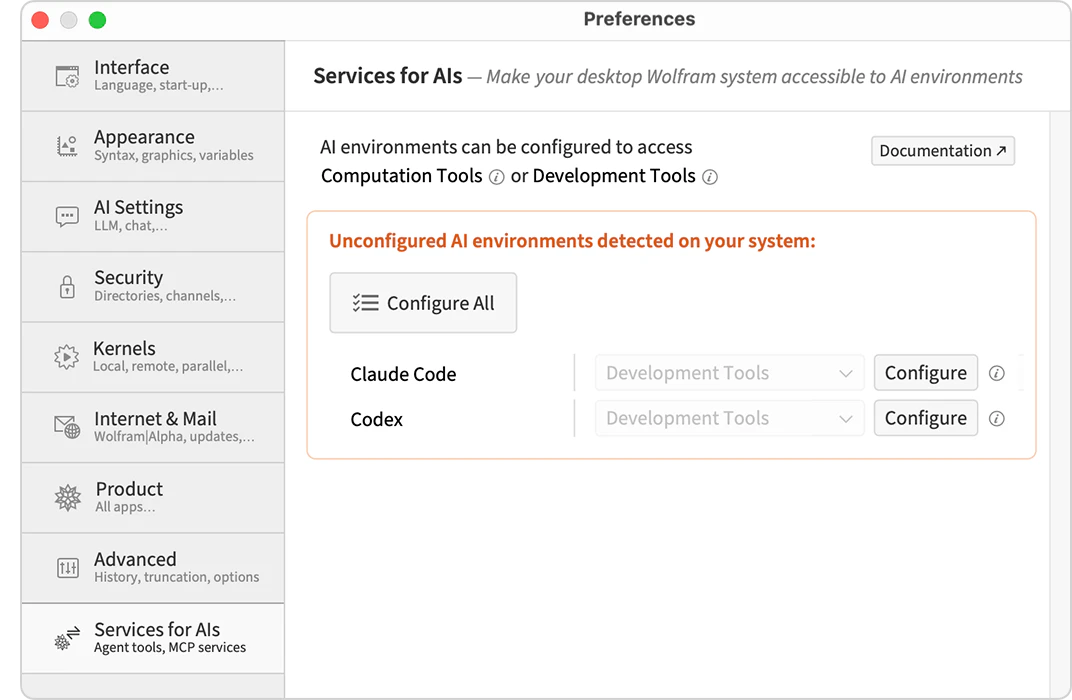
New and updated functionality in Wolfram Language 15: LLM & AI, notebook & user interfaces, symbolic & numeric computations, visualization & graphics, geometry & graphs, astronomy, chemistry, life sciences, knowledgebase, video, PDEs & system modeling, core language, compiler & evaluation, repositories.
AI Analysis
Wolfram Language 15 is a unified computational language powering tools like Mathematica, with major updates in LLM & AI integration for humans and AI agents, advanced notebooks/UI, symbolic/numeric computations, visualization, geometry, graphs, and specialized tools for astronomy, chemistry, life sciences, PDE modeling, and more. USP is its vast built-in knowledgebase and functions enabling one-language solutions. It solves fragmentation in scientific computing workflows, complex data handling, and lack of reliable AI-computation integration. Value proposition: efficient, accurate, reproducible results for technical and scientific problems.
In 2025-2026, AI agents and LLM adoption are surging, with rising demand for computable, reliable AI in science and data fields. Wolfram's mature symbolic tech complements this trend perfectly amid maturing AI infrastructure and supportive innovation policies. Excellent Timing.
High. Leverages Wolfram Research's 30+ years expertise; technical challenges in AI integration are well-managed with existing infrastructure. Moderate dev costs as iterative updates, strong scalability, low compliance risks for software. Established team fit and distribution channels.
Scientists, researchers, engineers, educators, and AI developers in academia, R&D labs, finance, and tech industries (physics, biology, data science). Primarily North America/Europe with growing Asia adoption. Scientific computing TAM ~$15B+, SAM for symbolic/AI tools ~$2B. Pain points: fragmented tools, irreproducible results; high willingness to pay for productivity licenses.
Medium. Direct competitors: 1. MATLAB (mathworks.com), 2. Python (SciPy/SymPy/Numpy, python.org), 3. Maple (maplesoft.com), 4. Julia (julialang.org). Advantages: unmatched symbolic computation, integrated knowledgebase, native AI for computation. Disadvantages: proprietary/expensive vs free alternatives, steeper initial learning curve.
Upgrade Pro to unlock full AI analysis
Similar Products

Auriko
Trading desk for LLM calls
▲ 332 votes

Equitybee Benchmark
Compare your startup equity grant for free.
▲ 218 votes

Cohere Parse 5
Turn complex docs, tables & images into AI-ready data
▲ 158 votes

Adapt
The company brain that gets work done
▲ 124 votes

Tapfree for Chrome
Voice dictation that adapts to what’s on your screen
▲ 122 votes

CodeBurn
See where your AI coding spend actually goes
▲ 101 votes