
Wondering
Duolingo for learning anything
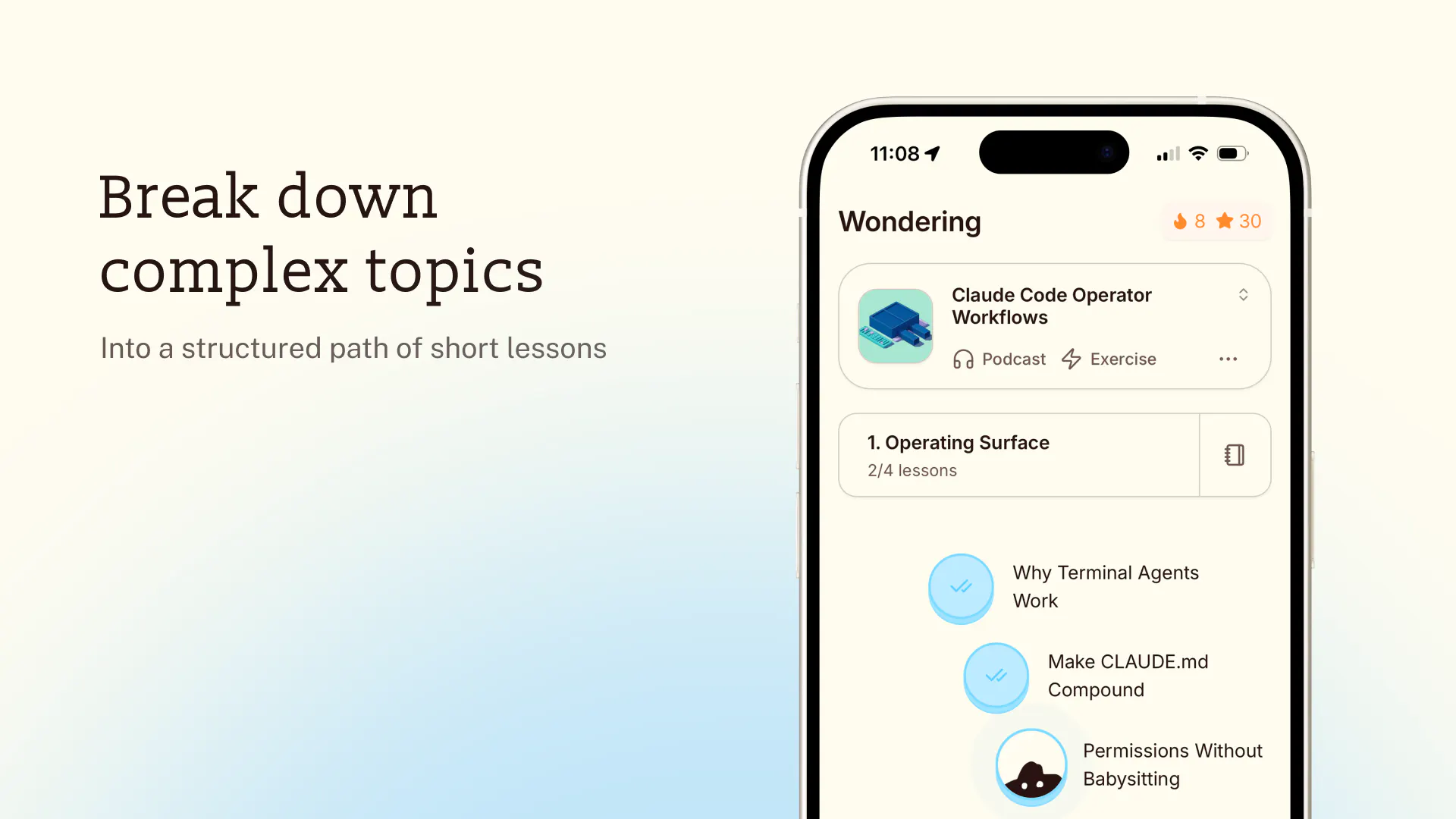
Wondering is the most delightful way to break down complex topics into knowledge you can remember and apply. Tell it what you want to learn, and it creates a personalized path of short lessons with visuals, podcasts, and interactive exercises. It surfaces the most important ideas and lets you explore them in your own way, like a thoughtful tutor beside you.
AI Analysis
Wondering is an AI-powered personalized learning platform that creates custom paths for any topic users want to master. Core features include bite-sized lessons with visuals, podcasts, and interactive exercises that break down complex subjects into memorable, applicable knowledge. It acts like a thoughtful personal tutor, surfacing key ideas while allowing flexible exploration. USP: Duolingo-style delightful experience extended to any subject. It solves pain points such as unstructured self-learning, low retention rates, disengagement, and difficulty applying knowledge. Overall value proposition: Makes learning efficient, enjoyable, and effective for lifelong skill development.
The market timing is favorable for 2025-2026 due to mature generative AI technologies enabling dynamic content creation, rising demand for personalized and flexible learning amid rapid skill obsolescence in the job market, and growing adoption of audio/visual micro-learning. Economic recovery and policy support for digital education further boost edtech. This aligns perfectly with user shifts toward AI tutors over rigid courses. Rating: Excellent Timing.
Overall feasibility is High. Technical difficulty is manageable using current LLMs, TTS, and image generation tools, though ensuring content accuracy and quality requires oversight. Development and AI operational costs are medium-high due to per-user generation but decrease with optimization. Low supply chain risks; compliance with data privacy (e.g., GDPR for education) is key. Strong scalability via cloud AI services and good fit for AI-savvy teams. Main risk is maintaining delightful UX at scale.
Main target segments: Lifelong learners and self-educators (ages 18-45), working professionals upskilling, college students supplementing studies; tech-savvy individuals with busy schedules. Geographically focused on English-speaking markets (US, Europe, UK, Australia) with global expansion potential. Estimated market size: EdTech TAM ~$400B by 2026, SAM for AI-personalized learning tools ~$30-50B, SOM for consumer micro-learning apps ~$5B+. Core pain points: Information overload, poor knowledge retention/application, lack of engaging structured paths for niche topics. Potential willingness to pay: Medium-high via freemium/subscription ($9-20/month) for premium personalization.
Competition level: Medium. Direct competitors: 1. Duolingo (duolingo.com) - gamified language learning. 2. Khan Academy with Khanmigo (khanacademy.org) - free courses plus AI tutor. 3. Brilliant (brilliant.org) - interactive STEM learning. 4. Memrise (memrise.com) - mnemonic-based courses. 5. Skillshare (skillshare.com) - creative classes. Advantages: Broader 'any topic' personalization, multi-format (visuals/podcasts/exercises) focus on retention/application, more adaptive tutor-like experience. Disadvantages: Newer entrant with less brand trust, potential AI content inaccuracies vs. curated competitors, likely paid model vs. some free alternatives. Strong differentiation in delightful, flexible AI paths but faces pressure from established edtech players.
Upgrade Pro to unlock full AI analysis
Similar Products

Load Nova
Dispatchers AI Co-Pilot and Dashboard that care about speed
▲ 131 votes

Adapt
The company brain that gets work done
▲ 124 votes

Tapfree for Chrome
Voice dictation that adapts to what’s on your screen
▲ 122 votes

Buddy AI Note
Your daily memo that turns notes into a plan
▲ 94 votes

Kosshi
Simple, fast outliner for Mac and iPhone.
▲ 90 votes

Thoughts for Mac
Capture notes from your menubar using text, images or voice
▲ 90 votes