
Yansu
AI that learns how you work and turns it into software
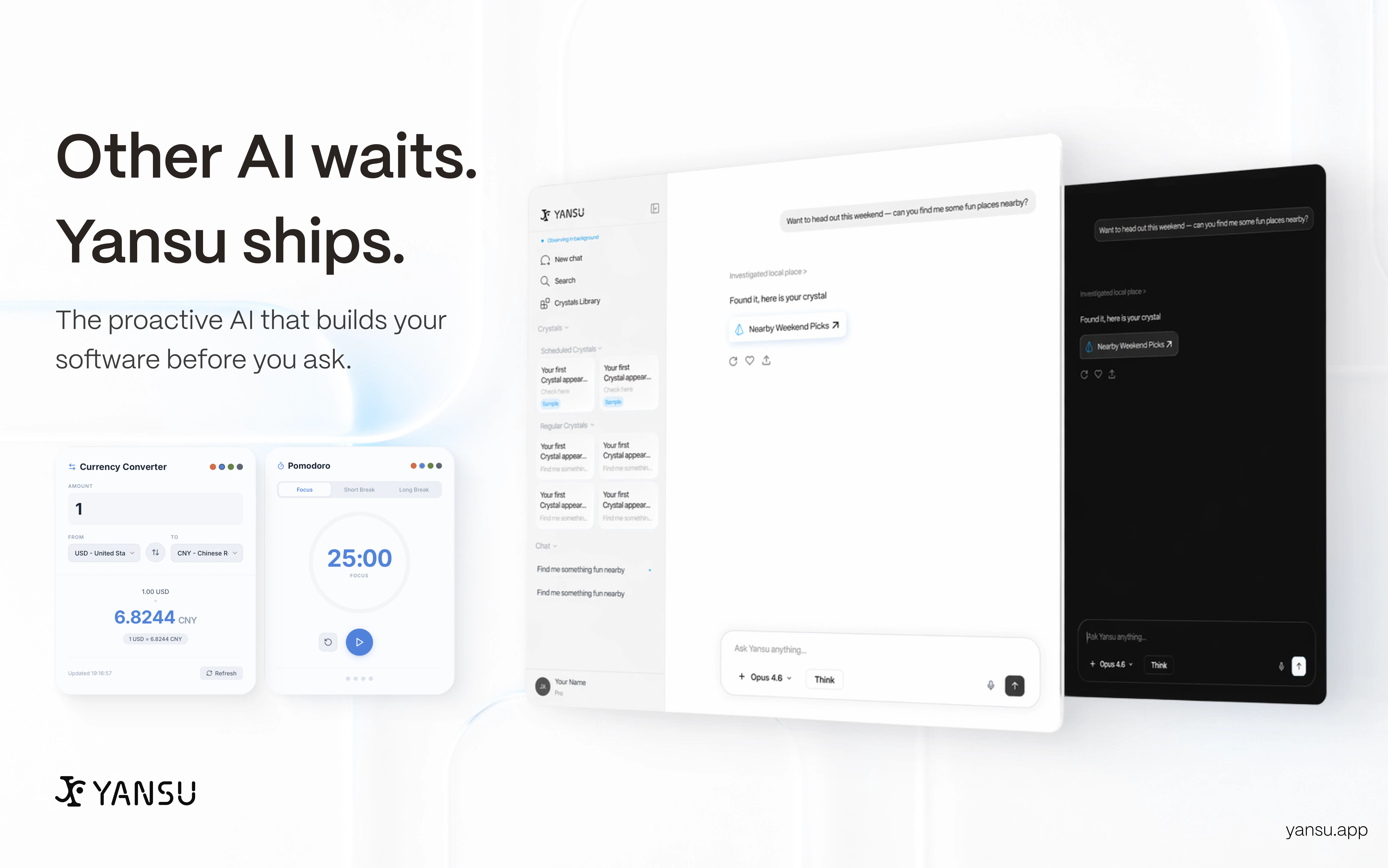
Yanshu learns from the work you already do. It spots repeated tasks across files, messages, and workflows, then turns the best patterns into apps and automations. No process mapping or blank canvas—just the routines worth systemizing. Use it to automate recurring work, build lightweight internal tools, and speed up daily ops without writing code.
AI Analysis
Yansu is an AI that learns from users' existing work by analyzing files, messages, and workflows to detect repeated tasks and patterns. It then converts these into custom apps, automations, and lightweight internal tools without any coding, process mapping, or starting from a blank canvas. Core features focus on passive observation, pattern spotting, and one-click systemization of routines. It solves key pain points like time lost on repetitive manual work, lack of resources for building custom software, and inefficient daily operations. The USP is its ability to identify and automate 'the routines worth systemizing' based on real user behavior. Overall value proposition: transforms implicit work habits into explicit, scalable productivity solutions.
The market timing is favorable for 2025-2026 as AI agentic capabilities and no-code platforms mature rapidly, aligning with rising demand for workflow automation amid economic pressures to improve efficiency. Enterprises and individuals are increasingly adopting AI to reduce repetitive tasks, supported by advancements in LLMs for pattern recognition. Policy support for digital transformation and remote work trends further boost adoption. Excellent Timing.
Overall feasibility is Medium. Technical challenges exist in cross-platform observation and accurate AI pattern detection, but current LLM and integration APIs make it achievable. Development and operation costs are moderate to high due to AI compute and maintenance. Key risks include data privacy/compliance (accessing work files/messages) and scalability of learned automations. Team needs strong AI and UX expertise. High scalability potential in SaaS model once core tech is stable.
Main targets are knowledge workers, operations teams, and managers in SMBs within tech, consulting, marketing, and finance industries, primarily in North America and Europe. TAM for AI-driven productivity and automation software exceeds $100B, with SAM for no-code internal tools around $15B and SOM near $2B. Core pain points include excessive time on repetitive tasks (often 20-40% of workday) and inability to quickly build custom tools without engineering support. Users show strong willingness to pay for proven time-saving tools, likely via subscription tiers.
Medium. Direct competitors: 1. Bardeen (bardeen.ai), 2. Zapier (zapier.com), 3. Adept (adept.ai), 4. Lindy (lindy.ai), 5. Microsoft Power Automate (powerautomate.microsoft.com). Advantages: passive learning from existing work vs manual setup in competitors; focuses on turning patterns into apps without blank slate. Disadvantages: likely higher privacy risks and potentially fewer pre-built integrations than Zapier; less brand recognition than Microsoft. Differentiation is strong in 'observation-first' approach but faces pressure from established automation platforms.
Upgrade Pro to unlock full AI analysis
Similar Products

Cohere Parse 5
Turn complex docs, tables & images into AI-ready data
▲ 158 votes

Opaline
PostHog for team Claude Code and Codex sessions.
▲ 141 votes

Adapt
The company brain that gets work done
▲ 124 votes

Kosshi
Simple, fast outliner for Mac and iPhone.
▲ 90 votes

WikiFix for Confluence
Find and fix issues in your knowledge base
▲ 86 votes

Refoid
Automate App Store refund responses and track every outcome
▲ 68 votes