
Zaro
Build agents & apps on top of your context with one prompt.
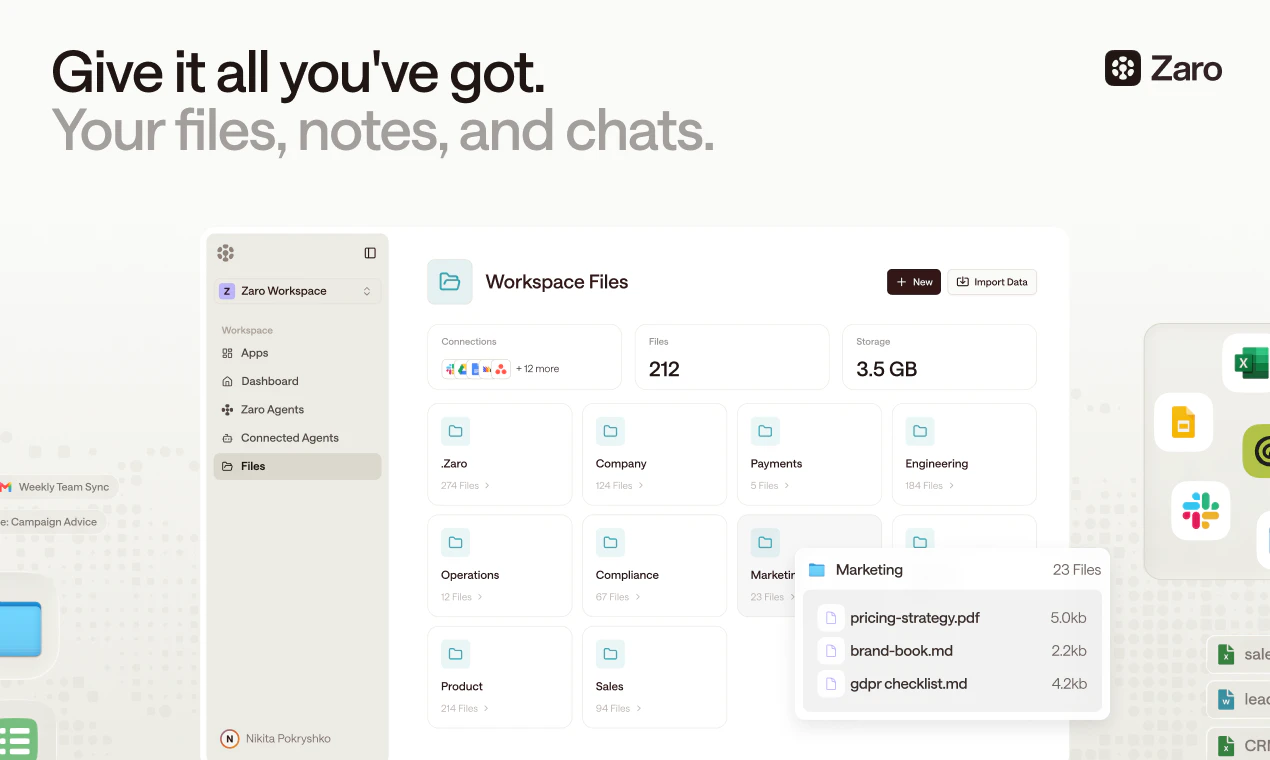
Zaro is where you can build working software from your scattered work. Everything you know is spread across Gmail, Slack, notes, and tabs that don't talk - Zaro pulls it into one place and lets you build apps from it in minutes: your research, your side projects, your plans, your decisions. Then they keep themselves updated, checking your connections every day so you don't have to. No code. No maintenance. No graveyard of prototypes you started and never finished.
AI Analysis
Zaro unifies fragmented personal data from Gmail, Slack, notes, and browser tabs into a single context layer. Users build functional agents and apps in minutes using one natural language prompt, with no coding required. Core features include instant app generation for research, projects, plans, and decisions, plus daily automatic updates by re-checking connected sources. It solves key pain points of information silos, manual searching across tools, and abandoned prototypes by creating self-maintaining software. The value proposition is turning scattered knowledge into living, always-up-to-date applications effortlessly, boosting productivity for non-technical users.
2025-2026 sees explosive growth in AI agents, RAG systems, and no-code platforms amid maturing LLMs and enterprise adoption of personal AI. User demand for solving information overload and automation is at a peak, supported by favorable economic focus on productivity tools. Policy emphasis on AI innovation further aids adoption. This is an ideal window before full market saturation. Excellent Timing.
Medium. Technical challenges include secure multi-service integrations (email, chat, notes), reliable context synthesis, and stable one-prompt app generation with daily updates. AI inference and data storage costs may be high at scale. Privacy/compliance risks (GDPR, data consent) are significant given personal information access. Scalability is promising via cloud but requires robust error handling. Feasible with current AI frameworks but needs strong engineering and legal expertise.
Primary users: Tech-savvy knowledge workers, product managers, researchers, consultants, and side-project entrepreneurs aged 25-45, concentrated in North America, Europe, and urban Asia. Industries include software, startups, academia, and professional services. TAM for AI productivity ~$100B+, SAM for no-code personal AI ~$10B, SOM for context-to-app niche ~$1B. Core pains: fragmented workflows and lost ideas. High willingness to pay ($15-50/month) for time-saving, automated solutions that replace manual effort.
Medium. Direct competitors: 1. Bardeen (bardeen.ai) - AI automation player. 2. Lindy (lindy.ai) - personalized AI agents. 3. Zapier Central (zapier.com/central) - AI workflow builder. 4. Mem (mem.ai) - AI knowledge workspace. 5. Adept.ai (adept.ai) - AI for work actions. Advantages: true one-prompt software creation from unified personal context with autonomous daily updates. Disadvantages: newer product with potentially less polished integrations and higher learning curve than established automation tools; limited ecosystem compared to Zapier.
Upgrade Pro to unlock full AI analysis
Similar Products

Cohere Parse 5
Turn complex docs, tables & images into AI-ready data
▲ 158 votes

Adapt
The company brain that gets work done
▲ 124 votes

Tapfree for Chrome
Voice dictation that adapts to what’s on your screen
▲ 122 votes

Kosshi
Simple, fast outliner for Mac and iPhone.
▲ 90 votes

Thoughts for Mac
Capture notes from your menubar using text, images or voice
▲ 90 votes

Refoid
Automate App Store refund responses and track every outcome
▲ 68 votes