
agent-manager
Know which coding agent is blocked without tabbing through
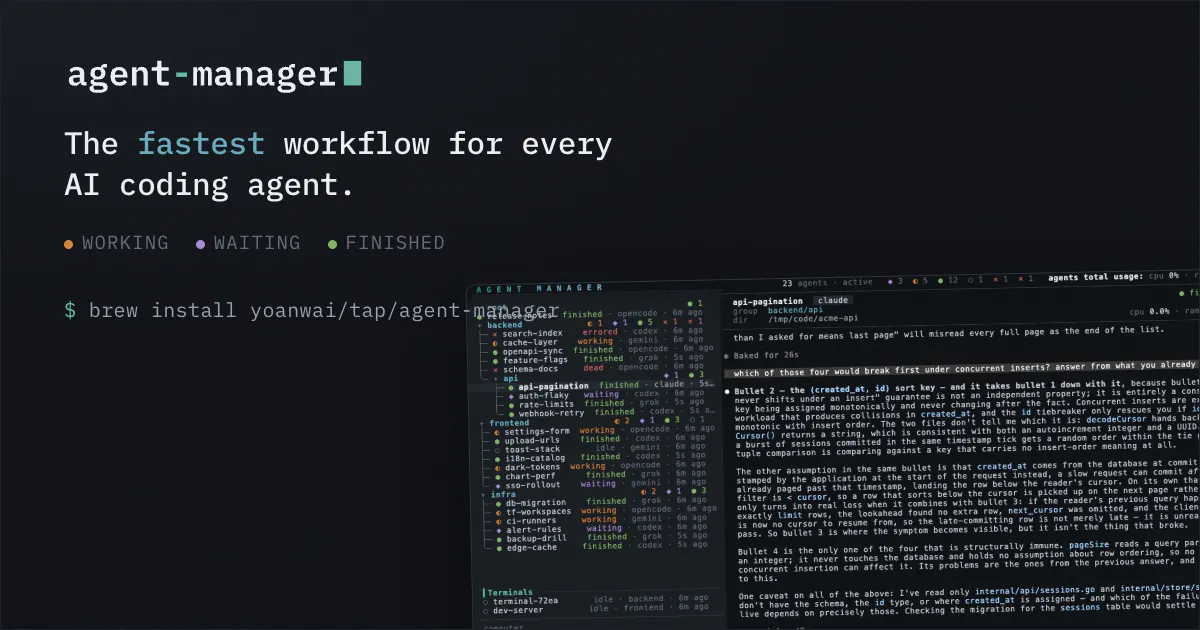
Run Claude Code, Codex, OpenCode, Gemini CLI, Grok and Pi in one tmux list with live status per session. space answers a blocked agent without attaching, f forks the conversation into a named sibling, T pins a plain shell next to the agents, and ctrl+r opens whole-file diffs where line comments go back as one review prompt. Sessions can spawn into their own git worktrees. Ordinary tmux sessions survive quitting the manager. One Go binary, Apache-2.0. macOS, Linux, Windows via WSL2.
AI Analysis
agent-manager consolidates AI coding agents (Claude Code, Codex, OpenCode, Gemini CLI, Grok, Pi) into one tmux list with live per-session status. It solves pain points of tab-switching, tracking blocked agents, and managing multiple terminal sessions by enabling space to reply without attaching, f to fork conversations into named siblings, T to pin shells, ctrl+r for diff-based review prompts, and per-session git worktrees. Ordinary tmux sessions persist after quitting. Delivered as one Apache-2.0 Go binary for macOS/Linux/WSL2. Value proposition: boosts developer productivity through seamless multi-agent orchestration in the terminal.
In 2025-2026, AI coding agents and CLI tools are maturing rapidly with surging adoption of multi-agent workflows for productivity. User demand for orchestration tools is rising as developers integrate multiple LLMs simultaneously, aligned with tech industry emphasis on efficiency. No significant policy or economic headwinds. Excellent Timing.
High. Implemented as a single lightweight Go binary with low technical complexity, leveraging mature tmux. Minimal dev/ops costs, no supply chain issues, open-source licensing avoids compliance risks. Excellent scalability for terminal users and strong fit for solo developers. Key reasons: simplicity and existing implementation.
Main segments: terminal-proficient software developers, AI engineers, and open-source contributors using multiple coding agents (demographics: tech professionals 25-45 years old). Industries: software development and tech startups. Geographic: global with concentration in US, Europe, China. TAM for AI developer tools growing rapidly (multi-billion by 2026); SAM for CLI productivity tools is mid-sized; SOM is niche but dedicated (tens of thousands of potential users). Core pains: multi-terminal clutter and blocked agent friction. Moderate-to-high willingness to pay for enhanced versions despite current free OSS model.
Low. Direct competitors: 1. Aider (aider.chat), 2. Open Interpreter (openinterpreter.com), 3. Warp (warp.dev), 4. Continue.dev (continue.dev), 5. Individual agent CLIs (e.g. Gemini CLI). Advantages: unique unified tmux dashboard with live status, AI-specific shortcuts (space/f/ctrl+r), git worktree integration, and persistence. Disadvantages: terminal/tmux-only (no GUI), steeper learning curve for non-tmux users, currently free with limited monetization compared to commercial terminals like Warp.
Upgrade Pro to unlock full AI analysis
Similar Products

Cohere Parse 5
Turn complex docs, tables & images into AI-ready data
▲ 158 votes

Opaline
PostHog for team Claude Code and Codex sessions.
▲ 141 votes

Adapt
The company brain that gets work done
▲ 124 votes

Tapfree for Chrome
Voice dictation that adapts to what’s on your screen
▲ 122 votes

Replay QA Security Scan
Automated Penetration Testing for AI-Built Apps
▲ 102 votes

Refoid
Automate App Store refund responses and track every outcome
▲ 68 votes