
Agent Mode on Arena
Get real-world tasks done with autonomous AI agents
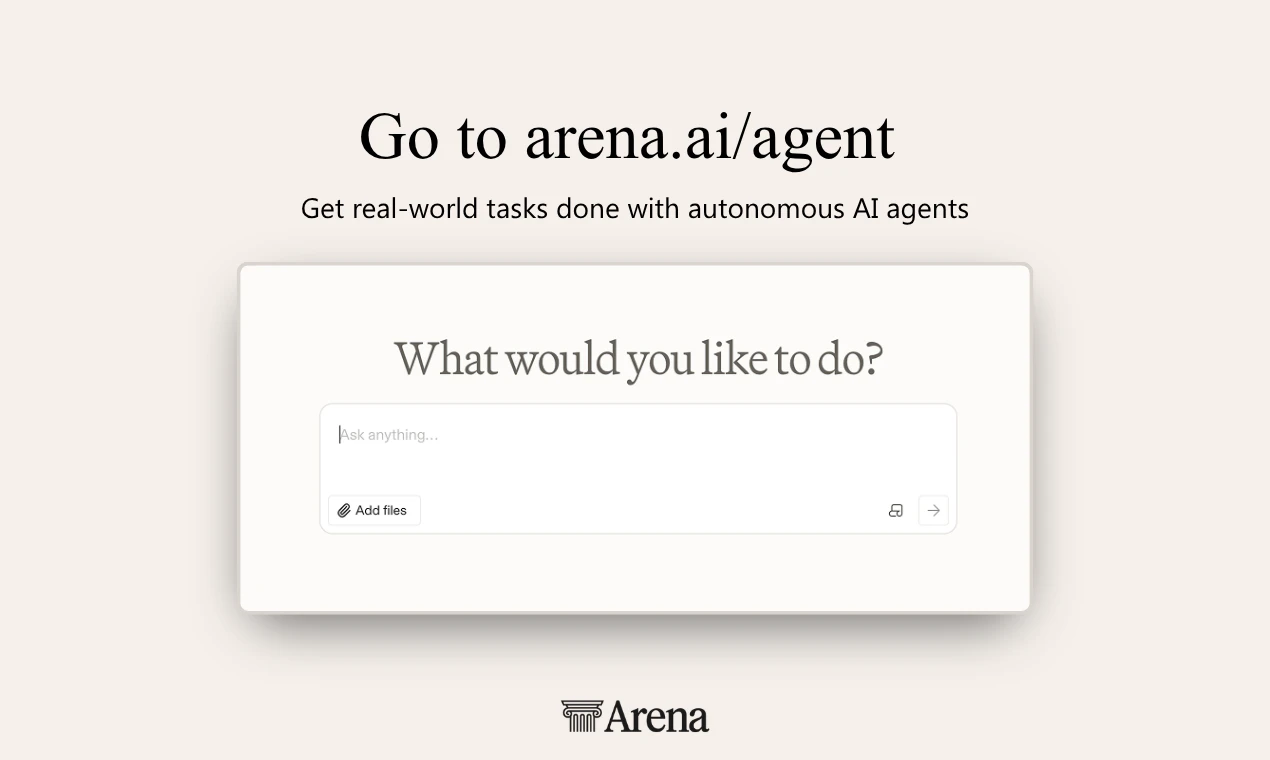
Most AI benchmarks test models in controlled environments. Agent Mode tests them on complex tasks to get more work done. Run autonomous agents that browse, research, code, use files, and complete multi-step workflows from a single prompt. Then watch each workflow unfold step by step. Every run contributes to the Agent Arena Leaderboard, ranking frontier models by real-world agentic performance.
AI Analysis
Agent Mode on Arena allows users to run autonomous AI agents that browse, research, code, use files, and execute complex multi-step workflows from a single prompt. Users observe each step unfolding in real time. It solves the pain of traditional AI benchmarks being limited to controlled environments that don't reflect real-world utility. The core USP is contributing every run to the Agent Arena Leaderboard, which ranks frontier models on genuine agentic performance. The value proposition is delivering transparent, practical evaluation of AI capabilities to help developers, researchers, and teams select and advance more effective autonomous agents.
In 2025-2026, the AI industry is shifting from conversational models to autonomous agentic systems with improved long-horizon reasoning and tool use. Technology maturity of LLMs supports reliable agent workflows, while user demand for productivity tools that 'get real work done' is surging. Economic tailwinds for AI infrastructure and minimal regulatory hurdles for evaluation platforms make this an ideal launch window. Excellent Timing.
Technical difficulty is moderate-high due to requirements for stable long-running agents, sandboxed browsing, file handling, and multi-step error recovery. Development costs involve LLM API integration and compute for real-time visualization, but the team behind LMSYS Chatbot Arena has proven infrastructure. Compliance risks are low (no sensitive data focus). Scalability is strong via cloud resources. Overall rating: High.
Primary users are AI/ML engineers, AI researchers, product teams at AI startups, and technical power users (ages 25-45, tech-savvy). Industries: AI development, software engineering, academic research. Geographically concentrated in US, China, Europe tech hubs. TAM for AI evaluation and agent tools exceeds $5B, SAM ~$800M for agent benchmarking platforms, SOM ~$50M in first 2 years. Pain points include unreliable agent performance and lack of standardized real-world testing. High willingness to pay for premium evaluation credits or API access.
Medium. Direct competitors: 1. OpenDevin (https://github.com/OpenDevin/OpenDevin), 2. CrewAI (https://www.crewai.com/), 3. AutoGen (https://microsoft.github.io/autogen/), 4. LangSmith (https://www.langchain.com/langsmith), 5. WebArena benchmark (research project). Advantages: Unique public leaderboard focused on real-world multi-step tasks with transparent step-by-step replay; leverages existing Arena user base. Disadvantages: Potentially higher latency than simpler agent frameworks; less focus on enterprise workflow customization compared to CrewAI or LangSmith. Strong differentiation through benchmark contribution model.
Upgrade Pro to unlock full AI analysis
Similar Products

Cohere Parse 5
Turn complex docs, tables & images into AI-ready data
▲ 158 votes

Opaline
PostHog for team Claude Code and Codex sessions.
▲ 141 votes

Adapt
The company brain that gets work done
▲ 124 votes

Kosshi
Simple, fast outliner for Mac and iPhone.
▲ 90 votes

WikiFix for Confluence
Find and fix issues in your knowledge base
▲ 86 votes

Refoid
Automate App Store refund responses and track every outcome
▲ 68 votes