
ARBR
Control Every AI Request
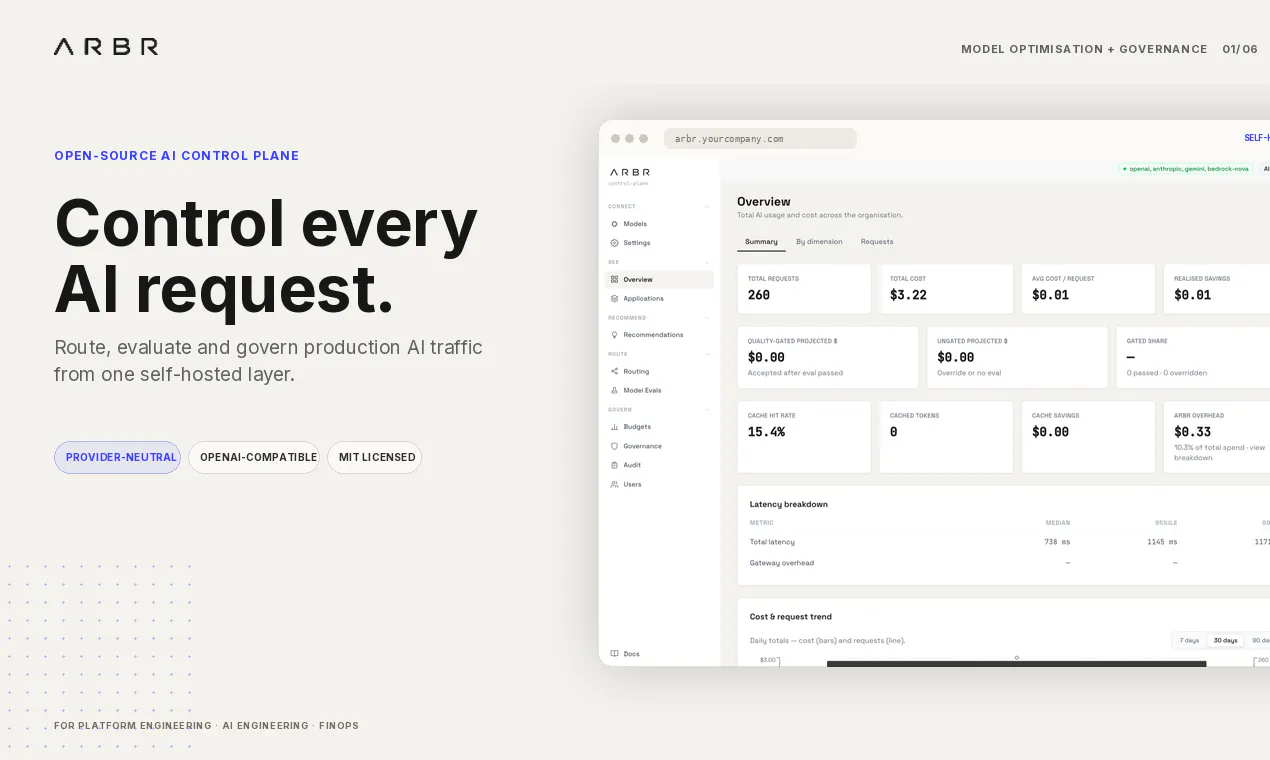
AI stacks are getting more complex with more models, providers, costs, and decisions. ARBR gives your applications one control layer across your AI stack. Connect once through an OpenAI-compatible endpoint to route, govern, observe, evaluate, and deploy across AI models. Open source, MIT-licensed, provider-neutral, and self-hosted.
AI Analysis
ARBR provides a unified control layer for complex AI stacks by offering a single OpenAI-compatible endpoint. Core features include routing, governance, observation, evaluation, and deployment across multiple AI models and providers. USPs: open-source (MIT-licensed), provider-neutral, and self-hosted for full control and privacy. It solves key pain points like managing diverse models, rising costs, decision complexity, and fragmented integrations in AI applications. Value proposition: simplifies AI stack management while maintaining flexibility and reducing vendor lock-in.
Favorable in 2025-2026 as AI model proliferation and multi-provider adoption surge, increasing demand for governance and optimization tools. Technology maturity for API abstraction layers is high, user needs for cost control and observability are growing rapidly amid economic pressures on AI spend. No major policy barriers. Excellent Timing.
High. Moderate technical difficulty using standard OpenAI APIs; low operational costs as open-source and self-hosted; minimal supply chain or compliance risks (provider-neutral); high scalability potential. Requires expertise in AI integrations but strong fit for developer-focused teams.
Main segments: AI/ML engineers, backend developers, and tech teams in startups and mid-sized enterprises building LLM apps. Industries: software/SaaS, AI services. Geographic: primarily US, Europe. TAM for AI infrastructure tools ~$20B+ by 2026; SAM for gateways ~$1-2B. Pain points: stack complexity and cost overruns. Moderate to high willingness to pay for support/enterprise features.
High. Direct competitors: 1. LiteLLM (litellm.ai), 2. Portkey (portkey.ai), 3. Helicone (helicone.ai), 4. OpenRouter (openrouter.ai), 5. Langfuse (langfuse.com). Advantages: fully self-hosted open-source for data control/customization, strong neutrality. Disadvantages: potentially fewer polished enterprise features, smaller ecosystem than commercial SaaS rivals, newer market presence.
Upgrade Pro to unlock full AI analysis
Similar Products

Cohere Parse 5
Turn complex docs, tables & images into AI-ready data
▲ 158 votes

Adapt
The company brain that gets work done
▲ 124 votes

Replay QA Security Scan
Automated Penetration Testing for AI-Built Apps
▲ 102 votes

WikiFix for Confluence
Find and fix issues in your knowledge base
▲ 86 votes

Audryo
Customer email your agent can operate.
▲ 68 votes

Refoid
Automate App Store refund responses and track every outcome
▲ 68 votes