
Athena Desktop
A local command room for AI coding agents.
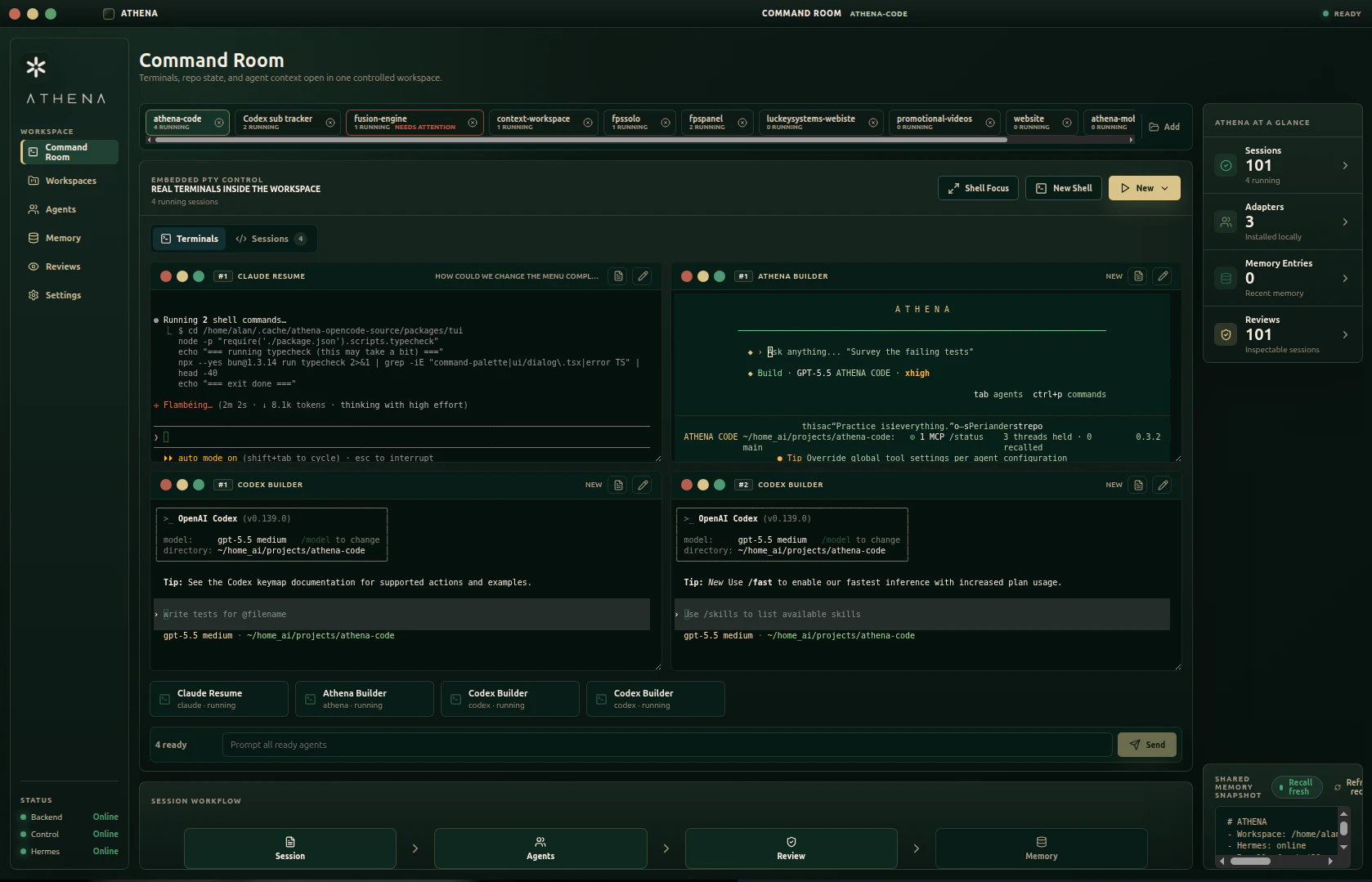
Athena is a desktop control surface for AI coding agents with shared project context. Built with Electron, React, and FastAPI, it embeds native terminals for Codex, OpenCode, Claude, and Hermes with Hermes memory integration. Features MCP bridge for cross-platform workspace control, embedded PTY terminals, native session discovery, and more.
AI Analysis
Athena Desktop serves as a local command center for AI coding agents, offering shared project context across tools. Core features include embedded native terminals for Codex, OpenCode, Claude, and Hermes, Hermes memory integration, MCP bridge for cross-platform workspace control, embedded PTY terminals, and native session discovery. Built with Electron, React, and FastAPI as an open-source desktop app. It addresses key pain points like fragmented management of multiple AI agents, loss of context between sessions, and inefficient workflow switching. The value proposition is a unified, privacy-focused control surface that boosts developer productivity in AI-assisted coding.
The 2025-2026 period is highly favorable as AI coding agents and local LLM usage are maturing rapidly, with rising demand for integrated developer interfaces amid growing adoption of tools like Claude. User needs are shifting toward unified, privacy-centric workflows. Economic and policy support for AI productivity tools remains strong. This represents Excellent Timing because the ecosystem is primed for innovative local control surfaces to manage proliferating AI agents.
Technical difficulty is moderate using mature stack (Electron, React, FastAPI). Development and operation costs are reasonable for an open-source desktop app with no hardware dependencies. Low supply chain and compliance risks, though API integrations with multiple AI services require ongoing maintenance. Strong scalability for user growth via open-source contributions. Overall rating: High, supported by accessible technologies and focused scope on local control features.
Primary users: Individual developers, software engineers, and indie hackers (ages 25-45) in the tech/software industry, concentrated in North America, Europe, and Asia. Estimated TAM for AI developer tools exceeds $10B, with SAM for AI coding interfaces around $2B and SOM for desktop agent managers near $100M. Core pain points include context fragmentation and multi-tool overhead. High willingness to pay for premium productivity gains, though open-source nature suggests freemium potential.
Medium. Direct competitors: 1. OpenDevin (github.com/OpenDevin/OpenDevin), 2. Aider (aider.chat), 3. Cursor (cursor.com), 4. Continue.dev (continue.dev). Advantages: Unique local desktop command room with multi-agent terminal embedding and shared context via Hermes; open-source focus. Disadvantages: Less mature ecosystem than Cursor's editor integration; may require more setup than CLI tools like Aider; limited built-in editing compared to full IDE competitors.
Upgrade Pro to unlock full AI analysis
Similar Products

Lev8
Find, research, and reach the right people
▲ 451 votes

Auriko
Trading desk for LLM calls
▲ 332 votes

Cohere Parse 5
Turn complex docs, tables & images into AI-ready data
▲ 158 votes

Adapt
The company brain that gets work done
▲ 124 votes

Tapfree for Chrome
Voice dictation that adapts to what’s on your screen
▲ 122 votes

CodeBurn
See where your AI coding spend actually goes
▲ 101 votes