
Basedash AI Sources
Trust every AI answer by seeing what built it
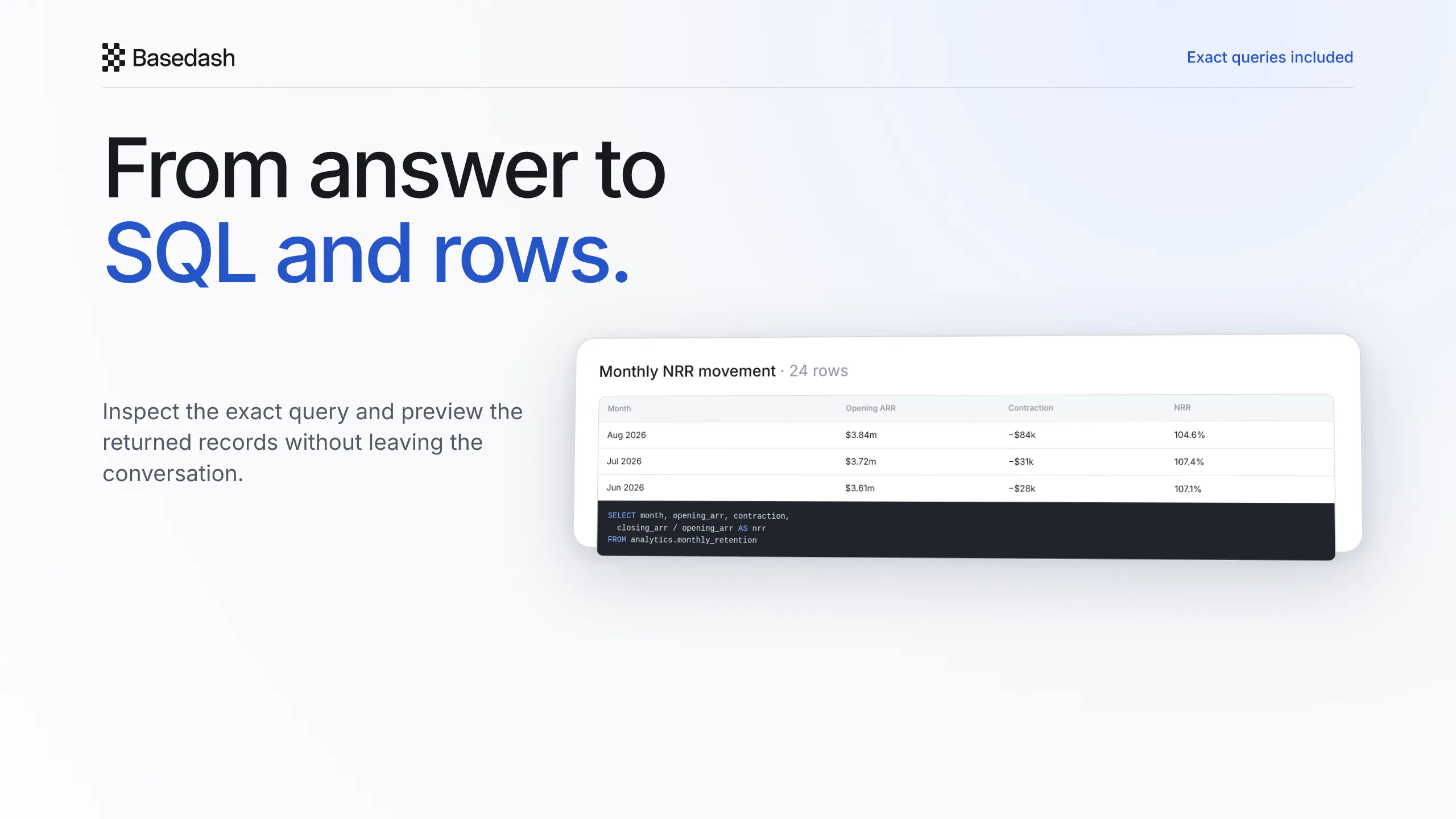
Basedash AI Sources shows exactly what produced every answer. Open Sources to inspect the tables, definitions, charts, data sources, read-only MCP connections, and web pages the AI used—plus every query, its SQL, and a preview of returned rows. Completed work collapses into a compact “Analyzed for…” summary, while actions that change something appear as clear cards beneath the answer. Ask the question, then see the receipts.
AI Analysis
Basedash AI Sources is a transparency feature for AI-driven data analytics that reveals exactly what data and logic produced each AI answer. Core features include inspectable tables, SQL queries with previews of returned rows, charts, definitions, read-only connections, and web pages. Analyses collapse into compact 'Analyzed for…' summaries, while data-changing actions appear as clear cards. It solves the major pain point of opaque, untrustworthy AI outputs in analytics by providing full visibility and auditability. The value proposition is enabling confident, verifiable use of AI for data insights and decisions.
In 2025-2026, AI integration in analytics is accelerating rapidly while concerns over hallucinations, compliance, and trust are at peak levels. Explainable AI is becoming a priority due to maturing LLM tech, enterprise adoption demands, and emerging AI governance policies. This is a perfect window for transparency tools. Rating: Excellent Timing.
Technical difficulty is medium-high due to the need for detailed AI reasoning traces, SQL generation, and secure data previewing, but it builds on established database and AI tech. Development and operation costs are typical for SaaS with moderate compliance risks around data access. Strong scalability in cloud setups. Overall rating: High, assuming experienced engineering team.
Primary users: data analysts, BI engineers, product managers, and technical leaders in mid-to-large companies. Industries: software/tech, finance, e-commerce, healthcare. Geographic focus: primarily North America and Europe. TAM for AI analytics platforms exceeds $15B with SAM for transparent/explainable tools around $3-5B; SOM depends on Basedash adoption. Core pain: mistrust in unverifiable AI data answers. High willingness to pay for enterprise reliability features.
Medium. Direct competitors: 1. ThoughtSpot (thoughtspot.com), 2. Tableau Pulse with AI (tableau.com), 3. Microsoft Power BI Copilot (powerbi.microsoft.com), 4. Akkio (akkio.com), 5. Julius AI (julius.ai). Advantages: unique deep visibility into SQL, row-level data, and source connections with clean summary UI. Disadvantages: narrower scope as Basedash add-on vs full BI suites; potentially higher learning curve for non-technical users. Strong differentiation in auditability.
Upgrade Pro to unlock full AI analysis
Similar Products

Equitybee Benchmark
Compare your startup equity grant for free.
▲ 218 votes
Basedash for Excel
Turn any Excel file into a live dashboard
▲ 127 votes

Databerry
Track all your business data in a single dashboard
▲ 101 votes

DecisionBox for Databricks
Connect DecisionBox to your Databricks to validate findings
▲ 72 votes

Bruin
The AI data agent that collaborates with your team
▲ 65 votes

Open Analytics 0.7.0
Open source and AI-native web analytics
▲ 0 votes