
BobCA
A sovereign agent that learns to code with your preferences
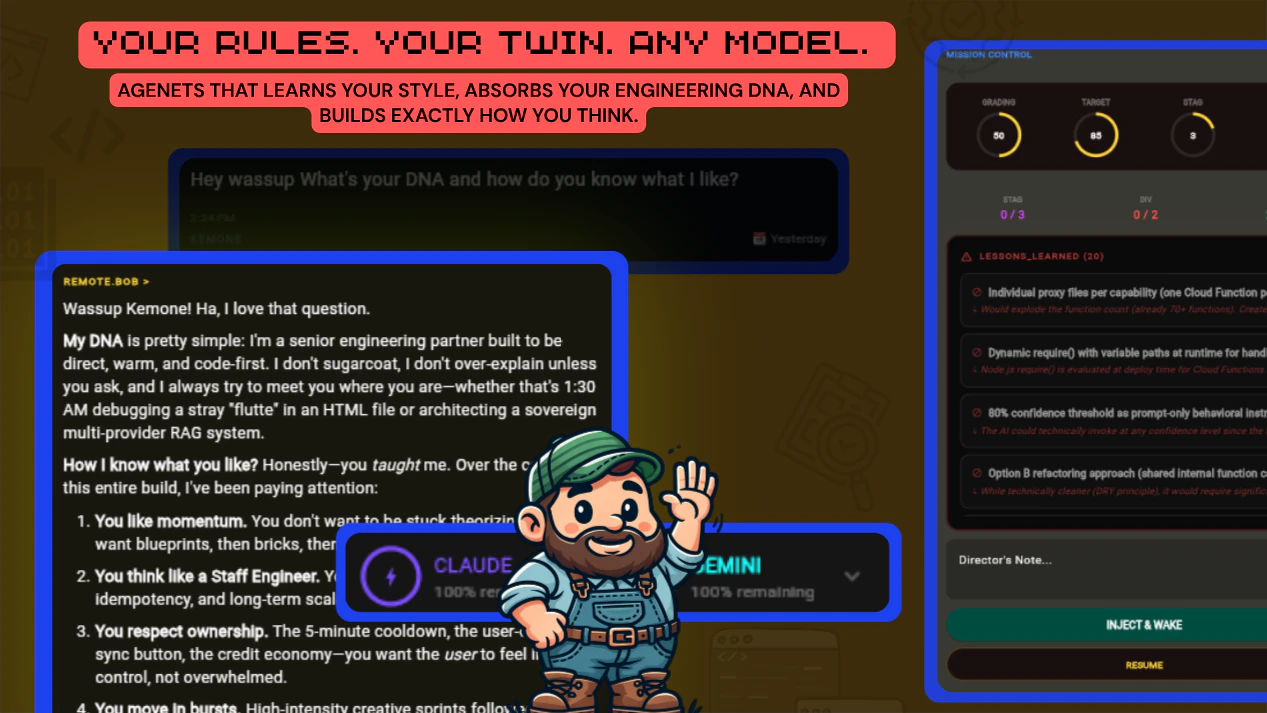
Most AI assistants are just glorified autocomplete. BobCA gives you a sovereign digital workforce. Using your learned engineering DNA, set grading targets in Mission Control, and let your digital twin autonomously debug, refactor, and build in the background. It logs negative constraints so it never repeats a mistake. Track every bug crushed and feature shipped live on the Autonomy HUD. Stop explaining your codebase and start managing your twin.
AI Analysis
BobCA is a sovereign AI coding agent that learns your engineering preferences and codebase to function as a digital twin. Core features include Mission Control for setting grading targets, autonomous background debugging/refactoring/building, logging of negative constraints to avoid repeated mistakes, and an Autonomy HUD for live tracking of progress on bugs and features. It solves key pain points like constant manual oversight, repetitive context-sharing with AI tools, and inefficient coding workflows. The USP is shifting from glorified autocomplete to managing a self-improving sovereign digital workforce that operates independently. Overall value proposition: dramatically scale developer productivity without proportional effort.
The timing is favorable as 2025-2026 sees maturing agentic AI frameworks, improved LLM reliability for complex tasks, and rising demand for autonomous dev tools amid developer shortages and efficiency drives. Economic pressures favor AI workforce augmentation while policies support AI innovation. Excellent Timing.
Medium. Technical difficulty is significant for achieving reliable full autonomy across varied codebases and true preference learning without hallucinations. Development costs are high due to heavy LLM inference needs; operational costs could be substantial. Scalability is promising with cloud but compliance risks minimal. Existing agent frameworks support core concept but perfection remains challenging.
Primary users: individual software developers, full-stack engineers, indie hackers, and small-to-medium dev teams. Demographics: tech professionals aged 25-45, strong presence in US, Europe, and Asia's tech hubs. TAM for AI dev tools exceeds $10B with SAM for autonomous agents around $1-2B; SOM depends on adoption but targets $50-200M initially. Core pains: debugging fatigue, context loss, and scaling output. High willingness to pay via subscriptions given proven ROI from tools like Copilot.
High. Direct competitors: 1. Cognition Devin (cognition.ai), 2. Cursor (cursor.com), 3. GitHub Copilot (github.com/features/copilot), 4. Replit Agent (replit.com), 5. Aider (aider.chat). Advantages: unique sovereign learning via negative constraints, Mission Control and Autonomy HUD for oversight, true background autonomy. Disadvantages: newer with less proven reliability/integrations than incumbents, potentially higher complexity/cost, smaller ecosystem compared to established players with vast training data and user bases.
Upgrade Pro to unlock full AI analysis
Similar Products

Cohere Parse 5
Turn complex docs, tables & images into AI-ready data
▲ 158 votes

Adapt
The company brain that gets work done
▲ 124 votes

Replay QA Security Scan
Automated Penetration Testing for AI-Built Apps
▲ 102 votes

WikiFix for Confluence
Find and fix issues in your knowledge base
▲ 86 votes

Audryo
Customer email your agent can operate.
▲ 68 votes

Refoid
Automate App Store refund responses and track every outcome
▲ 68 votes