
Brief
Navigate your agents to product-market fit
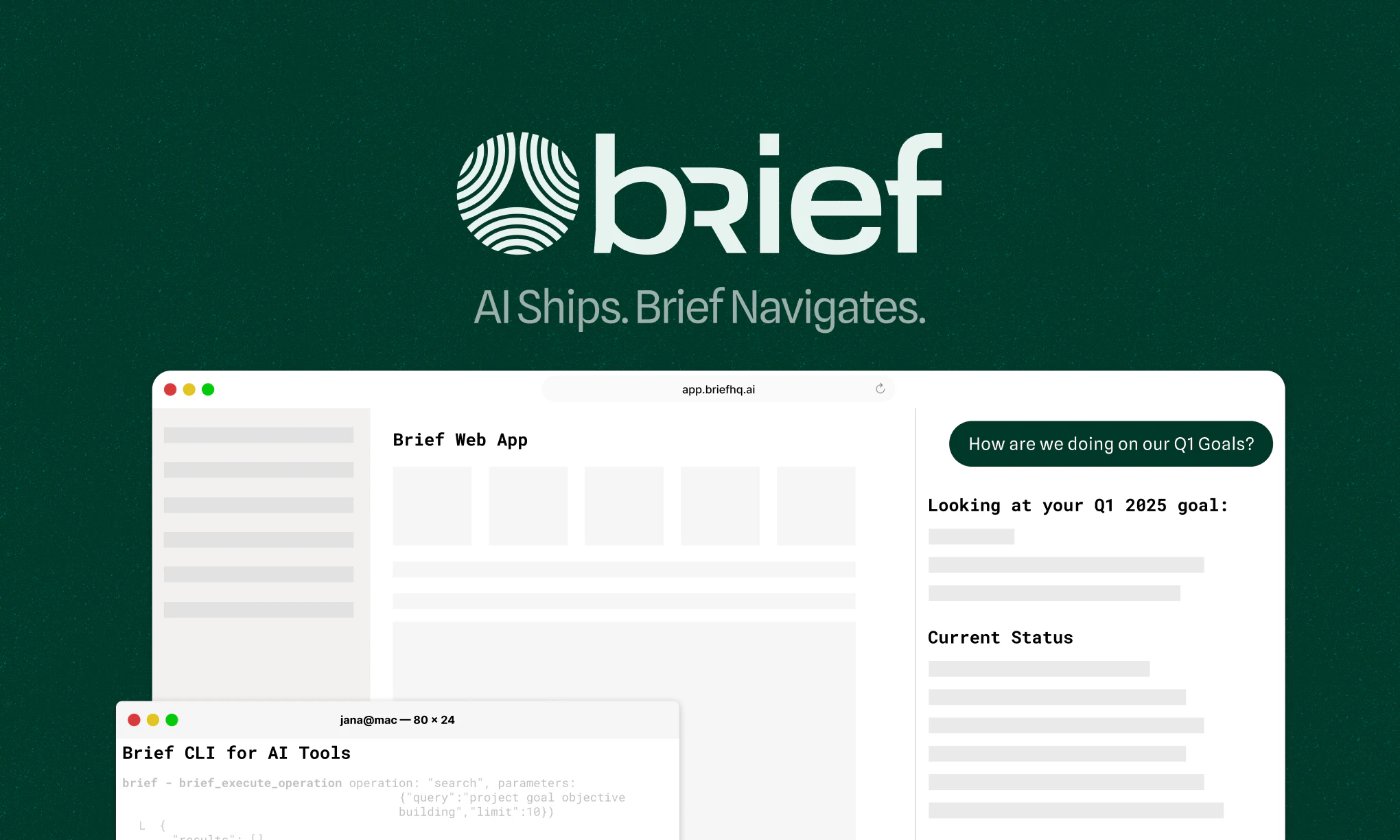
AI agents can ship quickly, but without the right product context, they're often flying blind. Brief gives product teams a living source of truth that captures decisions, preserves product intent, and serves relevant context to humans and agents through chat, Slack, CLI, and MCP. It keeps strategy, decisions, and execution connected from vision to impact.
AI Analysis
Brief is a living source of truth for product teams, capturing decisions, preserving product intent, and delivering relevant context to humans and AI agents via chat, Slack, CLI, and MCP. It solves the critical pain point of AI agents launching without sufficient product context, often resulting in misaligned outputs, while also bridging disconnected strategy, decisions, and execution. Core features include dynamic knowledge management that evolves with the product lifecycle. The value proposition is enabling faster, more accurate navigation to product-market fit by keeping all stakeholders and agents aligned from vision to measurable impact.
The market timing is highly favorable in 2025-2026 as AI agent adoption surges across product development workflows. LLM technology has matured enough to require high-quality, structured context layers, while user demands shift toward seamless human-AI collaboration tools. Economic pressures for efficiency favor such productivity platforms. Excellent Timing.
Technical difficulty is medium-high due to requirements for real-time context retrieval, multi-interface integrations (including MCP), and AI compatibility. Development and operation costs are typical for B2B SaaS with AI components. Compliance risks exist around data privacy for product docs. Scalability potential is strong via cloud infrastructure. Overall feasibility is High, supported by current availability of enabling AI and integration technologies.
Primary users are product managers, engineering leads, and AI developers in tech startups and mid-sized software companies, with expansion to enterprise product teams. Industries: SaaS, AI tools, digital products. Geographic focus: primarily US and Europe. TAM for AI-enhanced product management and dev tools exceeds $15B, with SAM around $5B and SOM in hundreds of millions. Core pain points include fragmented product knowledge and ineffective AI agent performance. Willingness to pay is high for tools promising alignment and speed, likely via tiered subscriptions.
Medium. Direct competitors: 1. Notion (notion.so), 2. Coda (coda.io), 3. Productboard (productboard.com), 4. Linear (linear.app), 5. Mem (mem.ai). Advantages: Deep specialization in AI agent context delivery and preserving 'product intent' with unique channels like CLI/MCP; living, connected knowledge graph. Disadvantages: Newer entrant with potentially smaller feature set than established all-in-one workspaces; may require more onboarding to demonstrate ROI compared to general-purpose tools.
Upgrade Pro to unlock full AI analysis
Similar Products

Cohere Parse 5
Turn complex docs, tables & images into AI-ready data
▲ 158 votes

Adapt
The company brain that gets work done
▲ 124 votes

Replay QA Security Scan
Automated Penetration Testing for AI-Built Apps
▲ 102 votes

WikiFix for Confluence
Find and fix issues in your knowledge base
▲ 86 votes

Audryo
Customer email your agent can operate.
▲ 68 votes

Refoid
Automate App Store refund responses and track every outcome
▲ 68 votes