
Browse.sh
Give your agents muscle memory for automating the web
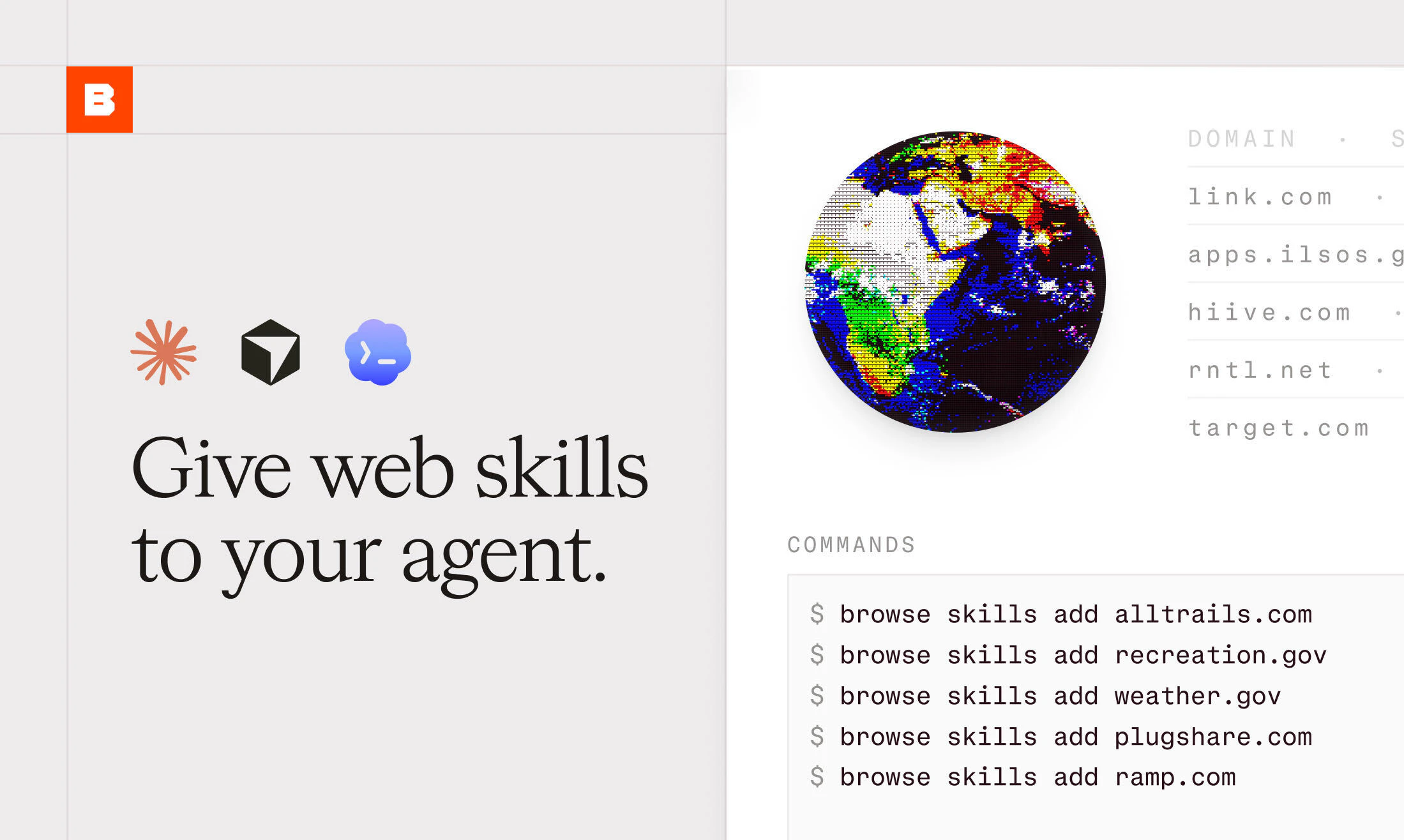
browse.sh — an open catalog of browser automation skills for any website. Find reusable SKILL.md recipes that teach AI agents to complete tasks online, and install them with the browse CLI.
AI Analysis
browse.sh is an open catalog of browser automation skills, offering reusable SKILL.md recipe files that teach AI agents how to complete specific tasks on websites. Users discover these community-contributed skills and install them via the browse CLI tool. It directly solves the pain point of AI agents lacking consistent 'muscle memory' for reliable web interactions, which often leads to brittle automations. The core value proposition is creating a standardized, shareable library that accelerates AI agent development for web tasks, turning fragmented knowledge into reusable, accessible automation building blocks.
The timing is highly favorable for 2025-2026. With the rapid maturation of LLM-powered autonomous agents (e.g. projects like Auto-GPT successors and enterprise AI workflows), demand for reliable web interaction capabilities is exploding. Technology for browser control has matured via frameworks like Playwright, while user needs shift toward no-code agent extensibility. Supportive AI innovation policies and economic incentives for automation further align. Excellent Timing.
Feasibility is High. Technical difficulty is moderate as it builds on established open-source browser tools and uses simple markdown (SKILL.md) for recipes. Development and operation costs are low due to its community-driven catalog model with CLI distribution. Minimal supply chain or compliance risks for a developer tool. Strong scalability via open contributions, though quality control of shared skills could require moderation. Fits well for small teams with web/AI expertise.
Primary users are AI developers, software engineers, and technical founders building autonomous web agents, concentrated in tech industries (SaaS, automation, AI startups). Geographically global but heaviest in North America, Europe, and East Asia tech hubs. AI automation tools TAM exceeds $15B by 2026; SAM for agent browser tooling ~$1-2B; SOM for open catalogs in hundreds of millions. Core pains: time wasted coding fragile one-off web scripts. High willingness to pay via CLI subscriptions, enterprise support, or premium skill libraries.
Competition level is Medium. Direct competitors: 1. Playwright (playwright.dev), 2. Puppeteer (pptr.dev), 3. Selenium (selenium.dev), 4. Browserbase (browserbase.com), 5. Skyvern (skyvern.com). Advantages: unique open SKILL.md recipe format and catalog specifically for AI agents, emphasizing shareable 'muscle memory' vs pure code libraries; strong community aspect. Disadvantages: younger project with potentially smaller ecosystem and fewer built-in integrations than mature frameworks; relies on user contributions for content breadth while competitors offer comprehensive out-of-box capabilities and commercial support.
Upgrade Pro to unlock full AI analysis
Similar Products

Cohere Parse 5
Turn complex docs, tables & images into AI-ready data
▲ 158 votes

Adapt
The company brain that gets work done
▲ 124 votes

Replay QA Security Scan
Automated Penetration Testing for AI-Built Apps
▲ 102 votes

WikiFix for Confluence
Find and fix issues in your knowledge base
▲ 86 votes

Audryo
Customer email your agent can operate.
▲ 68 votes

Refoid
Automate App Store refund responses and track every outcome
▲ 68 votes