
Bullet
30-60% faster than Claude Code and Codex
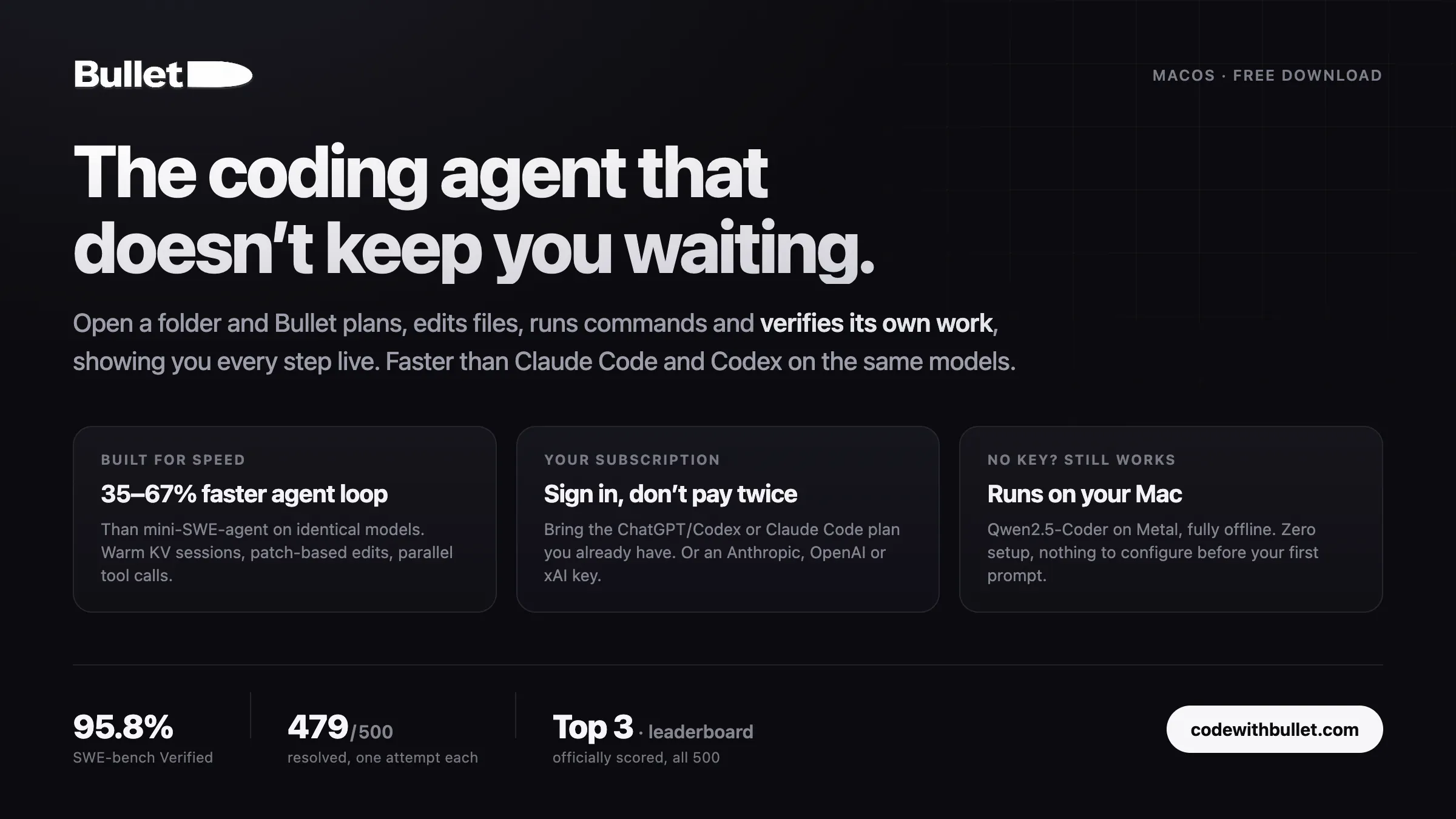
Bullet is a coding agent built for speed. We got tired of burning hours waiting on agent runs. The models were fine, but the loops around them were slow. Bullet auto-picks the right model/reasoning level per prompt, parallelizes searches/reads/commands, and uses targeted code search instead of embedding your whole repo. Works with your Claude Code or Codex subscription, API keys, or an on-device model. 95.8% on SWE-bench Verified (top 3), 119s/task. Built by Yale CS grads, ex-AppLovin/Citadel.
AI Analysis
Bullet is a high-speed AI coding agent that delivers 30-60% faster performance than Claude Code and Codex by addressing slow agent loops. Key features include auto-selecting optimal models/reasoning levels per prompt, parallelizing searches/reads/commands, and using targeted code search instead of full repo embeddings. It achieves 95.8% on SWE-bench Verified (top 3) with 119s per task. Compatible with Claude/Codex subscriptions, API keys, or on-device models. It solves developer pain of wasted hours waiting on slow runs, offering major productivity gains in vibe coding. Built by Yale CS grads with ex-AppLovin/Citadel experience, its value proposition is speed without sacrificing accuracy for developers and teams.
The 2025-2026 period is highly favorable as AI agentic coding tools mature rapidly amid exploding demand for developer productivity solutions. LLM technology has reached sufficient reliability, while engineers face increasing pressure for faster iteration cycles. Economic trends favor AI tools that reduce labor costs, and policies supporting AI innovation remain supportive. This aligns perfectly with the shift toward autonomous coding agents. Excellent Timing.
High. Technical difficulty is moderate as it orchestrates existing models/APIs rather than training new ones; parallelization and targeted search are established techniques. The Yale CS team with Big Tech experience fits well. Development/operation costs focus on API usage and optimization, with strong scalability potential via cloud. Minimal supply chain risks; main considerations are AI compliance and cost management at scale. Key reasons: proven benchmark results and lean approach.
Primary users: individual software developers, AI engineers, and dev teams at startups/tech companies. Demographics: tech professionals aged 25-40. Industries: software development, IT services. Geographic: global with concentration in US, Europe, China tech hubs. TAM for AI coding tools exceeds $15B by 2026; SAM for agentic coding ~$2B; SOM for speed-focused segment ~$300M. Core pains: slow AI agent response times wasting hours. High willingness to pay via subscriptions for proven time savings.
High. Direct competitors: 1. Cursor (cursor.com), 2. Anthropic Claude Computer Use (anthropic.com), 3. GitHub Copilot Workspace (github.com), 4. Aider (aider.chat), 5. Cognition Devin (cognition.ai). Advantages: 30-60% faster execution, superior SWE-bench score (95.8%), efficient targeted search avoiding full repo overhead, flexible model compatibility. Disadvantages: newer player may have less brand recognition and ecosystem integrations than incumbents like GitHub or Anthropic; pricing not detailed but likely subscription-based similar to rivals.
Upgrade Pro to unlock full AI analysis
Similar Products

Opaline
PostHog for team Claude Code and Codex sessions.
▲ 141 votes

Adapt
The company brain that gets work done
▲ 124 votes

Replay QA Security Scan
Automated Penetration Testing for AI-Built Apps
▲ 102 votes

Kosshi
Simple, fast outliner for Mac and iPhone.
▲ 90 votes

Thoughts for Mac
Capture notes from your menubar using text, images or voice
▲ 90 votes

Refoid
Automate App Store refund responses and track every outcome
▲ 68 votes