
Busabase
The general system of record for AI agents
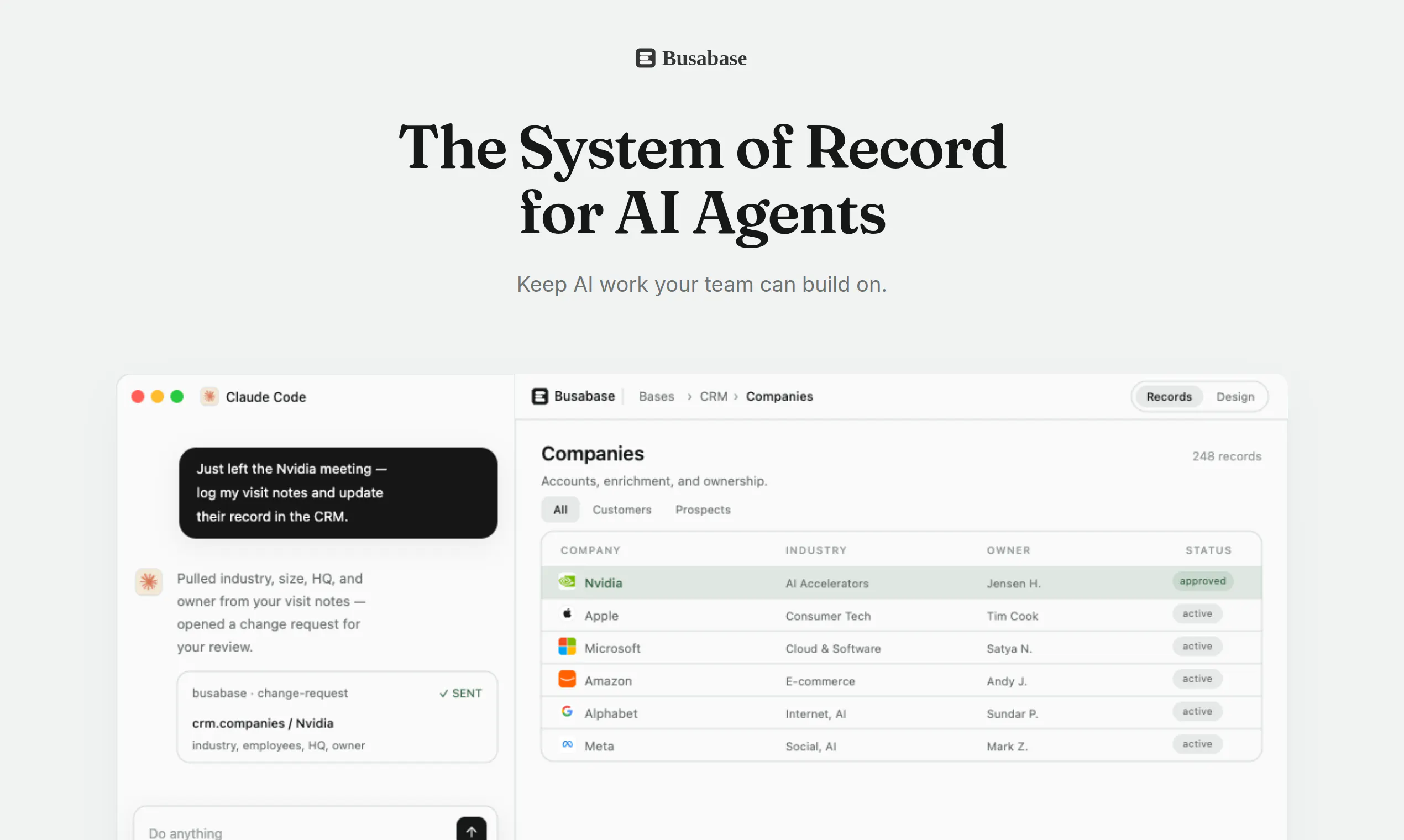
Different agents. One shared base. Busabase is a general-purpose database and workspace for people and AI agents. Keep business records, docs, skills, and apps in one place so the next task can build on them. Connect Claude Code, Codex, and more. Set access, review changes when needed, and see what changed. Busabase is open source, with Cloud, Personal Desktop, and self-hosting options.
AI Analysis
Busabase is a general-purpose database and collaborative workspace for humans and AI agents, acting as a shared system of record. Core features include storing business records, documents, skills, and apps in one place for continuity across tasks, integrations with Claude, Code Interpreter, and Codex, plus access controls, change reviews, and audit logs. It solves data fragmentation, lack of persistent memory, and poor collaboration between agents and users. USP is its open-source nature with Cloud, Desktop, and self-hosting flexibility. Value proposition: enables seamless AI-augmented workflows by building cumulative knowledge and improving productivity.
Favorable in 2025-2026 as AI agent ecosystems mature rapidly with rising adoption of multi-agent systems and autonomous tools. Technology for AI-database integrations is ready, user demand for persistent AI memory and unified workspaces is surging amid productivity AI trends. Supportive economic environment for AI efficiency tools. Excellent Timing.
High. Technical difficulty is manageable using established database and open-source frameworks with AI API integrations. Development and operation costs are moderated by community contributions. Self-hosting adds compliance considerations but enhances scalability. Strong potential for growth via cloud offerings and modular design. Key risks are integration maintenance with evolving AI models.
Primary segments: AI developers, software engineers, tech startups, and productivity teams in software/SaaS industries. Global distribution with heavy concentration in US, Europe. TAM for AI infrastructure/tools approx $100B+, SAM for agent memory/workspaces $5-10B, SOM $300-800M. Core pains: fragmented agent knowledge, no shared history, audit gaps. High willingness to pay for cloud/enterprise features; open-source appeals to indie devs.
Medium. Direct competitors: 1. Mem0 (mem0.ai), 2. Letta (letta.com), 3. Pinecone (pinecone.io), 4. Chroma (trychroma.com), 5. LangChain (langchain.com). Advantages: unified human-AI workspace with docs/skills/apps focus, open-source multi-deployment, strong audit features. Disadvantages: newer with potentially less mature vector/search capabilities than specialists, broader scope may dilute specialization vs pure memory layers.
Upgrade Pro to unlock full AI analysis
Similar Products

Adapt
The company brain that gets work done
▲ 124 votes

Replay QA Security Scan
Automated Penetration Testing for AI-Built Apps
▲ 102 votes

Kosshi
Simple, fast outliner for Mac and iPhone.
▲ 90 votes

WikiFix for Confluence
Find and fix issues in your knowledge base
▲ 86 votes

Audryo
Customer email your agent can operate.
▲ 68 votes

Refoid
Automate App Store refund responses and track every outcome
▲ 68 votes