
Checksum AI
Your coding agent’s testing buddy
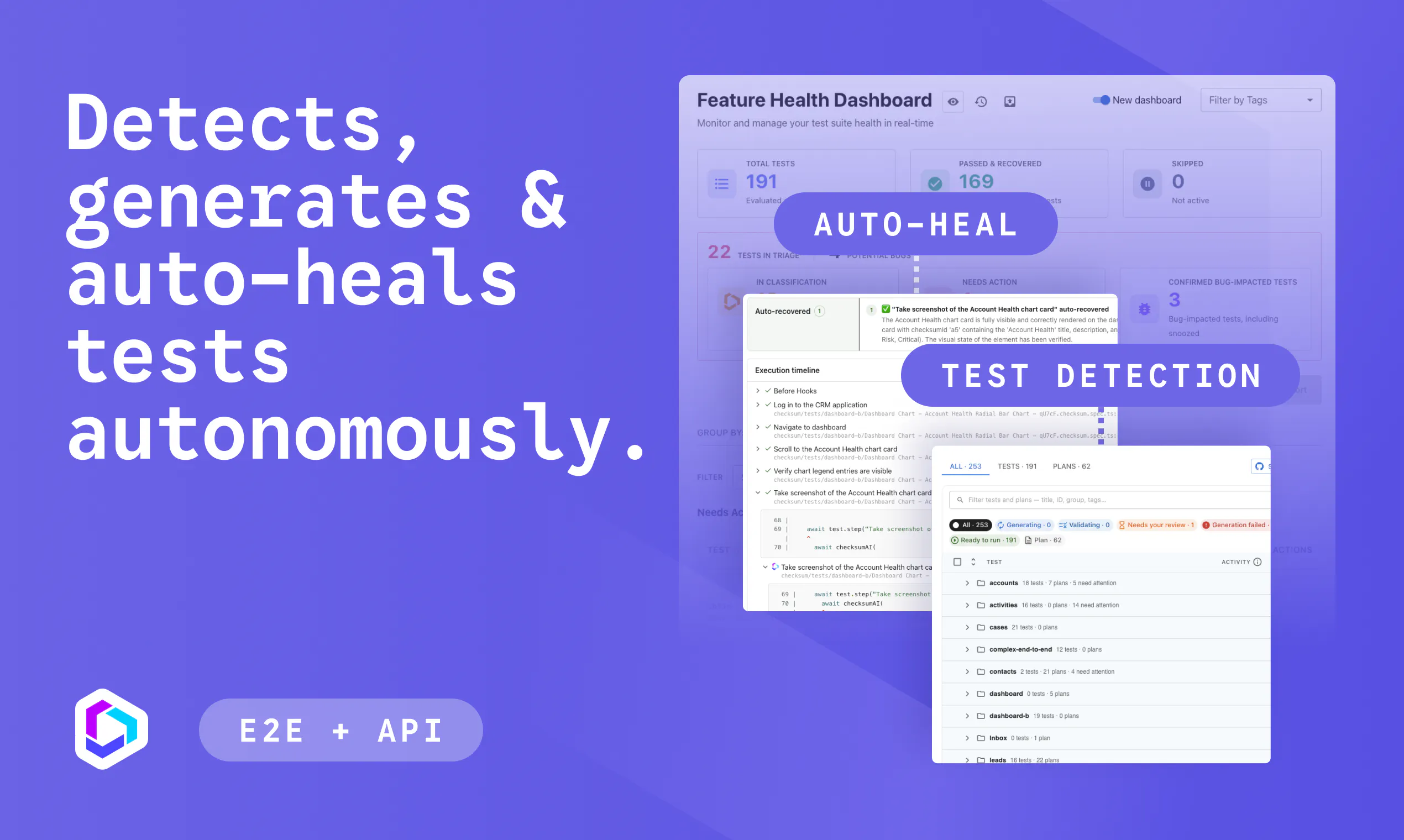
Checksum is an AI-native continuous testing platform for engineering teams shipping faster than manual QA can keep up. It generates, runs, and auto-heals end-to-end and API tests on every pull request, all as standard Playwright code in your own repo. When a test fails, Checksum tells you whether it found a real bug or a stale test, then fixes the false failures so your suite keeps pace with your coding agents.
AI Analysis
Checksum AI is an AI-native continuous testing platform for engineering teams using coding agents. Core features include generating, running, and auto-healing end-to-end and API tests on every pull request, delivered as standard Playwright code in the user's repo. It intelligently identifies real bugs versus stale tests and auto-fixes false failures. It solves key pain points like manual QA lagging behind rapid AI-accelerated development, flaky tests, and maintenance overhead. Unique selling point is seamless integration with CI/CD as code, keeping test suites in sync with fast-changing codebases. Overall value: enables faster, reliable shipping without proportional QA effort.
In 2025-2026, AI coding agents (e.g. Devin, Cursor) are driving unprecedented development velocity, outpacing traditional QA and increasing demand for intelligent automated testing. LLM technology for code analysis and test repair has reached sufficient maturity, while CI/CD efficiency is a top priority amid economic pressures for faster iteration. This aligns perfectly with rising adoption of AI dev tools. Excellent Timing.
Technical difficulty is medium-high due to need for accurate AI in failure classification, auto-healing, and Playwright code gen, but builds on mature LLMs and testing frameworks. Development/operation costs are manageable via SaaS with usage-based AI compute. Low supply chain risk; compliance focuses on data security for code repos. Strong scalability potential as cloud service. High overall for experienced AI/testing team. High
Main segments: Mid-to-large engineering teams and DevOps/QA engineers in SaaS, fintech, and tech companies adopting AI coding tools. Demographics: Developers aged 25-45, decision-makers like CTOs/VPEs. Geographic: Primarily North America and Europe. TAM for automated testing tools approx $12B (2025), SAM for AI-enhanced E2E/API testing ~$2.5B, SOM for PR-integrated solutions ~$400M. Core pains: test flakiness, QA bottlenecks with fast releases. High willingness to pay ($100-1000+/mo) for time savings and reliability.
Medium. Direct competitors: 1. Mabl (mabl.com), 2. Tricentis Testim (testim.io), 3. Applitools (applitools.com), 4. Functionize (functionize.com), 5. Reflect (reflect.run). Advantages: Keeps tests as editable Playwright code in repo (vs codeless tools), purpose-built for AI coding agents with smart bug-vs-stale-test classification and auto-healing on PRs. Disadvantages: Newer entrant with potentially less brand recognition and enterprise features than incumbents; pricing may need to compete on value. Strong differentiation in AI-native, code-centric approach reduces lock-in. Medium
Upgrade Pro to unlock full AI analysis
Similar Products

Cohere Parse 5
Turn complex docs, tables & images into AI-ready data
▲ 158 votes

Adapt
The company brain that gets work done
▲ 124 votes

Replay QA Security Scan
Automated Penetration Testing for AI-Built Apps
▲ 102 votes

WikiFix for Confluence
Find and fix issues in your knowledge base
▲ 83 votes

Audryo
Customer email your agent can operate.
▲ 68 votes

Refoid
Automate App Store refund responses and track every outcome
▲ 68 votes