
Chert
Vapi for FaceTime: AI video agents in a few lines
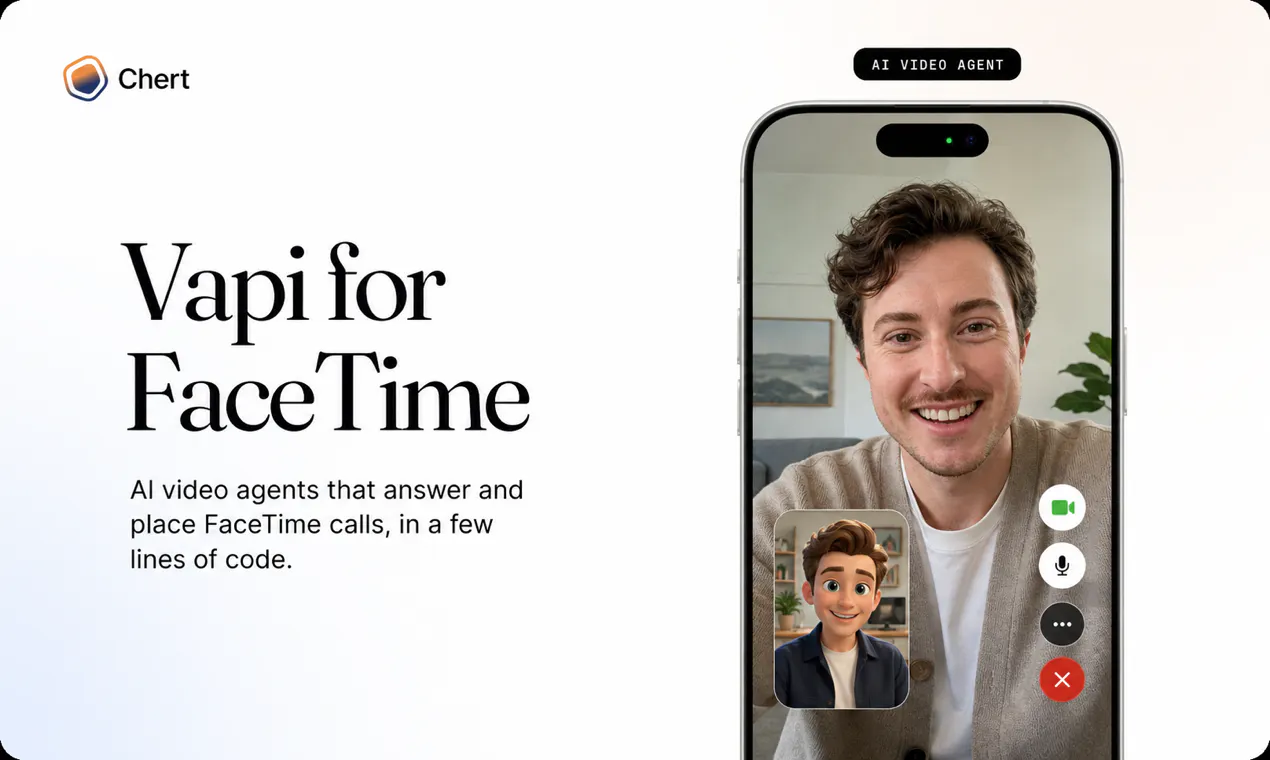
Chert is Vapi for FaceTime. Build and deploy interactive AI video agents that can answer and place FaceTime calls with just a few lines of code. Deploy agents for remote support, field service, telehealth intake, guided onboarding, or anything that's easier to show than explain. Try it live: FaceTime an agent right now and show it something.
AI Analysis
Chert is a developer tool that enables building and deploying interactive AI video agents for FaceTime with just a few lines of code. Core features include agents that can answer and place video calls, visually interpret what users show on camera, and support applications like remote support, field service, telehealth intake, and guided onboarding. Its unique selling point is being 'Vapi for FaceTime,' simplifying visual AI interactions similar to how Vapi simplified voice agents. It solves key pain points such as the technical complexity and time required to integrate AI into video calling platforms for demonstration-heavy scenarios. The overall value proposition is making advanced, context-aware video AI accessible to developers for more effective, show-don't-tell customer engagements.
In 2025-2026, multimodal AI (including real-time video understanding) is reaching maturity with models like advanced GPT variants and competitors rapidly improving. User demand is shifting from voice-only to richer video interactions for support and healthcare, while Apple continues enhancing FaceTime. Economic pressures favor automation in services, and privacy policies align with Apple's ecosystem focus. This is an opportune moment before mass adoption. Excellent Timing.
Technical difficulty is medium-high as it leverages proprietary FaceTime APIs, but the live demo indicates core integration is solved. Development and operation costs may be elevated due to video processing and AI inference. Supply chain is software-only with low physical risks, but compliance (e.g., HIPAA for telehealth) is a consideration. Scalability is strong via API model, and it fits AI-first teams well. Overall rating: High, supported by low-code approach reducing user barriers.
Primary segments: Software developers, startups, and enterprises in customer support, healthcare/telehealth, field services, and SaaS/product teams (ages 25-45, tech-savvy). Geographically focused on US, Europe, and other high iOS-adoption regions. Estimated TAM for AI agent platforms exceeds $5B by 2026; SAM for video-specific agents ~$500M; SOM for FaceTime niche ~$50-100M. Core pain points include complex video AI dev and lack of visual context tools. High willingness to pay for usage-based API that accelerates deployment and reduces engineering overhead.
Low. Direct competitors: 1. Vapi (vapi.ai) - voice-focused AI agents. 2. Retell AI (retell.ai) - conversational voice AI platforms. 3. LiveKit with AI extensions (livekit.io) - real-time video/audio SDKs. 4. Bland.ai - AI phone agents. This product has strong advantages in FaceTime-specific seamless iOS integration, native visual 'show it' capabilities, and extreme simplicity (few lines of code). Disadvantages: Ecosystem limited to Apple devices, less mature than voice-only competitors, and potentially higher video compute costs. Excellent differentiation in the emerging video agent space.
Upgrade Pro to unlock full AI analysis
Similar Products

Cohere Parse 5
Turn complex docs, tables & images into AI-ready data
▲ 158 votes

Opaline
PostHog for team Claude Code and Codex sessions.
▲ 141 votes

Adapt
The company brain that gets work done
▲ 124 votes

Tapfree for Chrome
Voice dictation that adapts to what’s on your screen
▲ 122 votes

Replay QA Security Scan
Automated Penetration Testing for AI-Built Apps
▲ 102 votes

Refoid
Automate App Store refund responses and track every outcome
▲ 68 votes