
Chiplab
Test firmware on a virtual chip with no hardware needed
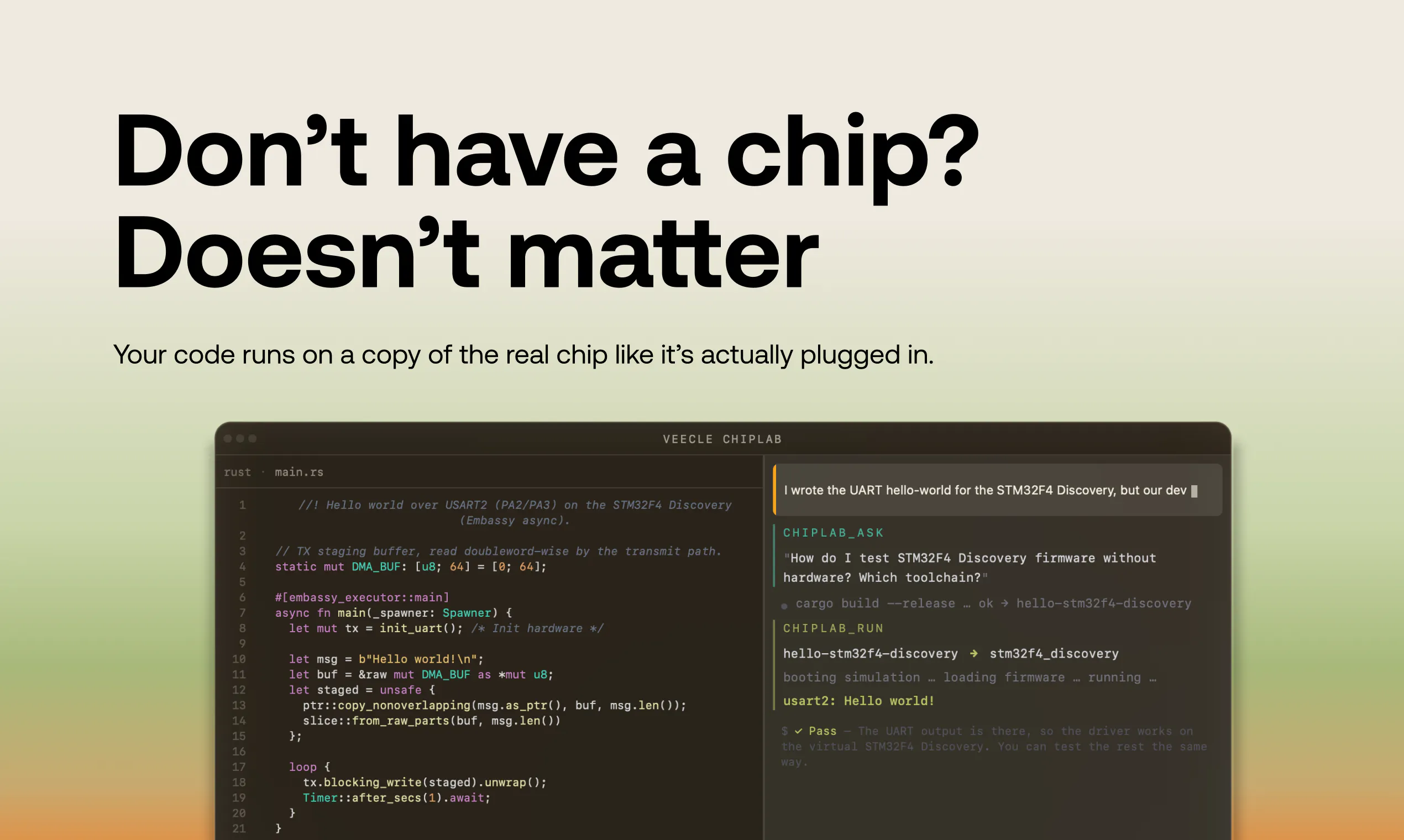
Chiplab lets AI coding agents build, run, and test embedded software on a virtual copy of the real chip. No physical board required. Just connect it over MCP to any AI coding agent (Cursor, Claude Code, VS Code, and more), and skip hardware entirely. Chiplab compiles, runs, and debugs your firmware, and tells you exactly what broke. Works today on STM32 and Nordic chips, with more on the way. Currently in beta and we'd love your feedback.
AI Analysis
Chiplab enables AI coding agents to build, run, test, and debug embedded firmware on a virtual replica of real chips (STM32 and Nordic currently), eliminating the need for physical hardware. It connects via MCP to tools like Cursor, Claude Code, and VS Code, compiling code, executing it, and precisely identifying failures. It solves key pain points such as hardware dependency, slow iteration, limited access to dev boards, and complex debugging in embedded development. The USP is seamless AI integration for hardware-free workflows, accelerating development cycles and reducing costs. Value proposition: faster prototyping and debugging for firmware engineers in the AI era.
In 2025-2026, AI coding agents are maturing rapidly with widespread adoption in developer workflows, while embedded/IoT markets expand with edge AI demands. User needs are shifting toward virtual and remote tools to speed up hardware-software co-development amid supply chain issues and remote work trends. Economic environment favors productivity tools that cut hardware costs. This aligns perfectly with AI proliferation removing traditional barriers. Excellent Timing.
Technical difficulty is medium-high due to need for cycle-accurate chip simulation, but proven in beta for key chips. Dev/operation costs involve cloud compute for simulations and ongoing chip model maintenance. Low supply chain risks (software-based), moderate compliance for data security. Strong scalability via cloud. Team fit assumes embedded + AI expertise. Overall High feasibility with existing implementation and AI infrastructure support. Rating: High.
Main segments: Embedded firmware engineers, hardware developers, and AI-augmented coders (ages 25-45, tech-savvy). Industries: IoT, robotics, consumer electronics, automotive. Geographic: Global, concentrated in US, Europe, China, and Asia's semiconductor hubs. TAM for embedded dev tools ~$5-8B, SAM for virtual simulators ~$500-800M, SOM for AI-integrated niche ~$50-100M. Core pains: hardware access bottlenecks and debug delays. High willingness to pay via subscriptions for time savings and productivity.
Competition level: Low. Direct competitors: 1. Renode (renode.io) - virtual hardware platform for embedded. 2. QEMU (qemu.org) - open-source emulator for various architectures. 3. Imperas (imperas.com) - commercial virtual platforms and simulators. 4. Antmicro's tools or STM32-specific simulators. Advantages: Unique MCP integration with AI agents like Claude/Cursor, focused error explanation for AI debugging, true no-hardware workflow. Disadvantages: Currently beta with limited chip support (vs broader compatibility in competitors), less mature ecosystem. Strong differentiation in AI-native embedded testing.
Upgrade Pro to unlock full AI analysis
Similar Products

Cohere Parse 5
Turn complex docs, tables & images into AI-ready data
▲ 158 votes

Opaline
PostHog for team Claude Code and Codex sessions.
▲ 141 votes

Adapt
The company brain that gets work done
▲ 124 votes

Tapfree for Chrome
Voice dictation that adapts to what’s on your screen
▲ 122 votes

Replay QA Security Scan
Automated Penetration Testing for AI-Built Apps
▲ 102 votes

Refoid
Automate App Store refund responses and track every outcome
▲ 68 votes