Cronhq
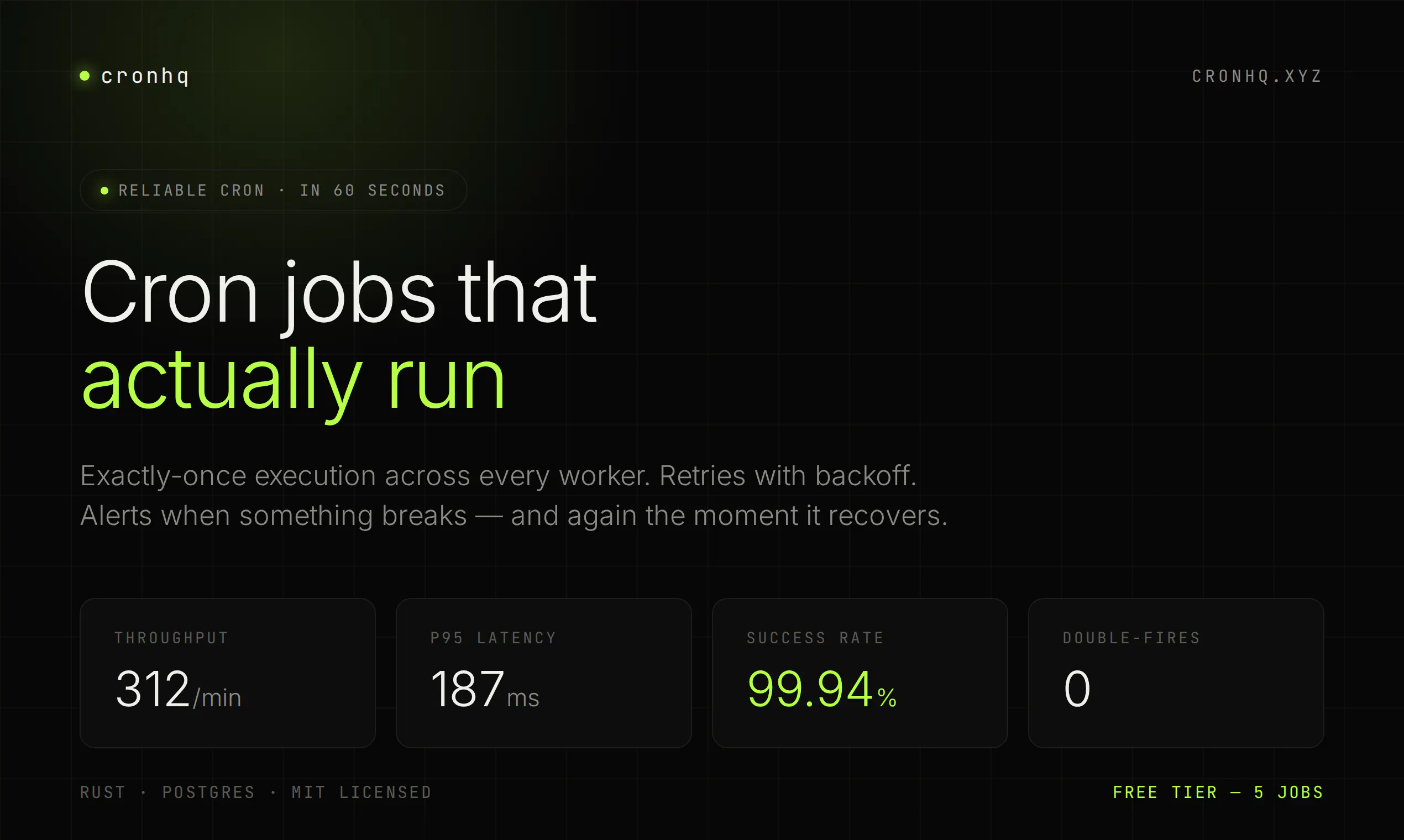
Cron jobs that actually run
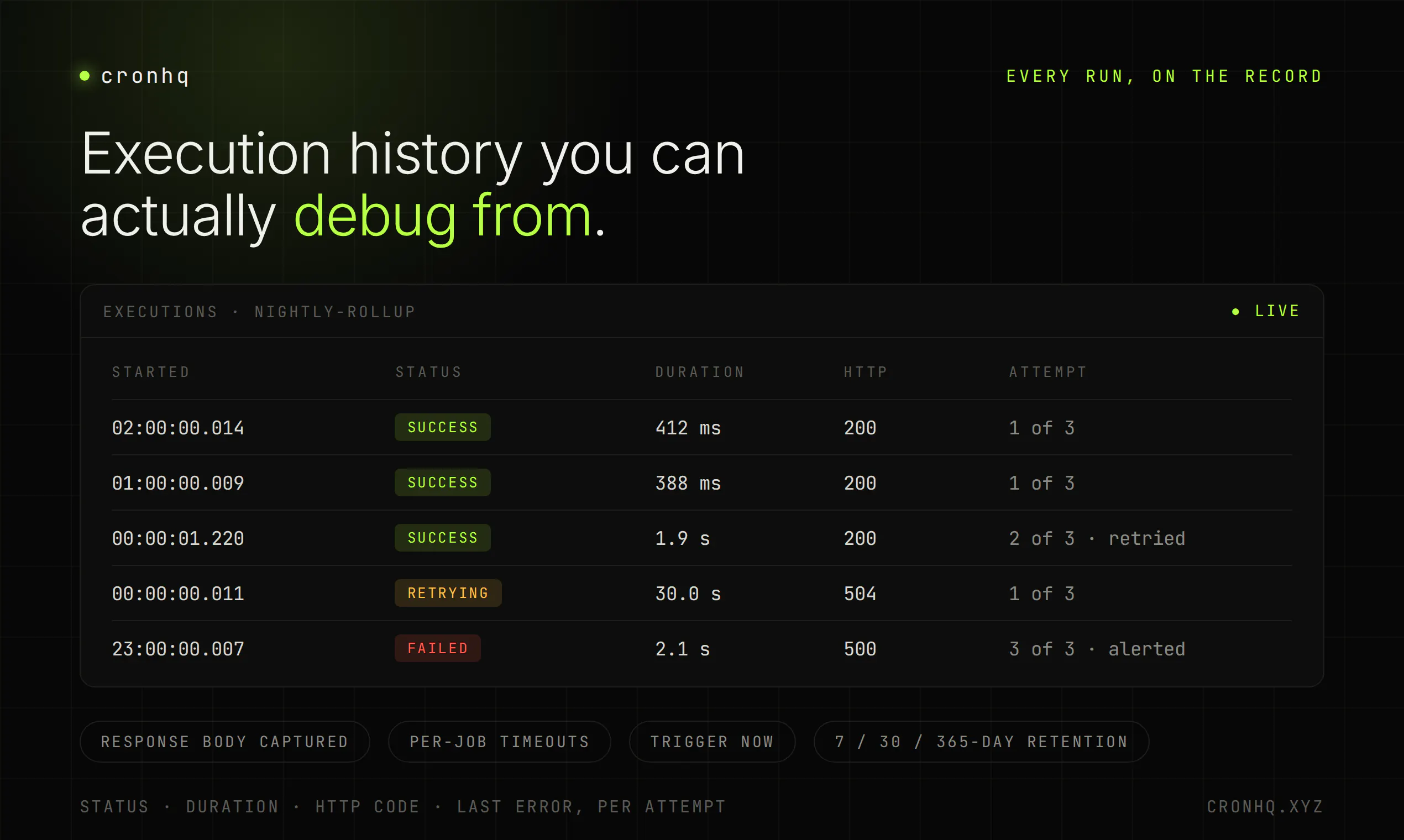
Cron jobs fail in silence. Two servers run the same crontab and your billing job fires twice. A job dies and nobody notices for weeks. Cronhq is a scheduler built around one guarantee: exactly-once execution, enforced by Postgres locks — not best-effort. Around it: retries with backoff, HMAC-signed webhooks, heartbeat monitors for jobs we don't run, and alerts that fire once on failure and once on recovery. Rust on Postgres. MIT-licensed, self-hostable, same image we run. Free tier: 5 jobs.
AI Analysis
Cronhq is a reliable cron job scheduler ensuring exactly-once execution via Postgres locks, addressing silent failures, duplicate runs from multiple servers, and undetected job deaths. Core features: retries with backoff, HMAC-signed webhooks, heartbeat monitors, and alerts on failure plus recovery. Built in Rust, MIT-licensed, fully self-hostable using the same image as their service, with a free tier for 5 jobs. It delivers dependable automation for critical tasks like billing, eliminating weeks of unnoticed issues and providing observable, guaranteed job runs for developers.
In 2025-2026, timing is favorable with surging adoption of AI automation, cloud-native systems, and distributed architectures increasing demand for fault-tolerant scheduling. Reliability guarantees beyond best-effort align with trends in resilient backend infrastructure and DevOps practices. Self-hosting and open source fit data control and cost optimization priorities amid economic pressures. While cloud schedulers exist, specialized exactly-once solutions meet evolving needs. Rating: Excellent Timing.
High feasibility. Leverages mature, stable technologies (Rust for performance, Postgres for locking/scalability) with low technical risk. Self-hosting model using identical images minimizes ops complexity and costs. Open-source MIT license aids community contributions and adoption. Low supply chain risks; compliance straightforward for dev tools. Strong scalability potential, though SaaS monitoring/alerts require ongoing maintenance. Team with DB expertise would fit well. Rating: High.
Primary segments: Software developers, DevOps/SRE engineers in startups, SaaS companies, fintech, and open-source enthusiasts. Global distribution with concentration in US/Europe tech hubs. Demographics: Technical professionals aged 25-45. Estimated market size: TAM for DevOps/automation tools ~$10B+, SAM for job scheduling SaaS ~$500M, SOM for reliable/open-source cron niche ~$50M. Core pain points: Silent cron failures causing billing errors or data inconsistencies. High willingness to pay for guaranteed reliability after free tier onboarding.
Medium. Direct competitors: 1. Cronitor (cronitor.io), 2. Healthchecks.io (healthchecks.io), 3. EasyCron (easycron.com), 4. SetCronJob (setcronjob.com). Advantages vs competitors: True exactly-once Postgres enforcement (vs best-effort), integrated retries/heartbeats/alerts, open-source self-hosting (unique), Rust efficiency. Disadvantages: Newer entrant may have smaller ecosystem/integrations; free tier limited to 5 jobs; less brand recognition than established monitoring-focused tools.
Upgrade Pro to unlock full AI analysis
Similar Products

Adapt
The company brain that gets work done
▲ 124 votes

React UI Kit V7
All the chat components you need. None of the complexity
▲ 115 votes

Replay QA Security Scan
Automated Penetration Testing for AI-Built Apps
▲ 102 votes
CodeBurn
See where your AI coding spend actually goes
▲ 101 votes

Saldor
Speed up procurement and AP.
▲ 78 votes

Refoid
Automate App Store refund responses and track every outcome
▲ 0 votes