
DCP
Give your AI agents encrypted permission and keys
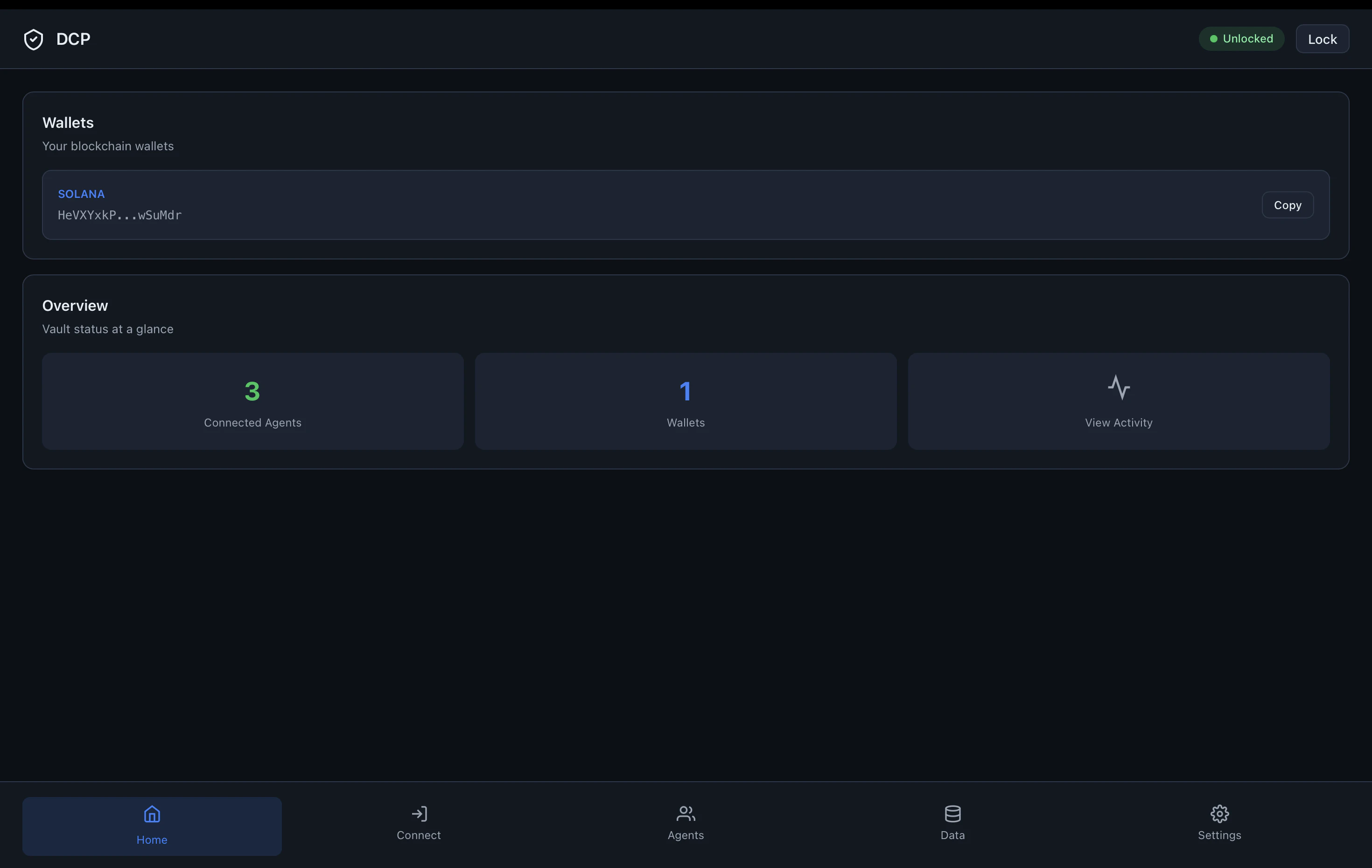
Today, many agents read keys and sensitive info from dotenv files, configs, or memory. One bad prompt or compromised tool can drain your wallet, API bill, or private data. DCP makes agents safe for real work: your wallets and API keys stay encrypted on your own machine. Give each agent only the scopes it needs; it asks, you approve from Telegram or App. Daily budgets, logs, and instant revoke keep you in control. Open source, non-custodial, and works with Claude, Cursor, OpenClaw, and Hermes.
AI Analysis
DCP solves the critical pain point of AI agents insecurely accessing keys and sensitive data from dotenv files, configs, or memory, which can lead to drained wallets, high API bills, or data leaks from bad prompts or compromised tools. Core features include local encryption of keys on the user's machine, granular scopes per agent, approval requests via Telegram or app, daily budgets, logs, and instant revoke. It is open-source, non-custodial, and integrates with Claude, Cursor, OpenClaw, and Hermes. The value proposition is enabling safe, controlled use of powerful AI agents for real work while keeping users fully in control of their credentials and spending.
The market timing is favorable in 2025-2026 as autonomous AI agents are rapidly maturing and being adopted for real tasks like coding, transactions, and data operations. Industry trends emphasize agentic AI with growing concerns over security and misuse. Technology for encryption and permission systems is mature, user demand for safe AI tooling is surging amid rising incidents, and policies are tightening on AI safety and privacy. This is an Excellent Timing for a non-custodial security layer tailored to popular AI tools.
Overall feasibility is High. Technical difficulty is manageable using established encryption libraries and local proxy mechanisms for agent integrations. Development and operation costs are low-to-moderate as an open-source project. Non-custodial design avoids major compliance risks around data handling. Scalability is strong for personal/developer use with potential to expand to teams. Key risks include initial integration complexity with diverse AI tools and building reliable approval UX, but the concept aligns well with solo or small team execution.
Primary targets are AI developers, indie hackers, and software engineers using tools like Claude and Cursor (demographics: tech professionals aged 25-45). Industries: AI/ML development, software engineering, early fintech AI apps. Geographic: Global with concentration in US, Europe, China tech hubs. TAM for AI dev tools/security ~$5-10B, SAM for agent security ~$500M, SOM ~$50M in first years. Core pain points: fear of uncontrolled costs/leaks from agents. High willingness to pay for peace of mind via premium features despite open-source core.
Competition level: Medium. Direct competitors: 1. HashiCorp Vault (vaultproject.io), 2. AWS Secrets Manager (aws.amazon.com/secrets-manager), 3. Doppler (doppler.com), 4. Infisical (infisical.com), 5. Akeyless (akeyless.io). DCP's advantages: AI-agent-specific granular scopes, local-only non-custodial encryption, Telegram/app approvals with budgets/revoke tailored for Claude/Cursor users, fully open source. Disadvantages: Earlier stage (Alpha), potentially narrower enterprise scalability and fewer pre-built integrations compared to mature cloud secrets managers.
Upgrade Pro to unlock full AI analysis
Similar Products

Cohere Parse 5
Turn complex docs, tables & images into AI-ready data
▲ 158 votes

Adapt
The company brain that gets work done
▲ 124 votes

Replay QA Security Scan
Automated Penetration Testing for AI-Built Apps
▲ 102 votes

WikiFix for Confluence
Find and fix issues in your knowledge base
▲ 86 votes

Audryo
Customer email your agent can operate.
▲ 68 votes

Refoid
Automate App Store refund responses and track every outcome
▲ 68 votes